Apprehension and Relocation Test: Procedure, Positive Results and Accuracy
Apprehension and Relocation Test: Purpose, Procedure, and Interpretation
The Apprehension and Relocation Test is a clinical shoulder examination used to assess anterior glenohumeral instability, particularly in patients with suspected anterior shoulder subluxation or dislocation. It consists of two related maneuvers: the apprehension test, which evaluates the patient’s response to a position that stresses the anterior shoulder structures, and the relocation test, which assesses whether posteriorly directed pressure on the humeral head reduces the patient’s sense of instability.
This test is commonly used when evaluating patients with a history of traumatic shoulder dislocation, recurrent instability, or a feeling that the shoulder may slip out of its socket during overhead activities. It can help clinicians determine whether anterior shoulder instability may be contributing to the patient’s symptoms.
What Is the Apprehension and Relocation Test Used For?
The primary purpose of the Apprehension and Relocation Test is to evaluate anterior shoulder instability. It is particularly useful when the patient reports recurrent shoulder dislocations, subluxation episodes, or a feeling of impending dislocation when the arm is elevated and externally rotated.
The test helps assess the stability of the glenohumeral joint, which depends on several anatomical structures, including the glenoid labrum, joint capsule, glenohumeral ligaments, and surrounding muscles.
The Apprehension and Relocation Test may be used to help assess:
- Anterior glenohumeral instability: Suspected excessive anterior translation of the humeral head.
- Recurrent anterior shoulder dislocation: Patients with previous dislocations who continue to experience instability.
- Shoulder subluxation: Partial displacement of the humeral head from the glenoid cavity.
- Post-traumatic shoulder instability: Instability following a traumatic shoulder injury.
- Functional instability: A sense of impending dislocation during activities involving shoulder abduction and external rotation.
The findings should be interpreted alongside the patient’s history and other physical examination findings. The test does not independently identify the precise anatomical lesion responsible for instability.
Anatomy and Clinical Significance
The glenohumeral joint is a highly mobile ball-and-socket joint formed by the humeral head and the glenoid cavity of the scapula. Its extensive range of motion comes at the cost of inherent joint stability.
The glenoid labrum deepens the glenoid cavity, while the joint capsule and glenohumeral ligaments provide additional passive restraint. The rotator cuff muscles contribute dynamic stability by helping maintain the humeral head in a centered position during movement.
During shoulder abduction and external rotation, the anterior capsuloligamentous structures are placed under tension. In a shoulder with anterior instability, this position may reproduce a characteristic feeling of impending dislocation.
Applying a posteriorly directed force to the humeral head during the relocation maneuver may improve joint positioning and reduce the patient’s apprehension. This response supports the presence of symptomatic anterior instability.
How to Perform the Apprehension and Relocation Test
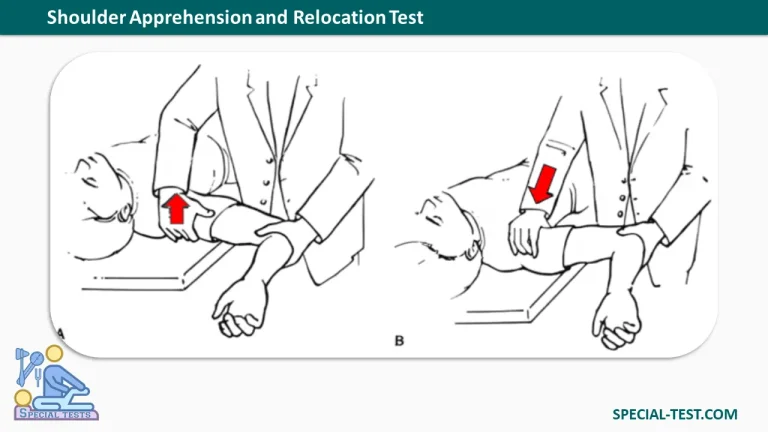
The examination is generally performed with the patient lying supine. The clinician should explain the procedure, obtain consent, and stop the maneuver if significant pain or apprehension occurs.
1. Patient Position
- Ask the patient to lie supine on the examination table.
- Position the affected shoulder so that the arm can be moved freely.
- Ensure that the patient is relaxed and understands the purpose of the test.
- Compare the affected shoulder with the unaffected side when clinically appropriate.
2. Apprehension Test
The apprehension maneuver is performed as follows:
- Position the patient’s shoulder in approximately 90 degrees of abduction.
- Gradually externally rotate the shoulder while supporting the arm.
- Observe the patient’s facial expression, muscle guarding, and verbal response.
- Ask whether the position produces a feeling that the shoulder is about to slip out of its socket.
A positive response is characterized primarily by a distinct sensation of impending dislocation or instability. Pain alone is less specific and should not automatically be considered a positive apprehension response.
3. Relocation Test
If the apprehension maneuver reproduces the patient’s characteristic instability symptoms, the clinician proceeds to the relocation maneuver.
- Maintain the shoulder in the position that produced apprehension.
- Place the hand over the anterior aspect of the proximal humerus.
- Apply a controlled, gentle posteriorly directed force to the humeral head.
- Ask the patient whether the sensation of impending dislocation decreases or disappears.
- Compare the patient’s response before and after applying the posterior force.
The posteriorly directed force helps counter the tendency of the humeral head to translate anteriorly in an unstable shoulder.
The maneuver should be performed carefully and should not involve forceful rotation or pressure. It should be stopped if the patient experiences substantial pain or distress.
What Is a Positive Apprehension and Relocation Test?
A positive finding is based on the patient’s characteristic response to the two maneuvers.
- Positive apprehension test: The patient experiences a distinct sense of impending anterior shoulder dislocation or instability during abduction and external rotation.
- Positive relocation test: The sensation of impending dislocation decreases or disappears when a posteriorly directed force is applied to the humeral head.
The combination of apprehension during the first maneuver and relief during relocation supports the clinical suspicion of anterior glenohumeral instability.
It is important to distinguish true apprehension from pain. Patients with rotator cuff disorders, subacromial pain, or other shoulder conditions may experience pain in the same position without having anterior instability. The examiner should therefore focus on the quality of the patient’s symptoms rather than pain intensity alone.
Test Accuracy: Sensitivity and Specificity
Reported diagnostic accuracy varies between studies because of differences in patient populations, examination techniques, and the reference standards used to diagnose shoulder instability.
The following ranges are commonly cited for the Apprehension Test:
| Diagnostic measure | Reported range |
|---|---|
| Sensitivity | 68–88% |
| Specificity | 50–100% |
Sensitivity describes the proportion of patients with the condition who test positive, while specificity describes the proportion of patients without the condition who test negative.
These ranges should be interpreted cautiously. They are not necessarily applicable to every version of the apprehension and relocation maneuvers, and the accuracy of the combined test may differ from that of the apprehension test alone. Clinicians should consult the original diagnostic studies when using specific estimates for clinical or research purposes.
A negative result does not completely exclude anterior shoulder instability, particularly when the patient’s history strongly suggests recurrent instability. Likewise, a positive response should be interpreted in the context of the overall clinical examination.
Clinical Tips and Common Mistakes
- Prioritize apprehension over pain: A feeling of impending dislocation is more characteristic of instability than pain alone.
- Use controlled movement: Gradually increase external rotation rather than forcing the shoulder into its end range.
- Apply posterior pressure gently: The relocation maneuver should assess symptom relief without excessive force.
- Consider the patient’s history: Previous traumatic dislocation, recurrent subluxation, and instability during overhead activities increase the relevance of the findings.
- Avoid interpreting the test in isolation: Combine it with other examination findings and, when indicated, imaging or specialist assessment.
- Use caution in acute injuries: Do not provoke instability unnecessarily in a patient with a suspected acute dislocation, fracture, or significant recent shoulder trauma.
References
- Orthofixar. Shoulder Apprehension Test.
- Hegedus EJ, et al. Physical examination tests of the shoulder: a systematic review with meta-analysis of individual tests. British Journal of Sports Medicine. Search the PubMed database for the relevant review and subsequent updates.
- Clinical diagnostic studies of the apprehension, relocation, and release tests for anterior glenohumeral instability. Search PubMed for original studies evaluating sensitivity, specificity, and likelihood ratios.