Biceps Load Test I: Procedure, Positive Sign & Accuracy
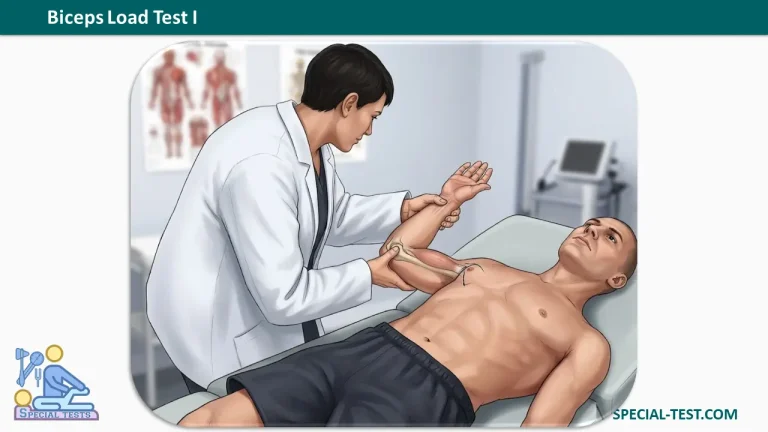
The Biceps Load Test I is an orthopedic shoulder examination used to identify possible superior labrum anterior-to-posterior (SLAP) lesions in patients with recurrent anterior shoulder instability. It is particularly useful when a superior labral tear is suspected alongside a Bankart lesion or a history of anterior shoulder dislocation.
Originally described by Kim and colleagues in 1999, the test evaluates the integrity of the superior glenoid labrum and the long head of the biceps tendon attachment. It combines the anterior shoulder apprehension position with resisted elbow flexion to determine whether activating the biceps improves or aggravates the patient’s symptoms.
The Biceps Load Test I is an important component of the clinical examination for shoulder instability, although its findings should always be interpreted alongside the patient’s history, other physical examination tests, and imaging when appropriate.
What Is the Purpose of the Biceps Load Test I?
The primary purpose of the Biceps Load Test I is to detect a possible SLAP lesion in patients with anterior glenohumeral instability, particularly those who have experienced recurrent shoulder dislocations.
A SLAP lesion involves injury to the superior portion of the glenoid labrum, where the long head of the biceps tendon attaches. The labrum contributes to shoulder stability by deepening the glenoid socket and supporting the surrounding capsuloligamentous structures.
A Bankart lesion, on the other hand, involves injury to the anteroinferior glenoid labrum and is commonly associated with traumatic anterior shoulder dislocation. Both lesions may coexist in patients with recurrent anterior instability.
The Biceps Load Test I helps clinicians assess whether the superior labrum–biceps tendon complex remains functionally intact in these patients.
Clinical Indications
The test may be considered in patients presenting with:
- Recurrent anterior shoulder dislocations or instability.
- Suspected SLAP lesions associated with anterior instability.
- A history of traumatic shoulder dislocation with persistent symptoms.
- Anterior shoulder apprehension during abduction and external rotation.
- Suspected combined Bankart and superior labral injuries.
How to Perform the Biceps Load Test I
The Biceps Load Test I procedure is performed with the patient lying supine on an examination table. Accurate positioning is essential for reliable interpretation.
Step-by-Step Examination Technique
- Patient positioning: Position the patient supine with the affected shoulder abducted to 90 degrees.
- Elbow positioning: Flex the patient’s elbow to 90 degrees while maintaining the shoulder initially in neutral rotation.
- Forearm positioning: Place the forearm in full supination, with the palm facing toward the patient’s head.
- Anterior apprehension maneuver: Slowly externally rotate the shoulder, reproducing the position used during the anterior shoulder apprehension test.
- Identify apprehension: Continue external rotation until the patient experiences anterior shoulder apprehension, a sensation of instability, or discomfort. Stop external rotation at this point without forcing the shoulder further.
- Apply resisted elbow flexion: Ask the patient to actively flex the elbow against the examiner’s resistance, attempting to bring the hand toward the face while maintaining forearm supination.
- Evaluate symptoms: Ask whether the sensation of instability or shoulder pain has improved, remained unchanged, or worsened during resisted elbow flexion.
The examiner should remain at approximately the same level as the patient and provide adequate support to the arm throughout the procedure.
Important: The forearm must remain supinated during the examination. The test should be performed carefully, particularly in patients with a history of recurrent dislocation, to avoid unnecessarily provoking instability.
What Is a Positive Biceps Load Test I?
A positive Biceps Load Test I occurs when resisted elbow flexion fails to reduce the patient’s apprehension or pain, or when these symptoms become worse.
This response suggests a possible SLAP lesion affecting the superior labrum–biceps tendon complex.
Positive Test
The test is considered positive when:
- Anterior shoulder apprehension remains unchanged during resisted elbow flexion.
- Shoulder pain or the sensation of instability increases during biceps contraction.
These findings raise suspicion of a superior labral tear, especially in patients with recurrent anterior shoulder instability.
Negative Test
The test is considered negative when:
- Resisted elbow flexion reduces the patient’s apprehension.
- The patient experiences improved shoulder comfort or a greater sensation of stability.
A negative response suggests that the superior labrum–biceps tendon complex may be intact.
However, a negative Biceps Load Test I does not completely exclude a SLAP lesion, and a positive result does not independently establish the diagnosis.
Why Does the Biceps Load Test I Work?
The Biceps Load Test I is based on the relationship between the long head of the biceps tendon and the superior glenoid labrum.
The long head of the biceps originates partly from the superior labrum and partly from the supraglenoid region of the scapula.
During resisted elbow flexion, contraction of the biceps generates tension through its proximal tendon and attachment.
When the superior labrum–biceps anchor is intact, this muscular activation may contribute to shoulder stabilization and reduce the apprehension associated with anterior instability.
If the superior labral attachment is damaged, activation of the biceps may fail to provide the expected stabilizing effect or may reproduce symptoms.
Therefore, the patient’s response to resisted biceps contraction helps the examiner evaluate possible injury to the superior labral complex.
Biceps Load Test I: Sensitivity and Specificity
The original study by Kim et al. (1999) investigated the diagnostic performance of the Biceps Load Test I in 75 patients with recurrent anterior shoulder dislocations. Test findings were compared with arthroscopic examination.
The researchers reported the following diagnostic accuracy:
| Diagnostic measure | Result |
|---|---|
| Sensitivity | 90.9% |
| Specificity | 96.9% |
| Positive predictive value | 83% |
| Negative predictive value | 98% |
| Interobserver agreement (kappa) | 0.846 |
Interpretation of Diagnostic Accuracy
Sensitivity of 90.9%: In the original study, the test correctly identified approximately 91% of patients who had a SLAP lesion.
Specificity of 96.9%: The test correctly identified approximately 97% of patients without a SLAP lesion.
Positive predictive value of 83%: Among patients with a positive test result, 83% had a SLAP lesion in the study population.
Negative predictive value of 98%: Among patients with a negative result, 98% did not have a SLAP lesion in that population.
Although these findings suggest promising diagnostic performance, the study involved a relatively small, selected patient population.
Subsequent research and critical reviews have raised concerns about the reliability and generalizability of individual shoulder special tests. Accordingly, these original accuracy estimates should not be applied indiscriminately to every patient with shoulder pain.
Biceps Load Test I vs. Biceps Load Test II
The Biceps Load Test I and Biceps Load Test II both assess possible SLAP lesions, but they differ in their clinical indications and examination techniques.
| Feature | Biceps Load Test I | Biceps Load Test II |
|---|---|---|
| Primary indication | SLAP lesion with anterior shoulder instability | SLAP lesion without associated instability |
| Shoulder abduction | 90° | 120° |
| Shoulder rotation | External rotation to apprehension | External rotation toward maximal range |
| Elbow position | 90° flexion | 90° flexion |
| Forearm position | Supination | Supination |
| Positive finding | Apprehension or pain persists or worsens | Pain develops or increases during resisted elbow flexion |
The Biceps Load Test II was introduced by Kim and colleagues in 2001 to evaluate SLAP lesions independently of anterior shoulder instability.
Choosing between these tests depends on the patient’s clinical presentation and whether shoulder instability is present.
Clinical Significance and Limitations
The Biceps Load Test I can be a useful examination maneuver when evaluating patients with recurrent anterior shoulder instability and suspected associated SLAP pathology.
Nevertheless, it should not be used as the sole diagnostic criterion.
Clinicians should consider the mechanism of injury, history of dislocations, location of pain, symptoms of apprehension, and findings from additional shoulder examinations.
MRI or MR arthrography may be appropriate when further assessment of the labrum is required. Arthroscopy can provide direct visualization when clinically indicated.
The test is most informative when used as part of a comprehensive orthopedic shoulder assessment rather than as an isolated screening maneuver.
Frequently Asked Questions (FAQ)
1. What is the Biceps Load Test I used for?
The Biceps Load Test I is used to assess possible superior labral anterior-to-posterior (SLAP) tears in patients with anterior shoulder instability, particularly those with recurrent anterior dislocations or associated Bankart lesions.
2. What indicates a positive Biceps Load Test I?
A positive result occurs when shoulder apprehension or pain remains unchanged or worsens during resisted elbow flexion with the forearm supinated. This suggests possible injury to the superior labrum–biceps tendon complex.
3. What does a negative Biceps Load Test I mean?
A negative test occurs when resisted elbow flexion reduces anterior shoulder apprehension or discomfort. This suggests that the biceps–superior labral attachment may be intact, although it does not definitively exclude a SLAP tear.
4. What is the sensitivity and specificity of the Biceps Load Test I?
The original study by Kim et al. reported a sensitivity of 90.9% and specificity of 96.9% in 75 patients with recurrent anterior shoulder dislocations. These values reflect the original study population and may not represent diagnostic accuracy in other clinical settings.
5. What is the difference between Biceps Load Test I and II?
Biceps Load Test I is primarily designed for patients with anterior shoulder instability, with the shoulder abducted to 90 degrees. Biceps Load Test II is intended to evaluate SLAP lesions without associated instability and uses approximately 120 degrees of shoulder abduction.
6. Can the Biceps Load Test I diagnose a SLAP tear on its own?
No. Although the test can increase or decrease clinical suspicion of a SLAP lesion, definitive clinical decision-making requires consideration of the patient’s history, additional physical examination findings, and imaging when indicated.
7. Why must the forearm be supinated during the test?
Forearm supination is an essential part of the standardized testing position. It helps establish the intended biceps loading conditions during resisted elbow flexion, allowing the examiner to assess symptoms associated with the superior labral–biceps tendon complex.
8. Is the Biceps Load Test I useful for Bankart lesions?
The test is not designed to directly diagnose Bankart lesions. Instead, it evaluates possible associated superior labral injury in patients who have anterior shoulder instability, a condition frequently associated with Bankart lesions.
References
- Kim SH, Ha KI, Han KY. Biceps load test: a clinical test for superior labrum anterior and posterior lesions in shoulders with recurrent anterior dislocations. American Journal of Sports Medicine. 1999;27(3):300–303. PubMed PMID: 10352763.
- Tennent TD, Beach WR, Meyers JF. A review of the special tests associated with shoulder examination. Part II: Laxity, instability, and superior labral anterior and posterior (SLAP) lesions. American Journal of Sports Medicine. 2003;31(2):301–307. PubMed PMID: 12642270.
- Kim SH, Ha KI, Ahn JH, et al. Biceps load test II: A clinical test for SLAP lesions of the shoulder. Arthroscopy. 2001;17(2):160–164. PubMed PMID: 11172245.
- Arnander M, Tennent D. Clinical assessment of the glenoid labrum. Shoulder & Elbow. 2014;6(4):291–299. PubMed Central.
- Orthofixar. Biceps Load Test: Clinical Indications, Examination Technique, and Diagnostic Accuracy. Orthofixar – Biceps Load Test.