Biceps Load Test II: How to Perform It and Interpret It for SLAP Lesions
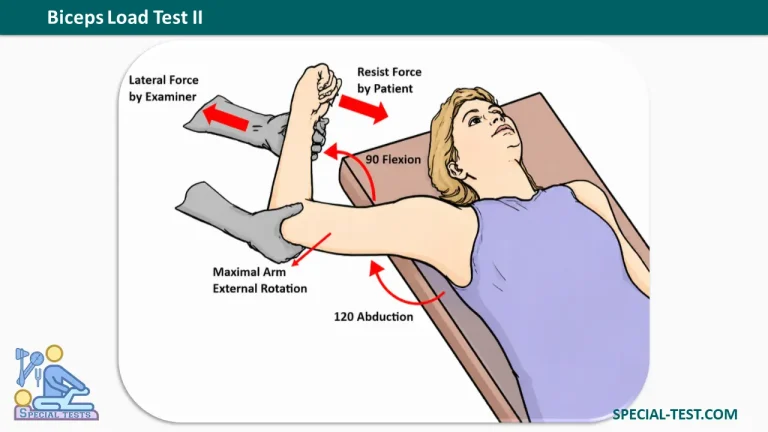
The Biceps Load Test II is a physical examination maneuver for detecting a superior labrum anterior and posterior (SLAP) lesion. Kim and colleagues described it in 2001 [1] as a refinement of their earlier Biceps Load Test [2]. Unlike its predecessor, it is intended for isolated SLAP lesions and does not depend on shoulder instability being present. This article explains what the test is for, how to perform it, what a positive result means, and how much weight it deserves in clinical practice.
What Is the Biceps Load Test II Used For?
The Biceps Load Test II is used to identify SLAP lesions independent of shoulder instability. The original Biceps Load Test was developed for patients with recurrent anterior shoulder dislocation [2]. The second version extends the same principle to patients without a history of instability, such as overhead athletes, throwers, and manual workers who present with deep shoulder pain.
A SLAP lesion involves the superior glenoid labrum at the attachment of the long head of the biceps tendon. The test puts the biceps-labral complex under tension and asks whether that provokes pain.
How to Perform the Biceps Load Test II
Patient Position
The patient lies supine on the examination table, relaxed, with the examiner standing on the side being tested.
Step-by-Step Technique
- Abduct the patient’s arm to 120°.
- Externally rotate the arm to its maximal extent.
- Flex the elbow to 90° and keep the forearm supinated.
- Ask the patient to flex the elbow further, as if bringing the hand toward the head, while the examiner resists the movement.
Why This Position Matters
Kim et al. proposed that abduction and external rotation change the direction of the biceps fibers relative to the posterosuperior labrum, so the labrum is already “peeled back” from the glenoid margin [1]. Resisted biceps contraction then increases the tension on a labrum that is already stressed, which reproduces or worsens pain when a lesion is present.
What Is a Positive Result?
Suspect a SLAP lesion if the test triggers pain deep in the joint or along the joint line during resisted elbow flexion. In the original description, a test counts as positive when pain appears, or increases, during the resisted flexion phase [1]. It is negative if resisted flexion produces no pain, or if existing pain is unchanged or reduced.
A positive result should be interpreted as a clue within the full clinical picture. It is not a stand-alone diagnosis.
Diagnostic Accuracy: What Does the Evidence Show?
In the original prospective study of 127 patients, the Biceps Load Test II had a sensitivity of 89.7% and a specificity of 96.9%. The positive predictive value was 92.1%, the negative predictive value was 95.5%, and the kappa coefficient was 0.815 [1]. Those are strong figures. Of the 38 positive tests, 35 patients had a SLAP lesion at arthroscopy, and most of the lesions in that series were type II.
Limitations of the Evidence
These numbers come from the group that developed the test. Later studies have reported far less impressive results. Cook et al., in a diagnostic accuracy study of five orthopedic tests for SLAP lesions [3], and Oh et al., who studied physical examinations for type II SLAP lesions [4], found lower sensitivity and specificity. Secondary sources summarising these studies give a wide range, so you should check the exact figures on PubMed before quoting them. The main points are:
- Accuracy in independent settings appears much lower than in the original report.
- Test performance varies with the population, the examiner, and how SLAP lesions are defined.
- No single clinical test reliably confirms or excludes a SLAP lesion on its own.
For this reason, clinicians usually combine the Biceps Load Test II with other SLAP tests such as O’Brien’s active compression test, the crank test, and Speed’s test. They then confirm the diagnosis with MR arthrography or arthroscopy where indicated.
Clinical Pearls
- Perform the test on both shoulders, and compare the side that hurts with the healthy one.
- Make sure the patient can relax in the abducted, externally rotated position. Guarding can cause false results.
- Keep in mind other causes of deep shoulder pain, such as subacromial impingement, rotator cuff tears, and biceps tendinopathy. These conditions can also hurt with resisted elbow flexion.
- Document where the pain is felt and at which phase of the maneuver it appears.
Frequently Asked Questions (FAQ)
What is the Biceps Load Test II used for?
It is used to screen for SLAP lesions of the shoulder, independent of shoulder instability.
How is the Biceps Load Test II different from the Biceps Load Test I?
The first test was designed for patients with recurrent anterior shoulder dislocation. The second uses 120° of abduction, which allows it to assess isolated SLAP lesions in patients without instability [1,2].
What does a positive Biceps Load Test II mean?
Pain deep in the joint or along the joint line during resisted elbow flexion raises suspicion of a SLAP lesion. Further evaluation is needed to confirm it.
How accurate is the Biceps Load Test II?
The original study reported 89.7% sensitivity and 96.9% specificity [1]. Later independent studies reported lower values [3,4], so the test works best as part of a cluster of examination findings.
Can the test diagnose a SLAP lesion on its own?
No. Combine it with the history, other special tests, and imaging when needed.
Is the test painful for the patient?
It can reproduce the patient’s usual deep shoulder pain, which is the purpose of the test. Stop if the pain is severe.
Research Limitations
Most of the high-accuracy data for this test comes from a single original study, and its results were not consistently reproduced by independent groups. Clinicians should view its diagnostic accuracy with caution and keep up with newer evidence.
References
- Kim SH, Ha KI, Ahn JH, Choi HJ. Biceps load test II: a clinical test for SLAP lesions of the shoulder. Arthroscopy. 2001;17(2):160-164. (PubMed)
- Kim SH, Ha KI, Han KY. Biceps load test: a clinical test for superior labrum anterior and posterior lesions in shoulders with recurrent anterior dislocations. Am J Sports Med. 1999;27(3):300-303. (PubMed)
- Cook C, Beaty S, Kissenberth MJ, et al. Diagnostic accuracy of five orthopedic clinical tests for diagnosis of superior labrum anterior posterior (SLAP) lesions. J Shoulder Elbow Surg. 2012;21(1):13-22. (PubMed)
- Oh JH, Kim JY, Kim WS, Gong HS, Lee JH. The evaluation of various physical examinations for the diagnosis of type II superior labrum anterior and posterior lesion. Am J Sports Med. 2008;36(2):353-359. (PubMed)