Anterior Release Test (Surprise Test): Procedure, Positive Signs and Accuracy
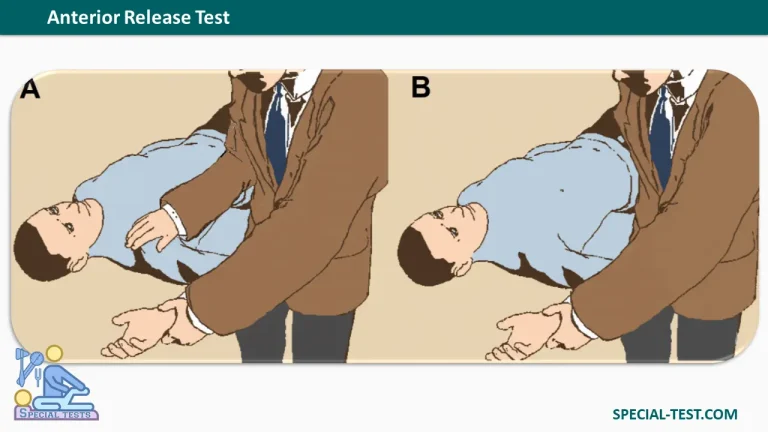
The Anterior Release Test, also known as the Surprise Test or Shoulder Release Test, is a clinical examination used to assess anterior shoulder instability. It helps healthcare professionals identify abnormal forward translation of the humeral head within the glenohumeral joint, particularly in patients with suspected recurrent dislocation, subluxation, or subtle shoulder instability.
The test is based on reproducing the patient’s feeling of apprehension, which is the sensation that the shoulder may slip out of its socket. It is commonly performed alongside the anterior apprehension test and Jobe relocation test to improve clinical assessment.
Originally described by Gross and Distefano in 1997, the Anterior Release Test is particularly useful when conventional shoulder instability tests produce inconclusive findings.
What Is the Purpose of the Anterior Release Test?
The primary purpose of the Anterior Release Test is to identify anterior glenohumeral instability, a condition in which the humeral head moves excessively toward the front of the shoulder socket.
This abnormal translation may occur because of damage or insufficiency involving the joint capsule, glenohumeral ligaments, or glenoid labrum.
The test is particularly relevant in patients with:
- Previous anterior shoulder dislocation or subluxation.
- Recurrent episodes of shoulder instability.
- Apprehension during shoulder abduction and external rotation.
- Shoulder symptoms associated with overhead throwing activities.
- Suspected occult anterior shoulder instability.
Occult instability refers to subtle instability that may cause pain or functional limitations without an obvious history of complete shoulder dislocation.
How to Perform the Anterior Release Test
The Anterior Release Test is performed with the patient lying supine. It is typically conducted after the anterior apprehension and relocation maneuvers.
Step-by-step procedure:
- Patient positioning: Position the patient supine on an examination table, with the affected shoulder abducted to 90 degrees and the elbow flexed to 90 degrees.
- Shoulder external rotation: The examiner carefully moves the patient’s shoulder into external rotation while monitoring for discomfort, guarding, or apprehension.
- Apply posterior pressure: While maintaining the test position, the examiner applies a posteriorly directed force to the humeral head. This pressure helps stabilize the shoulder by limiting anterior translation.
- Release the posterior force: Near the tolerated end range of external rotation, the examiner quickly releases the posteriorly directed pressure while maintaining control of the patient’s arm.
- Observe the response: The examiner watches for sudden apprehension, muscular guarding, withdrawal, or reproduction of the patient’s characteristic instability symptoms.
The sudden removal of posterior stabilization allows the humeral head to translate anteriorly, potentially reproducing the sensation associated with shoulder instability.
Important precaution: The release maneuver can provoke significant apprehension and may cause dislocation in susceptible patients. It should only be performed by a qualified healthcare professional when clinically appropriate. In patients with recurrent dislocations or marked instability, the maneuver may be avoided.
What Is a Positive Anterior Release Test?
A positive Anterior Release Test is characterized primarily by the sudden return of apprehension when the examiner releases the posteriorly directed pressure.
The patient may experience a sensation that the shoulder is about to dislocate, accompanied by guarding, resistance to further movement, or sudden withdrawal of the arm.
These findings suggest anterior shoulder instability, particularly when apprehension improves with the relocation maneuver and returns after the stabilizing force is removed.
Does Pain Alone Indicate a Positive Test?
Pain during the Surprise Test is not necessarily diagnostic of anterior shoulder instability.
Although pain can accompany instability, it may also occur in patients with other shoulder disorders, including:
- Bankart lesion: Damage to the anteroinferior glenoid labrum, frequently associated with anterior shoulder dislocation.
- SLAP lesion: Injury involving the superior labrum from anterior to posterior.
- Biceps tendon pathology: Disorders affecting the long head of the biceps tendon and surrounding tissues.
- Rotator cuff pathology: Tendinopathy or tears that can produce shoulder pain during provocative movements.
Pain reproduction should therefore be interpreted cautiously, particularly in older patients with rotator cuff disorders.
A clearly reproduced feeling of instability or apprehension is generally more clinically meaningful than isolated pain.
Anterior Release Test Sensitivity and Specificity
The diagnostic accuracy of the Anterior Release Test has been investigated in several clinical studies.
In a 2004 study published in the American Journal of Sports Medicine, Lo and colleagues evaluated the apprehension, relocation, and surprise tests in 46 patients with different shoulder conditions.
The researchers reported the following diagnostic values for the Surprise Test:
| Diagnostic measure | Result |
|---|---|
| Sensitivity | 63.89% |
| Specificity | 98.91% |
A sensitivity of 63.89% indicates that the test identified approximately 64% of patients with anterior shoulder instability in the studied population.
Its specificity of 98.91% indicates that approximately 99% of patients without the target condition were correctly classified as negative.
These findings suggest that a positive Surprise Test can provide strong evidence supporting anterior shoulder instability, while a negative result does not reliably exclude the condition.
Evidence From the Original 1997 Study
Gross and Distefano evaluated the Anterior Release Test in 100 shoulders undergoing preoperative examination, comparing clinical findings with surgical findings.
Their study reported:
- Sensitivity: 91.9%
- Specificity: 88.9%
- Positive predictive value: 87.1%
- Negative predictive value: 93.0%
- Overall accuracy: 90.2%
The differences between the 1997 and 2004 studies highlight how diagnostic accuracy can vary according to patient selection, study design, and assessment methods. Neither set of values should be regarded as universally applicable to every patient population.
Anterior Release Test vs. Apprehension and Relocation Tests
Three related shoulder examination maneuvers are frequently used together when evaluating anterior instability.
Anterior Apprehension Test: The examiner abducts and externally rotates the shoulder to assess whether the patient experiences fear or apprehension that the shoulder may dislocate.
Jobe Relocation Test: A posteriorly directed force is applied to the humeral head while the shoulder remains in the apprehension position. Reduction in apprehension supports the suspicion of anterior instability.
Anterior Release (Surprise) Test: The examiner removes the posteriorly directed stabilizing force, observing whether the patient’s apprehension suddenly returns.
The key distinction is that the Anterior Release Test evaluates the patient’s response to the withdrawal of external stabilization.
When all three tests reproduce a consistent instability pattern, the combined findings can strengthen the clinical diagnosis.
Clinical Significance and Limitations
The Anterior Release Test is a valuable component of the physical examination for suspected anterior glenohumeral instability.
Its high specificity in the 2004 study makes it particularly useful for supporting the diagnosis when the result is positive.
However, the test should not be used in isolation. A comprehensive shoulder assessment should include the patient’s injury history, previous dislocations, functional limitations, range of motion, and other instability tests.
When clinically indicated, imaging such as MRI or MR arthrography may help evaluate associated labral, capsular, or ligamentous injuries.
Clinical takeaway: The Surprise Test is most informative when it reproduces the patient’s characteristic apprehension and its findings agree with the overall clinical examination.
Frequently Asked Questions (FAQ)
1. What is the Anterior Release Test used for?
The Anterior Release Test is used to evaluate anterior glenohumeral instability. It helps determine whether releasing a posterior stabilizing force reproduces the patient’s characteristic feeling of shoulder instability.
2. Why is the Anterior Release Test called the Surprise Test?
It is called the Surprise Test because the examiner suddenly removes the posteriorly directed force supporting the humeral head. This unexpected release may provoke a rapid return of apprehension in patients with anterior shoulder instability.
3. What indicates a positive Surprise Test?
A positive result is primarily indicated by sudden apprehension, guarding, or the feeling that the shoulder is about to dislocate following the release of posterior stabilization. Pain may also occur, but pain alone is less specific.
4. What are the sensitivity and specificity of the Anterior Release Test?
A 2004 study reported a sensitivity of 63.89% and a specificity of 98.91%. The original 1997 study reported 91.9% sensitivity and 88.9% specificity. These values reflect different study populations and methods.
5. Can the Anterior Release Test diagnose a Bankart lesion?
No. A positive test can suggest anterior shoulder instability, which may be associated with a Bankart lesion, but it cannot independently confirm a labral tear. Additional clinical assessment and appropriate imaging may be necessary.
6. What is the difference between the Relocation Test and the Surprise Test?
The Relocation Test evaluates whether posterior pressure on the humeral head reduces apprehension. The Surprise Test assesses whether apprehension returns when that pressure is released.
7. Is the Anterior Release Test safe?
The test can provoke significant apprehension and, in some circumstances, an anterior shoulder dislocation. It should be performed only by a trained healthcare professional, with particular caution in patients with recurrent or severe shoulder instability.
References
- Gross ML, Distefano MC. Anterior release test. A new test for occult shoulder instability. Clinical Orthopaedics and Related Research. 1997;(339):105–108. DOI: 10.1097/00003086-199706000-00014. PubMed PMID: 9186207.
- Lo IKY, Nonweiler B, Woolfrey M, Litchfield R, Kirkley A. An evaluation of the apprehension, relocation, and surprise tests for anterior shoulder instability. American Journal of Sports Medicine. 2004;32(2):301–307. DOI: 10.1177/0095399703258690. PubMed PMID: 14977651.
- Tzannes A, Paxinos A, Callanan M, Murrell GAC. An assessment of the interexaminer reliability of tests for shoulder instability. Journal of Shoulder and Elbow Surgery. 2004;13(1):18–23. PubMed PMID: 14735068.
- Lizzio VA, Meta F, Fidai M, Makhni EC. Clinical Evaluation and Physical Exam Findings in Patients with Anterior Shoulder Instability. Current Reviews in Musculoskeletal Medicine. 2017;10(4):434–441. PubMed PMID: 29043566.
- OrthoFixar. Shoulder Anterior Release Test: Procedure, Sensitivity & Specificity. OrthoFixar Clinical Reference.