How to Perform the Moro Reflex Test: Technique, Normal Response & Clinical Significance
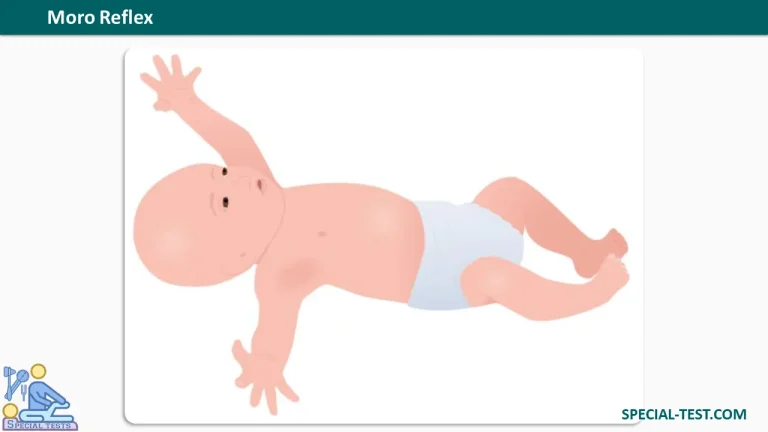
The Moro reflex test is an important component of the newborn neurological examination. It evaluates an infant’s involuntary motor response to a sudden change in head position, loss of postural support, or an unexpected stimulus. Also known as the Moro startle reflex, this primitive reflex helps clinicians assess early neurological function, muscle tone, and the symmetry of upper-limb movement.
The Moro reflex is normally present at birth in full-term infants and gradually disappears as the central nervous system matures, usually by 4–6 months of age. An absent, asymmetric, exaggerated, or persistent Moro reflex may indicate an underlying neurological or musculoskeletal problem and should be interpreted alongside other examination findings. [1,2]
This article explains how to perform the Moro reflex test, recognize a normal response, and understand the clinical significance of abnormal findings.
What Is the Moro Reflex?
The Moro reflex is an involuntary, primitive reflex observed in newborns and young infants. It is typically triggered by a sudden change in head position or postural support that creates the sensation of falling.
The reflex is an important part of the neonatal neurological assessment because it provides information about motor responses, muscle tone, and the integrity of neurological pathways involved in early development. Research on primitive reflexes has demonstrated their value in identifying infants who may require further assessment for neurodevelopmental disorders. [1,3]
The Moro reflex can be observed during routine newborn examinations and is particularly useful when assessing an infant’s response to external stimuli.
How to Perform the Moro Reflex Test
The Moro reflex should be assessed by a trained healthcare professional in a controlled clinical environment. The infant must be handled gently, with appropriate support of the head and neck throughout the examination.
1. Position the Infant
Place the infant in the supine position on a firm, safe examination surface. Observe the infant’s resting posture and the natural position of the upper and lower limbs.
The infant should be reasonably calm before testing, because crying, spontaneous movements, and changes in alertness may influence the observed response.
2. Apply a Controlled Stimulus
Several techniques have historically been described for eliciting the Moro reflex. The objective is to produce a brief, controlled change in postural support rather than an actual fall.
Supported head-position technique: The examiner supports the infant’s head, neck, and trunk while introducing a brief, controlled change in head position. The response is then observed for the characteristic movement of the arms.
Gentle arm-traction technique: With the infant lying supine, the examiner gently holds the infant’s hands or forearms and applies slight traction before releasing the traction in a controlled manner. The head and neck must remain protected, and the infant must not be allowed to fall.
Auditory stimulus: A sudden, unexpected sound may produce a startle response. However, an auditory startle response is not necessarily equivalent to the complete Moro reflex, so the findings must be interpreted carefully.
Some descriptions of the examination include abruptly lowering the infant or allowing the head to drop backward. These maneuvers should not be attempted by parents or untrained individuals. A clinician should select an age-appropriate, safe technique and maintain continuous support of the infant.
Importantly, the Moro reflex is triggered by the suddenness of the stimulus, not by the distance the infant is moved. Lifting an infant several inches or dropping the body is unnecessary and unsafe. [2]
3. Observe the Response
After applying the stimulus, observe the infant’s arms, hands, trunk, and overall motor response.
A typical Moro reflex consists of two phases:
- First phase — abduction and extension: The infant rapidly moves the arms outward and extends them. The fingers generally spread, and the trunk may extend slightly.
- Second phase — adduction and flexion: The arms move inward toward the body, followed by flexion and a clasping or embracing movement.
The infant may cry during or after the response. Crying is not required for the reflex to be considered present.
The examiner should pay particular attention to whether both arms move symmetrically, whether the response occurs in both phases, and whether the intensity appears appropriate for the infant’s age and developmental status.
What Is a Positive or Normal Moro Reflex Result?
A normal Moro reflex is a characteristic, usually symmetrical, two-phase motor response to an appropriate stimulus.
The expected findings include:
- Sudden outward movement and extension of both arms.
- Spreading of the fingers during the initial phase.
- Subsequent inward movement and flexion of the arms.
- Similar movement on both sides of the body.
- Possible crying following the stimulus.
Although the legs and trunk may also move, the most recognizable component is the outward extension of the arms followed by an embracing movement.
The Moro reflex is present in healthy term newborns. It becomes less prominent as the infant develops voluntary motor control and is generally integrated by approximately 4–6 months of age. [1,2]
Abnormal Moro Reflex Findings and Their Clinical Significance
An abnormal Moro reflex does not establish a specific diagnosis. Instead, it may provide an important clue that further neurological, developmental, or musculoskeletal assessment is needed.
1. Absent or Decreased Moro Reflex
A weak or absent response may be associated with several conditions, including:
- Generalized muscle weakness.
- Marked hypotonia, or abnormally reduced muscle tone.
- Peripheral nerve injury.
- Neurological impairment affecting the pathways involved in the reflex.
- Prematurity and differences in neuromuscular maturation.
The Moro reflex may be less pronounced in premature infants because their neuromuscular control and antigravity muscle function are still developing. Findings should therefore be interpreted in relation to gestational age and corrected age, where appropriate. [2,4]
2. Asymmetric Moro Reflex
An asymmetric Moro reflex occurs when one arm moves differently from the other. For example, one arm may show reduced abduction or extension while the opposite arm demonstrates a normal response.
Possible causes include:
- Obstetric brachial plexus injury: Damage to the peripheral nerves supplying the upper limb may reduce movement on the affected side.
- Clavicular fracture: Pain or restricted movement may limit the infant’s response.
- Humeral fracture or other upper-limb injury: Discomfort may cause reduced movement of the affected arm.
- Other neurological or musculoskeletal abnormalities: These may interfere with symmetrical movement.
An asymmetric response warrants clinical evaluation to identify the cause rather than assuming that the abnormality is neurological.
3. Exaggerated Moro Reflex
An unusually strong or easily triggered response may occur in some infants with increased startle sensitivity or neurological disturbances. Its significance depends on the infant’s age, clinical history, and other examination findings.
An exaggerated response should not be used alone to diagnose a neurological disorder.
4. Persistent Moro Reflex
The Moro reflex normally disappears as neurological maturation progresses. Persistence beyond the expected developmental period, particularly beyond approximately 6 months, may warrant evaluation for delayed neurological maturation or other developmental abnormalities.
Persistent primitive reflexes have been described in infants with neurodevelopmental disorders, including cerebral palsy. However, the Moro reflex alone cannot confirm cerebral palsy or developmental delay. A comprehensive assessment of motor milestones, muscle tone, posture, and other primitive reflexes is necessary. [1,3]
5. Reduced Response Associated With Abnormal Muscle Tone
Marked hypertonia, or abnormally increased muscle tone, can restrict the range of movement during the Moro reflex. The arms may fail to extend fully, the hands may remain closed, or the expected two-phase response may be difficult to observe.
Similarly, profound hypotonia or flaccid weakness may reduce the strength of the response. The examiner should assess muscle tone and spontaneous movement in addition to the reflex itself.
Clinical Importance of the Moro Reflex Test
The Moro reflex is a useful component of the newborn neurological examination because it helps clinicians assess early motor function and identify findings that may require further investigation.
Its clinical value includes:
- Evaluating the symmetry of upper-limb movement.
- Identifying possible peripheral nerve or musculoskeletal injuries.
- Assessing aspects of early neuromuscular function.
- Supporting the neurological evaluation of premature and term infants.
- Identifying abnormal primitive reflex patterns that may justify developmental follow-up.
However, the Moro reflex should never be interpreted in isolation. A complete newborn assessment includes muscle tone, spontaneous movements, posture, feeding-related reflexes, developmental milestones, and the infant’s medical history. [1,3,4]
Safety Precautions When Performing the Moro Reflex
The Moro reflex test must be performed carefully because newborns have limited head control and require continuous support.
Important precautions include:
- Support the infant’s head and neck throughout the examination.
- Use a firm, safe examination surface.
- Never drop the infant or deliberately allow the head to fall unsupported.
- Avoid excessive traction on the arms or shoulders.
- Do not use painful stimuli or unnecessarily loud noises.
- Stop the maneuver if the infant shows signs of distress or injury.
- Seek further clinical evaluation if the response is absent, markedly asymmetric, or otherwise concerning.
Parents should not attempt to elicit the reflex by dropping, shaking, or suddenly releasing their infant. If a caregiver is concerned about a baby’s startle response or development, a pediatric healthcare professional should assess the infant.
Frequently Asked Questions (FAQ)
1. What is the Moro reflex test used for?
The Moro reflex test assesses an infant’s involuntary motor response to a sudden change in postural support. It helps clinicians evaluate symmetry of movement, muscle tone, and aspects of early neurological development.
2. When does the Moro reflex appear?
The Moro reflex develops before birth and is usually present in full-term newborns. Its appearance and strength may vary with gestational age and neurological maturity.
3. At what age does the Moro reflex disappear?
The Moro reflex typically disappears by approximately 4–6 months of age. Persistence beyond this period may warrant further developmental assessment, especially if accompanied by other abnormal neurological findings. [1,2]
4. What is a normal Moro reflex response?
A normal response consists of two phases: outward abduction and extension of the arms, followed by inward movement and flexion. The response should generally be symmetrical on both sides.
5. What does an absent Moro reflex indicate?
An absent reflex may be associated with prematurity, reduced muscle tone, generalized weakness, peripheral nerve injury, or neurological impairment. The cause cannot be determined from this finding alone, and a clinical assessment is necessary.
6. What does an asymmetric Moro reflex mean?
An asymmetric response may indicate a peripheral nerve injury, such as brachial plexus injury, or a musculoskeletal problem, such as a clavicular fracture. Further examination is needed to determine the cause.
7. Can a persistent Moro reflex indicate cerebral palsy?
Persistence beyond the expected age may raise concern about delayed neurological maturation or a neurodevelopmental disorder, including cerebral palsy. However, it is not diagnostic on its own; assessment of the infant’s overall development and neurological findings is essential.
8. Is it safe for parents to perform the Moro reflex test at home?
Parents should not deliberately trigger the reflex using sudden drops, unsupported head movements, or forceful arm traction. A trained healthcare professional can assess the reflex safely during a routine infant examination.
References
- Zafeiriou DI. Primitive reflexes and postural reactions in the neurodevelopmental examination. Pediatric Neurology. 2004;31(1):1–8. Read on PubMed.
- Pattnaik P, Al Khalili Y. Moro Reflex. StatPearls. NCBI Bookshelf. Updated August 2, 2025. Read on NCBI Bookshelf.
- Futagi Y, Toribe Y, Suzuki Y. The grasp reflex and moro reflex in infants: hierarchy of primitive reflex responses. International Journal of Pediatrics. 2012;2012:191562. Read on PubMed Central.
- Salandy S, Rai R, Gutierrez S, Ishak B, Tubbs RS. Neurological examination of the infant: A comprehensive review. Clinical Anatomy. 2019;32(6):770–777. Read on PubMed.