Tonic Neck Reflexes: Definition, Testing Procedure, and Clinical Significance
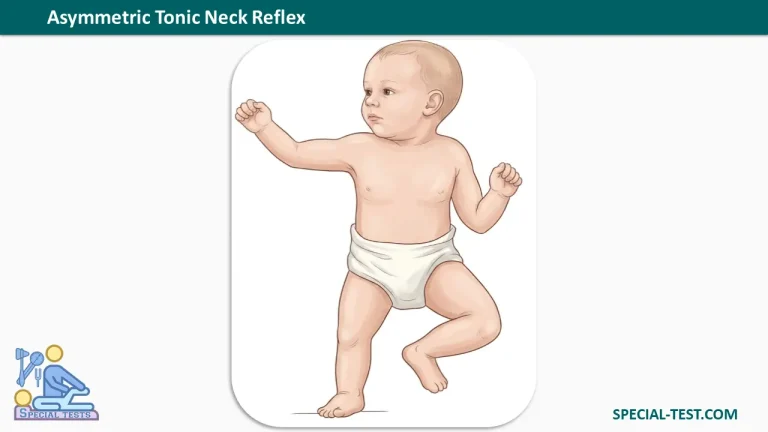
Tonic neck reflexes are primitive reflexes assessed during the neurological and developmental examination of infants. They involve characteristic changes in muscle tone and limb posture in response to changes in head and neck position. The two main types are the asymmetric tonic neck reflex (ATNR) and the symmetric tonic neck reflex (STNR). These reflexes provide information about early neurological development, postural control, and the maturation of the central nervous system.
The asymmetric tonic neck reflex is commonly evaluated during routine infant neurological examinations because it is normally present at birth and gradually integrates as the nervous system matures. The symmetric tonic neck reflex develops later and contributes to the transition toward more advanced postural and motor skills.
Abnormalities in these reflexes, particularly their persistence beyond the expected developmental period, may indicate neurological dysfunction. However, reflex findings should always be interpreted alongside the infant’s age, muscle tone, spontaneous movements, developmental milestones, and other neurological examination findings.
What Are Tonic Neck Reflexes Used For?
Tonic neck reflexes are used to assess neurological function and early motor development in infants. Their examination may help clinicians identify abnormalities in muscle tone, postural responses, and the integration of primitive reflexes.
The two main types are:
- Asymmetric tonic neck reflex (ATNR): Present at birth in typical development and usually becomes less prominent by approximately 4–6 months of age.
- Symmetric tonic neck reflex (STNR): Generally emerges around 5–8 months of age and is often diminished or no longer readily elicited by approximately 12 months.
These age ranges are approximate. Reflex responses vary between infants, and an individual finding should not be used alone to diagnose a neurological disorder.
Clinical indications
Assessment of tonic neck reflexes may be useful when evaluating:
- Primitive reflex development and integration.
- Abnormal muscle tone, including hypotonia or increased tone.
- Delayed gross motor development.
- Abnormal posturing or asymmetrical limb movements.
- Possible central nervous system dysfunction.
- Infants with suspected cerebral palsy or other neurological disorders.
A persistent or exaggerated primitive reflex may raise concern for an underlying neurological abnormality, particularly when accompanied by other abnormal findings.
How to Perform the Tonic Neck Reflex Examination
The examiner should ensure that the infant is comfortable, adequately supported, and in a suitable position. Movements should be gentle and controlled, and the examiner should observe the entire body rather than focusing only on the limbs.
The ATNR and STNR are tested using different positions and head movements.
1. Asymmetric Tonic Neck Reflex (ATNR)
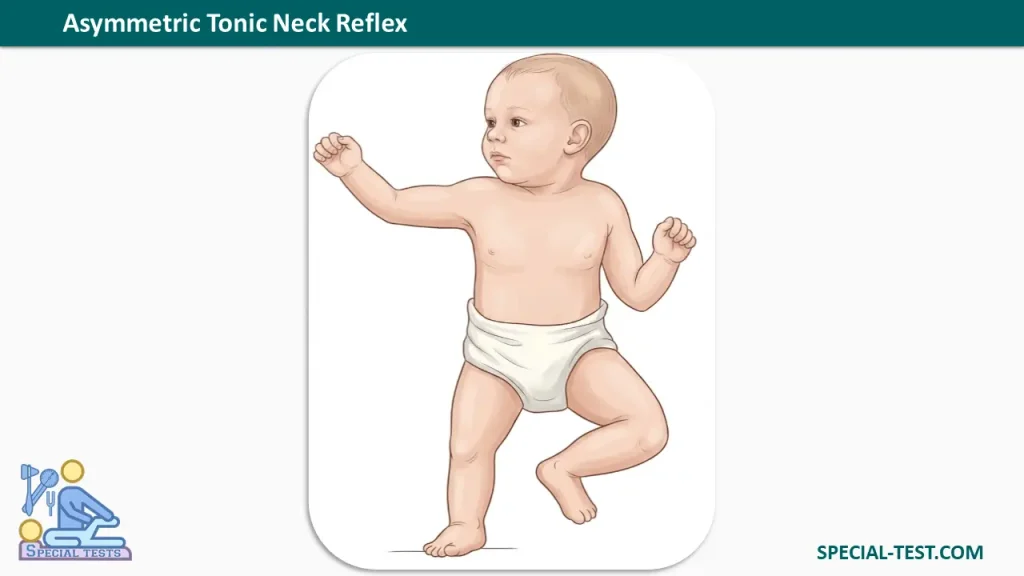
The asymmetric tonic neck reflex is also known as the fencing reflex because the infant’s posture resembles that of a fencer preparing to engage an opponent.
Testing position
- Place the infant in the supine position on a stable examination surface.
- Position the head in the midline.
- Ensure that the infant is relaxed and that spontaneous limb movements can be observed.
Examination procedure
- Gently rotate the infant’s head to one side without flexing or extending the neck.
- Maintain the rotated position briefly, traditionally for approximately 5–10 seconds, while observing the arms and legs.
- Return the head to the midline and allow the infant to relax.
- Repeat the maneuver by rotating the head to the opposite side.
- Compare the posture and muscle tone of both sides.
Avoid forceful rotation or maintaining a position that causes distress.
Normal response
A positive ATNR response produces a characteristic pattern of limb positioning:
- Face (chin) side: The arm tends to extend, often with increased extensor tone. The leg on this side may also extend.
- Occiput side: The arm tends to flex, sometimes with increased flexor tone. The leg may also flex.
- Hand response: Grasping may be easier to elicit on the flexed side.
The combination of extension on the face side and flexion on the opposite side produces the characteristic fencing posture.
Positive and abnormal findings
The ATNR is expected during early infancy, but its clinical interpretation depends on the infant’s age and the consistency of the response.
- Expected early response: A transient, age-appropriate fencing posture when the head is rotated.
- Abnormal persistence: A reflex that remains strongly expressed beyond the expected period of integration may indicate impaired neurological maturation.
- Exaggerated response: Marked or persistent asymmetry of limb posture may be associated with an upper motor neuron disorder or cerebral palsy.
- Absent response: An absent ATNR may occur for several reasons, including differences in developmental state, reduced muscle tone, or neurological dysfunction. It is not diagnostic of flaccid paralysis or severe hypotonia by itself.
A response that occurs consistently with every head rotation, especially when it interferes with voluntary movement or is accompanied by other abnormal neurological signs, warrants further assessment.
2. Symmetric Tonic Neck Reflex (STNR)
The symmetric tonic neck reflex differs from the ATNR because its response is associated with neck flexion and extension rather than rotation. It is a later-developing primitive reflex that influences the relationship between upper- and lower-limb muscle tone.
Testing position
The infant is commonly positioned prone across the examiner’s lap, with the trunk and limbs safely supported. This position is sometimes described as the quadruped or quadriceps position in clinical examination descriptions.
The examiner should ensure that the infant’s head, trunk, and limbs are adequately supported throughout the maneuver.
Examination procedure
- Position the infant securely in the prone-supported position.
- Gently extend the head and neck while observing the upper and lower limbs.
- Return the head toward neutral.
- Gently flex the head and neck while observing the resulting changes in limb posture.
- Compare the responses during flexion and extension.
Normal response
The STNR produces reciprocal changes in upper- and lower-limb muscle tone.
With neck extension:
- The upper limbs tend to extend, or their extensor tone increases.
- The lower limbs tend to flex, or their flexor tone increases.
With neck flexion:
- The upper limbs tend to flex, or their flexor tone increases.
- The lower limbs tend to extend, or their extensor tone increases.
These responses reflect the influence of head and neck position on limb posture during early motor development.
Positive and abnormal findings
The STNR is interpreted according to developmental age, the strength and consistency of the response, and the infant’s overall motor function.
- Absent or weak response: May reflect developmental variation, the infant’s state during examination, or neurological dysfunction. An absent STNR alone does not establish a diagnosis.
- Persistent response: Continued expression beyond the expected developmental period may interfere with the development of coordinated posture and movement.
- Functional effects: A strongly persistent STNR may make transitions between prone, kneeling, crawling, and upright positions more difficult.
- Abnormal gait or posture: Persistent primitive reflex activity may contribute to atypical movement patterns in children with neurological disorders.
The STNR is often diminished or no longer readily elicitable by around 12 months of age, although there is no single definitive age at which it must disappear in every child.

Clinical Interpretation and Differential Diagnosis
Tonic neck reflexes should be assessed as part of a comprehensive neurological examination rather than used as isolated diagnostic tests. The quality, symmetry, persistence, and functional effects of a reflex are often more informative than its simple presence or absence.
For example, research on the ATNR in preterm infants suggests that the quality of the response, particularly whether it dominates spontaneous movement, can contribute to neurological assessment. However, findings must be interpreted in the context of gestational age and other clinical observations.
When an abnormal tonic neck reflex is identified, the clinician should consider:
- Cerebral palsy and other disorders affecting central motor control.
- Abnormal muscle tone, including hypotonia or spasticity.
- Delayed motor development.
- Asymmetry of spontaneous movement or posture.
- Other neurological conditions affecting normal reflex integration.
A single abnormal reflex does not establish cerebral palsy. Combining primitive reflex assessment with postural reactions, developmental milestones, and a structured neurological examination provides more useful clinical information.
Key Differences Between ATNR and STNR
| Feature | ATNR | STNR |
|---|---|---|
| Full name | Asymmetric tonic neck reflex | Symmetric tonic neck reflex |
| Typical onset | Present at birth | Emerges around 5–8 months |
| Main stimulus | Head rotation | Neck flexion or extension |
| Face-side response | Arm extension | Not applicable |
| Neck extension response | Not the defining maneuver | Upper limbs extend; lower limbs flex |
| Neck flexion response | Not the defining maneuver | Upper limbs flex; lower limbs extend |
| Expected integration | Usually by 4–6 months | Often diminished by approximately 12 months |
| Clinical concern | Persistent obligatory fencing posture | Persistent interference with coordinated posture and movement |
These developmental ranges are approximate and should not replace age-appropriate neurological assessment.
Frequently Asked Questions (FAQs)
1. What is the tonic neck reflex?
The tonic neck reflex is a primitive reflex in which changing the position of the head or neck produces predictable changes in limb posture and muscle tone. The two main forms are the asymmetric tonic neck reflex and the symmetric tonic neck reflex.
2. What is the normal age for disappearance of the ATNR?
The asymmetric tonic neck reflex is normally present at birth and generally becomes less prominent by approximately 4–6 months of age. Persistent, obligatory responses beyond this period may warrant further neurological assessment.
3. What is the difference between ATNR and STNR?
The ATNR is triggered by rotating the head to one side and produces extension on the face side with flexion on the opposite side. The STNR is triggered by neck flexion or extension and produces reciprocal changes in upper- and lower-limb posture.
4. What does a persistent tonic neck reflex indicate?
A persistent or exaggerated tonic neck reflex may indicate abnormal neurological maturation or impaired motor control, particularly when associated with developmental delay, abnormal muscle tone, or asymmetrical movement. Cerebral palsy is one possible diagnosis, but the reflex alone is not diagnostic.
5. What does an absent asymmetric tonic neck reflex mean?
An absent ATNR may reflect variation in the infant’s developmental state, examination conditions, muscle tone, or neurological function. It should not automatically be interpreted as flaccid paralysis or severe hypotonia. The clinician should evaluate other primitive reflexes and the overall neurological examination.
6. Can a persistent STNR affect crawling?
A strongly persistent STNR may interfere with the coordination of the upper and lower limbs and make transitions between postures more difficult. However, crawling varies among typically developing infants, and the absence of crawling alone does not establish an abnormal STNR.
7. Is the tonic neck reflex test painful?
No. When performed correctly, the examination involves gentle head and neck movements while the infant is appropriately supported. The maneuver should be stopped if the infant becomes distressed, and forceful neck movement should be avoided.
8. Are tonic neck reflexes sufficient to diagnose cerebral palsy?
No. Tonic neck reflexes are only one component of neurological assessment. Diagnosis requires consideration of the child’s developmental history, neurological findings, movement patterns, and appropriate investigations when indicated.
References
- Arcilla CK, Vilella RC. Tonic Neck Reflex. StatPearls. NCBI Bookshelf. Read on NCBI.
- Coryell J, Cardinali N. The asymmetrical tonic neck reflex in normal full-term infants. Physical Therapy. 1979;59(6):747–753. PubMed.
- Marinelli PV. The asymmetric tonic neck reflex: Its presence and significance in the newborn. Clinical Pediatrics. 1983;22(8):544–546. PubMed.
- Lacey JL, Henderson-Smart D, Edwards D, Storey B. Neurological assessment of the preterm infant in the special care nursery and the diagnostic significance of the asymmetrical tonic neck reflex. Australian Journal of Physiotherapy. 1987;33(3):135–142. PubMed.
- Zafeiriou DI. Primitive reflexes and postural reactions in the neurodevelopmental examination. PubMed search.
- Orthofixar. Orthopedic and clinical examination resources.