Startle Reflex in Infants: Definition, Examination & Clinical Significance
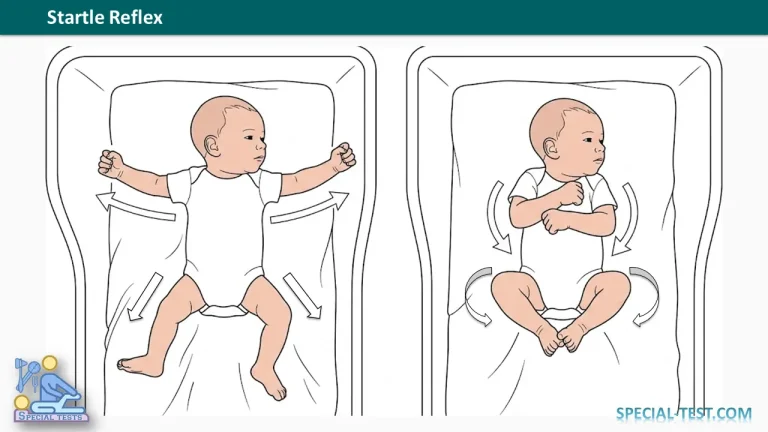
The startle reflex is an involuntary motor response to a sudden unexpected sensory stimulus, such as a loud noise or a brief tactile stimulus. In newborns and young infants, this response provides useful information during the neurological examination and helps clinicians assess muscle tone, motor responses, and symmetry of movement.
The startle reflex is described as a mass myoclonic reflex because it involves a rapid, generalized muscular response. It is important to distinguish this reflex from the Moro reflex, another primitive neonatal reflex characterized by an initial extension and abduction of the arms, followed by flexion and adduction. Although these responses may appear similar, their motor patterns differ and should be assessed separately.
During a clinical examination, the startle response can provide additional information about the integrity of the infant’s nervous system. However, an absent or asymmetric response should not be interpreted in isolation; the findings must be correlated with muscle tone, spontaneous limb movements, other primitive reflexes, and the infant’s overall neurological examination. The evaluation of abnormal neonatal muscle tone requires consideration of several possible central and peripheral neurological causes. [4]
What Is the Startle Reflex Used For?
The startle reflex is used as part of the neurological examination of newborns and infants to evaluate their response to sudden sensory stimulation. It may help clinicians identify abnormalities in motor responsiveness, muscle tone, and the symmetry of limb movement.
The main clinical purposes of assessing the startle reflex include:
- Neurological assessment: Observing the infant’s generalized motor response to an unexpected stimulus.
- Assessment of muscle tone: Identifying an unusually weak or absent motor response that may warrant further evaluation for hypotonia or neurological dysfunction.
- Detection of asymmetry: Comparing the movement of both upper and lower limbs to identify possible unilateral weakness.
- Differentiation of neonatal reflexes: Distinguishing the flexion-dominant startle response from the characteristic extension-abduction pattern of the Moro reflex.
- Supporting the neurological examination: Combining the observed response with other findings to guide further assessment when abnormalities are suspected.
An abnormal startle response is a clinical finding rather than a definitive diagnosis. For example, neonatal hypotonia can arise from disorders affecting the brain, spinal cord, peripheral nerves, neuromuscular junction, or muscles. Therefore, the reflex should be interpreted alongside the infant’s history and the findings of a comprehensive examination. [4]
How to Perform the Startle Reflex Test
The startle reflex can be assessed during a neonatal neurological examination by observing the infant’s response to a brief, unexpected stimulus. The examination should be performed by a trained healthcare professional in a safe, controlled environment.
Patient Position
- Place the infant in the supine position on a firm, safe examination surface.
- Allow the upper and lower limbs to rest in a natural, relaxed position, with the limbs generally extended or partially flexed according to the infant’s spontaneous posture.
- Observe the infant’s baseline muscle tone, spontaneous movements, and the position of both arms and legs before applying the stimulus.
Eliciting the Reflex
- Apply a brief sensory stimulus, such as a sudden sound or a gentle tap to the sternum, according to the clinical examination technique being used.
- Observe the immediate motor response, including movement at the elbows, knees, hands, and feet.
- Compare the response on both sides of the body and note whether the movement is generalized, symmetrical, and appropriately vigorous.
The stimulus should be brief and controlled. Repeated loud noises or forceful tapping are unnecessary and should be avoided. The examination should never compromise the infant’s comfort or safety.
What Is the Normal Response to the Startle Reflex?
A normal startle response consists of a brief, involuntary, generalized motor reaction to a sudden sensory stimulus. In the examination description used here, the expected response includes:
- Flexion of the elbows and knees rather than the prominent initial extension seen in the Moro reflex.
- A brief, generalized muscular contraction.
- Hands that may remain closed during the observed response.
- A response that is broadly symmetrical, without a clear difference in movement between the two sides.
The precise appearance of the startle response can vary with the infant’s age, state of alertness, stimulus, and examination technique. The examiner should therefore assess the overall response rather than relying on a single joint movement.
Startle Reflex vs. Moro Reflex
| Feature | Startle reflex | Moro reflex |
|---|---|---|
| Stimulus | Sudden auditory or tactile stimulus | Sudden change in support or head position, or another appropriate stimulus |
| Typical motor pattern | Brief, generalized muscular response; flexion may predominate in the described examination | Initial arm abduction and extension, followed by adduction and flexion |
| Clinical use | Assessment of responsiveness and motor reaction | Assessment of a primitive neonatal reflex and its symmetry |
| Interpretation | Considered with tone and other neurological findings | Considered with other primitive reflexes and the overall neurological examination |
The two reflexes can overlap in their triggering stimuli and appearance. Consequently, the stimulus alone does not reliably distinguish them; the observed motor pattern is important.
What Is a Positive Startle Reflex Test?
A positive startle reflex test refers to the presence of an observable motor response after the appropriate stimulus. In the clinical examination described above, the response is characterized by generalized muscle activity with flexion of the elbows and knees.
The startle response is generally considered a lifelong protective reaction, although its expression changes with age and neurological development. It should not be confused with primitive neonatal reflexes, which have distinct developmental patterns.
1. Normal Response
A normal response demonstrates that the infant reacts to the stimulus with an observable motor response. The examiner should document its intensity, distribution, and symmetry.
A present response does not, by itself, exclude a neurological disorder. The findings must be interpreted in the context of the infant’s other examination findings.
2. Absent or Markedly Reduced Response
An absent or markedly reduced response may raise concern about impaired motor responsiveness or an underlying neurological or neuromuscular abnormality.
Severe hypotonia is one possible clinical concern when an infant has markedly reduced spontaneous movement and weak or absent responses. However, absence of the startle reflex alone is not sufficient to diagnose severe hypotonia. Other findings, including passive muscle tone, antigravity movement, tendon reflexes, and feeding or respiratory difficulties, should be assessed. Neonatal hypotonia has a broad differential diagnosis and may involve central or peripheral nervous system disorders. [4]
An absent response should prompt assessment of the infant’s alertness, the adequacy of the stimulus, and other neurological findings before any conclusion is reached.
3. Asymmetric Response
An asymmetric startle response occurs when one side of the body moves less than the other or when the response is clearly unequal between the limbs.
Possible causes include:
- Obstetric brachial plexus palsy: A birth-related injury to the brachial plexus may cause weakness or reduced movement in one upper limb.
- Peripheral nerve injury: Damage to a peripheral nerve may produce localized weakness.
- Musculoskeletal injury: A clavicular fracture or another painful injury may limit movement of the affected limb.
- Central neurological abnormalities: Certain brain or spinal cord disorders can affect motor function and produce asymmetrical findings.
Neonatal brachial plexus palsy is evaluated primarily through a careful examination of spontaneous movement, active joint motion, and the distribution of weakness. Serial examinations and timely referral are important when a birth-related nerve injury is suspected. [1, 2]
An asymmetric startle response does not establish a diagnosis of brachial plexus palsy. The examiner should assess shoulder movement, elbow flexion and extension, wrist and finger movement, grasp, and associated injuries.
Clinical Significance and Limitations
The startle reflex is one component of the infant’s neurological examination, not a stand-alone diagnostic test. Its clinical value depends on the quality of the observed response and its relationship to other findings.
When the response is absent, reduced, or asymmetric, the clinician should assess the infant’s general condition, spontaneous movements, muscle tone, other primitive reflexes, and relevant birth history. Further investigations may be indicated depending on the suspected underlying cause.
In particular, persistent unilateral weakness in a newborn warrants timely clinical assessment because early recognition of brachial plexus birth palsy and appropriate follow-up can improve the evaluation and management of the injury. [1, 2]
Frequently Asked Questions (FAQ)
1. What is the startle reflex in infants?
The startle reflex is an involuntary motor response to a sudden unexpected stimulus, such as a loud noise or tactile stimulation. It produces a brief muscular reaction and can be assessed as part of the infant’s neurological examination.
2. Is the startle reflex present at birth?
The startle response is observable in early infancy and generally persists throughout life. Its appearance and intensity change with development and the circumstances in which it is elicited.
3. How do you test the startle reflex in a newborn?
The infant is positioned supine on a safe examination surface. A trained clinician applies a brief, controlled auditory or tactile stimulus and observes the resulting muscular response, including its distribution, intensity, and symmetry.
4. What is the difference between the startle reflex and the Moro reflex?
The startle reflex is a brief, generalized response to a sudden stimulus. The Moro reflex has a characteristic sequence of initial arm abduction and extension followed by adduction and flexion. Although the two responses can overlap, their motor patterns differ.
5. What does an absent startle reflex indicate?
An absent response may warrant evaluation for impaired responsiveness, abnormal muscle tone, or neurological or neuromuscular dysfunction. It does not independently establish severe hypotonia or any specific diagnosis.
6. Can an asymmetric startle reflex indicate brachial plexus injury?
Yes, asymmetry may raise suspicion of a peripheral nerve injury, including obstetric brachial plexus palsy. However, the diagnosis requires assessment of the distribution of weakness, active limb movement, associated injuries, and other clinical findings.
7. Does the startle reflex disappear with age?
Unlike certain primitive neonatal reflexes, the startle response generally persists throughout life. Its expression changes with age and neurological development.
8. Is the startle reflex a reliable test for neurological disease?
No single startle response can reliably diagnose or exclude neurological disease. It is best interpreted as one part of a comprehensive neurological examination.
References
- Benjamin K. Part 2. Distinguishing physical characteristics and management of brachial plexus injuries. Advances in Neonatal Care. 2005;5(5):240–251. Read on PubMed
- Shah V, Coroneos CJ, Ng E. The evaluation and management of neonatal brachial plexus palsy. Paediatrics & Child Health. 2021;26(8):493–497. Read the full article on PubMed Central
- Buterbaugh KL, Shah AS. The natural history and management of brachial plexus birth palsy. Current Reviews in Musculoskeletal Medicine. 2016;9(4):418–426. Read on PubMed
- Parano E, Lovelace RE. Neonatal peripheral hypotonia: clinical and electromyographic characteristics. Child’s Nervous System. 1993;9(3):166–171. Read on PubMed