Placing Reaction: Definition, Procedure, Interpretation, and Clinical Significance
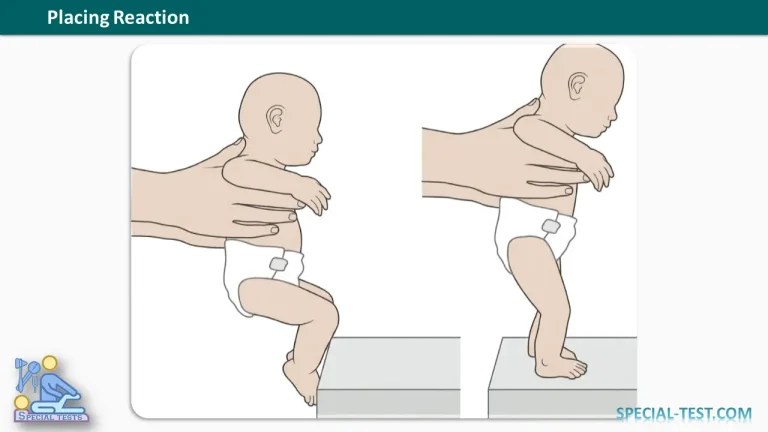
The placing reaction is a primitive neurological response assessed during the examination of newborns and infants. It evaluates the infant’s ability to respond to tactile stimulation of the limbs by making an appropriate movement to place the foot or hand on a supporting surface. This response is useful as part of a comprehensive neurological examination, particularly when assessing early motor development and the integrity of sensorimotor pathways.
The placing reaction is examined separately in the upper and lower limbs. During testing, the examiner gently brings the infant’s foot or the back of the forearm into contact with the edge of an examination table. A typical response involves flexion of the appropriate limb, followed by placement of the foot or hand onto the surface.
Assessment of the placing reaction should be interpreted alongside other primitive reflexes, postural responses, spontaneous movements, muscle tone, and developmental milestones. An absent, asymmetric, or unusually persistent response may warrant further evaluation, but no single finding is sufficient to establish a neurological diagnosis.
What Is the Placing Reaction Used For?
The placing reaction is used as part of the neurological examination of newborns and infants to assess early sensorimotor function and the organization of motor responses.
Its principal clinical applications include:
- Neurological assessment: Evaluating responses to tactile stimulation of the upper and lower limbs.
- Assessment of early motor development: Observing the infant’s ability to produce an organized limb movement in response to contact with a surface.
- Detection of asymmetry: Comparing the responses of the right and left limbs for differences in movement or responsiveness.
- Evaluation of suspected neurological dysfunction: Identifying findings that, when considered with the rest of the examination, may suggest a need for further investigation.
- Monitoring neurological development: Documenting changes in primitive responses as the infant matures.
The placing reaction is not a standalone diagnostic test. Its clinical value depends on the infant’s age, alertness, general condition, and the findings of the complete neurological examination.
How to Perform the Placing Reaction Test
The placing reaction is tested separately in the lower and upper limbs. The infant should be handled gently and securely supported throughout the examination.
1. Lower Limb Placing Reaction
Patient position: Hold the infant upright in a vertical suspension position, facing away from the examiner. Support the infant securely beneath the axillae, with the examiner’s thumbs providing appropriate support to the back of the head.
Procedure:
- Ensure that the infant is securely supported and that the lower limbs can move freely.
- Bring the anterior aspect of the distal tibia or the dorsum of one foot gently against the edge of the examination table.
- Observe the infant’s response to this contact.
- A typical placing response consists of flexion at the hip and knee, accompanied by dorsiflexion of the ankle as the foot is brought toward the table.
- When the sole contacts the table, the infant may extend the lower limb and place the foot onto the supporting surface.
- Repeat the procedure on the opposite side to compare the responses.
Normal response: The infant responds to contact with the table edge by flexing the lower limb and placing the foot onto the surface. The response should be assessed on both sides.
Clinical interpretation: An absent or asymmetric response may be associated with neurological or motor dysfunction, but it can also be influenced by the infant’s state, technique, and other clinical factors. The finding should therefore be interpreted in conjunction with the remainder of the examination.
2. Upper Limb Placing Reaction
Patient position: Hold the infant securely around the waist, with the infant facing away from the examiner. Ensure that the upper limbs are free to move.
Procedure:
- Support the infant in an upright position without restricting movement of the arms.
- Gently bring the dorsum of the forearm, near the ulna, against the edge of the examination table.
- Observe the response of the elbow and hand.
- A typical response involves flexion of the elbow, followed by placement of the hand onto the table.
- Repeat the maneuver on the opposite upper limb and compare the responses.
Normal response: The infant flexes the elbow and brings the hand onto the supporting surface following appropriate tactile contact.
Clinical interpretation: Differences between the two arms, a consistently absent response, or an unexpected movement pattern may warrant further neurological assessment. In older infants and children, voluntary movements can resemble the placing reaction, making careful interpretation essential.
What Is a Positive Placing Reaction?
A positive placing reaction refers to the expected limb movement elicited by the test.
- Lower limb: The infant flexes the hip and knee, dorsiflexes the ankle as appropriate, and places the foot onto the examination table.
- Upper limb: The infant flexes the elbow and places the hand onto the table.
The response should be distinguished from spontaneous or intentional movement, particularly in older infants.
Normal Age and Developmental Significance
The placing reaction is described in traditional infant neurological examinations as being present at birth in healthy full-term newborns. Its expression and disappearance vary with the limb tested and the infant’s neurological maturation.
The commonly cited age ranges are:
- Upper limb placing: Usually diminishes or disappears by approximately 2–4 months of age.
- Lower limb placing: Usually diminishes or disappears by approximately 1–2 months of age.
Some clinical descriptions report that these responses may persist beyond these periods, occasionally up to 12 months or longer. Such persistence should not automatically be considered abnormal; the precise response, examination technique, and developmental context matter.
These age ranges are approximate rather than definitive diagnostic cutoffs. The placing reaction should not be confused with the stepping reflex, the plantar grasp reflex, or later voluntary reaching and standing behaviors.
What Does an Absent Placing Reaction Mean?
An absent placing reaction in a newborn may indicate neurological dysfunction, particularly when accompanied by abnormal muscle tone, reduced spontaneous movement, or other abnormal primitive reflexes. However, absence alone does not confirm a neurological disorder.
Possible factors associated with an abnormal response include:
- Neurological impairment affecting sensory input or motor output.
- Peripheral nerve or limb dysfunction that limits the expected movement.
- Differences in gestational age and neurological maturity, especially in preterm infants.
- Reduced alertness, illness, or an unsuitable examination technique.
An asymmetric response may be particularly important because it can indicate a difference in motor function between the two limbs. The clinician should repeat the maneuver carefully, assess spontaneous movements, and perform a complete neurological examination before determining whether further investigation is required.
Clinical Tips for Accurate Assessment
To improve the reliability of the placing reaction test:
- Ensure that the infant is securely supported throughout the maneuver.
- Use gentle contact with the examination table rather than forceful stimulation.
- Allow the infant’s limbs to move freely.
- Test both sides independently and document any asymmetry.
- Consider the infant’s gestational age, chronological age, alertness, and general clinical condition.
- Interpret the response together with other primitive reflexes, muscle tone, posture, and spontaneous movements.
Important: If the placing reaction is absent or asymmetric, particularly when other neurological abnormalities are present, arrange an appropriate clinical assessment. The finding should not be used in isolation to diagnose cerebral palsy, peripheral nerve injury, or another neurological disorder.
Placing Reaction vs. Other Infant Reflexes
The placing reaction is one of several responses evaluated during the neurological examination of infants. It is useful to distinguish it from other movements that may appear similar.
| Response | Main characteristic |
|---|---|
| Placing reaction | Limb flexion and placement of the foot or hand onto a surface after contact |
| Stepping reflex | Alternating stepping-like movements when an infant is supported upright with the feet contacting a surface |
| Plantar grasp reflex | Flexion of the toes following stimulation of the plantar surface |
| Moro reflex | A characteristic startle response involving arm abduction and extension, followed by adduction and flexion |
| Voluntary reaching | Purposeful movement of the arm toward a desired object as motor development progresses |
Correct identification of these responses helps clinicians document neurological findings more accurately and assess infant development in context.
Frequently Asked Questions (FAQ)
1. What is the placing reaction in newborns?
The placing reaction is a neurological response in which an infant moves a foot or hand onto a supporting surface after the limb is brought into contact with the edge of an examination table.
2. How do you test the lower limb placing reaction?
Support the infant upright beneath the axillae, facing away from the examiner. Gently bring the anterior distal tibia or dorsum of the foot against the table edge and observe whether the infant flexes the hip and knee and places the foot on the surface. Repeat on the opposite side.
3. How do you test the upper limb placing reaction?
Hold the infant securely around the waist while facing away from the examiner. Gently bring the dorsum of the forearm near the ulna against the table edge. A typical response is elbow flexion followed by placement of the hand onto the table.
4. When does the placing reaction disappear?
The upper limb placing reaction commonly diminishes by approximately 2–4 months, while the lower limb response commonly diminishes by approximately 1–2 months. These are approximate ranges, and persistence must be interpreted in the context of the overall neurological examination.
5. What does an absent placing reaction indicate?
An absent response may suggest neurological or sensorimotor dysfunction, but it is not diagnostic by itself. The clinician should consider age, gestational maturity, examination technique, spontaneous movement, muscle tone, and other neurological findings.
6. Is the placing reaction present at birth?
It is traditionally described as present at birth in healthy full-term newborns. However, the response may vary, and an absent response requires interpretation alongside other examination findings.
7. What is the difference between the placing reaction and the stepping reflex?
The placing reaction involves bringing a foot or hand onto a surface following contact with its edge. The stepping reflex consists of alternating stepping-like movements when the supported infant’s feet contact a surface.
8. Can the placing reaction diagnose cerebral palsy?
No. An absent, asymmetric, or persistent placing reaction cannot independently diagnose cerebral palsy. Diagnosis requires a comprehensive assessment of motor development, neurological signs, clinical history, and other relevant investigations.
9. Why should both sides be tested?
Testing both sides helps identify asymmetry in the infant’s motor responses. A consistent difference between the limbs may warrant further evaluation, especially when accompanied by abnormal tone or reduced spontaneous movement.
10. Is the placing reaction a primitive reflex?
The placing reaction is commonly included in traditional neonatal neurological examinations alongside primitive reflexes and early postural responses. Its exact classification may vary among examination frameworks, so it is best documented by describing the observed response rather than relying exclusively on its label.