Vertical Suspension Positioning: Purpose, Procedure, and Positive Findings
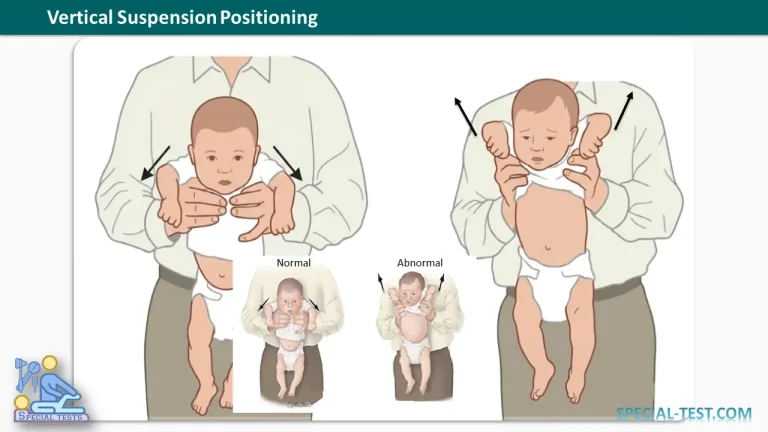
The Vertical Suspension Positioning Test is a clinical neurological examination technique used to assess an infant’s lower-limb posture, muscle tone, and motor responses when held upright. It is particularly useful during the neurological examination of infants when there is concern about abnormal muscle tone or an early motor disorder, such as cerebral palsy.
During this examination, the clinician observes the infant’s head position, hip and knee flexion, and the alignment of the lower extremities. Abnormal findings, especially persistent extension and crossed adduction of the legs (scissoring), may suggest increased muscle tone associated with spastic diplegia or spastic paraplegia.
The response must be interpreted in the context of the infant’s age, developmental stage, and other neurological findings. This positioning test alone cannot establish a definitive diagnosis.
What Is the Vertical Suspension Positioning Test Used For?
The Vertical Suspension Positioning Test is used to evaluate an infant’s postural control and lower-extremity muscle tone during supported upright positioning.
Its main clinical purposes include:
- Assessing lower-limb muscle tone: Identifying abnormal extension, excessive adduction, or resistance to passive movement.
- Screening for neurological abnormalities: Recognizing postural responses that may indicate an underlying central nervous system disorder.
- Identifying possible spasticity: Observing persistent extension and crossing of the legs, which may be associated with spastic motor patterns.
- Supporting early developmental assessment: Contributing to the broader neurological examination when an infant has abnormal spontaneous movements or delayed motor development.
The test is particularly relevant when evaluating infants for possible upper motor neuron dysfunction. However, abnormal findings should be assessed alongside other neurological signs, including deep tendon reflexes, spontaneous movement patterns, primitive reflexes, and age-appropriate motor milestones.
How to Perform the Vertical Suspension Positioning Test
The Vertical Suspension Positioning Test is performed by supporting the infant upright and observing the natural position of the head and lower extremities.
Step-by-Step Examination Technique
- Position the infant upright. Hold the infant vertically, facing away from the examiner, in a comfortable and stable position.
- Provide support under the axillae. Place both hands beneath the infant’s armpits, supporting the trunk securely without compressing the chest or neck.
- Observe the head position. Assess whether the infant maintains the head near the midline or demonstrates abnormal head positioning.
- Examine the lower extremities. Observe the position of the hips, knees, and legs. In the expected response described for this examination, the infant flexes the hips and knees.
- Look for abnormal extension or adduction. Note whether the legs remain rigidly extended, move into excessive adduction, or cross over one another in a scissoring pattern.
- Interpret the findings in context. Consider the infant’s age, overall muscle tone, spontaneous movements, and results of the remainder of the neurological examination.
The infant should be handled gently throughout the assessment. The examiner should avoid forcing the legs into a particular position or interpreting a brief movement as a persistent abnormal response.
What Is the Normal Response?
A normal response during Vertical Suspension Positioning is characterized by an appropriate, non-rigid posture of the lower extremities.
Expected findings include:
- The head is maintained near the midline, depending on the infant’s developmental maturity.
- The hips and knees assume a flexed position.
- The lower extremities do not demonstrate persistent, rigid extension with crossed adduction.
- The infant’s posture and movements are not dominated by excessive muscle stiffness.
The response varies with age and neurological maturity. Therefore, the examiner should interpret the findings according to the infant’s developmental stage rather than relying on a single expected posture.
What Is a Positive Vertical Suspension Positioning Test?
A positive or abnormal response is characterized by persistent extension and adduction of the lower extremities, resulting in a scissoring posture.
Important abnormal findings include:
- Fixed extension of the legs: The hips and knees remain extended rather than assuming the expected flexed posture.
- Excessive hip adduction: The thighs move toward or across the midline.
- Scissoring of the lower extremities: One leg crosses over the other because of excessive adductor activity.
- Increased muscle tone: The lower limbs appear stiff or demonstrate resistance to movement.
These findings may suggest a spastic motor pattern associated with upper motor neuron dysfunction. In an infant, persistent lower-limb extension and scissoring can raise suspicion of spastic diplegic cerebral palsy or another neurological disorder affecting the lower extremities.
Research on infant neurological examination has investigated vertical suspension as a standardized assessment of lower-limb posture and movement. However, the findings must be interpreted alongside other clinical indicators rather than treated as an independent diagnostic test. 1,2
At What Age Does the Vertical Suspension Response Disappear?
The traditional description of this examination states that the characteristic infantile response normally disappears after approximately 4 months of age.
This age should be treated as a clinical reference rather than an absolute developmental cutoff. Postural responses change as the nervous system matures, and their interpretation depends on the particular examination protocol used.
Persistent abnormal posturing beyond the expected developmental period, especially when accompanied by hypertonia, abnormal reflexes, or delayed motor milestones, warrants further neurological assessment.
Clinical Significance and Limitations
The Vertical Suspension Positioning Test is a screening component of the infant neurological examination. It may help clinicians recognize abnormal lower-extremity tone, but it cannot confirm cerebral palsy or determine its cause on its own.
When scissoring or persistent extension is observed, further assessment may include:
- Evaluation of passive muscle tone and resistance to movement.
- Assessment of deep tendon reflexes and other signs of upper motor neuron dysfunction.
- Observation of spontaneous movements and postural control.
- Review of developmental milestones and perinatal history.
- Standardized neurological assessment, such as the Hammersmith Infant Neurological Examination (HINE), when appropriate.
The HINE incorporates several neurological examination items and has been studied for identifying infants at risk of cerebral palsy. It provides a broader assessment than any single positioning maneuver. 2,3
Atypical findings should prompt consideration of the infant’s overall clinical presentation and, when indicated, referral to a pediatric neurologist or developmental specialist.
Frequently Asked Questions (FAQ)
1. What is the Vertical Suspension Positioning Test used for?
It is used to assess an infant’s postural responses, lower-limb positioning, and muscle tone during supported upright suspension. Abnormal extension and scissoring may indicate a neurological motor abnormality.
2. What is the normal response to Vertical Suspension Positioning?
The expected response described in this examination includes maintaining the head near the midline and flexing the hips and knees without persistent, rigid extension or scissoring of the legs.
3. What does a positive Vertical Suspension Positioning Test indicate?
Persistent extension and crossed adduction of the legs may indicate increased lower-extremity muscle tone associated with spasticity. This finding can raise suspicion of spastic diplegia or another central nervous system disorder but is not diagnostic by itself.
4. What is the scissoring response in infants?
Scissoring refers to the crossing of the lower extremities caused by excessive hip adduction, often accompanied by increased muscle tone and extension. It may occur in infants with spastic motor disorders.
5. At what age should the Vertical Suspension response disappear?
Traditional descriptions place the disappearance of the characteristic response at approximately 4 months of age. Interpretation should account for developmental variability and the specific neurological examination protocol.
6. Can this test diagnose cerebral palsy?
No. The test can identify concerning postural patterns, but cerebral palsy diagnosis requires a comprehensive assessment of neurological findings, motor development, clinical history, and other relevant investigations.
References
- Dey P, Dogra DP, Roy PP, Bhaskar H. Autonomous vision-guided approach for the analysis and grading of vertical suspension tests during Hammersmith Infant Neurological Examination (HINE). 2016 IEEE Engineering in Medicine and Biology Society Conference. PubMed
- Neurological assessment tool for screening infants during the first year after birth: The Brief-Hammersmith Infant Neurological Examination. PubMed Central
- Feldkamp M, Abbink F, Güth V. Electromyographic study of movements in infants with cerebral palsy. Zeitschrift für Orthopädie und ihre Grenzgebiete. 1976. PubMed
- Yokochi K, et al. Leg movements in the supine position of infants with spastic diplegia. Developmental Medicine & Child Neurology. 1991;33(10):903–907. PubMed