Leg-Straightening Reflex: Definition, How to Perform, Positive Response & Clinical Significance
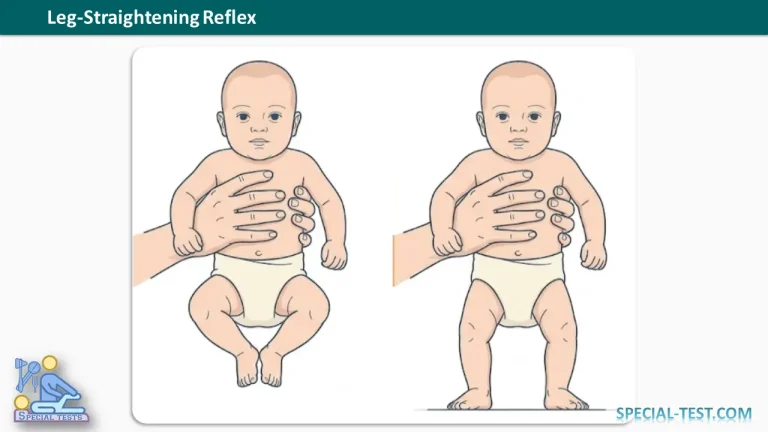
The leg-straightening reflex, also known as the positive support reflex or positive supporting reaction, is a primitive postural response assessed during the neurological examination of infants. It is characterized by extension of the lower limbs when the soles of the feet come into contact with a firm supporting surface while the infant is held upright.
This reflex is part of the assessment of early motor development and neuromuscular function. Examining it helps clinicians evaluate an infant’s ability to respond to weight-bearing stimulation and maintain an extended posture through the legs and trunk.
The positive support reflex is normally present during early infancy and gradually becomes less prominent as the nervous system matures and voluntary motor control develops. Its interpretation should consider the infant’s age, overall neurological findings, muscle tone, and other primitive reflexes. Abnormal persistence or an atypical response may warrant further developmental assessment.
What Is the Leg-Straightening Reflex Used For?
The leg-straightening reflex is used primarily to assess early postural responses, lower-limb extension, and neurological maturation in infants. It demonstrates how the infant’s nervous system responds to contact between the feet and a supporting surface.
The main clinical purposes of assessing this reflex include:
- Neurological examination: Evaluating the infant’s automatic motor responses during a pediatric neurological assessment.
- Assessment of lower-limb extension: Observing whether contact with a firm surface produces an extension response in the hips, knees, and ankles.
- Early motor development: Assessing the development of postural reactions that precede more mature weight-bearing and locomotor abilities.
- Identification of abnormal responses: Recognizing absent, asymmetric, exaggerated, or unusually persistent responses that may require additional neurological evaluation.
Primitive reflexes and postural reactions change as the infant’s nervous system develops. Research on infant reflex development demonstrates that these responses follow an age-related pattern of maturation and can provide useful information when interpreted alongside other neurological findings [1,2].
At What Age Is the Leg-Straightening Reflex Present?
The positive support response is typically observed during the neonatal period and early infancy. In traditional descriptions of the leg-straightening reflex, it gradually diminishes at approximately 4 months of age.
However, the precise developmental timeline can vary according to the definition of the response and the examination method used. The positive support reaction should also be distinguished from the stepping reflex, which produces alternating stepping movements when an infant is held upright with the feet touching a supporting surface.
The stepping reflex generally becomes less apparent by approximately 2–3 months of age, whereas the positive support response involves predominantly extension of the lower limbs rather than alternating steps [3].
These responses should not be considered interchangeable because they represent different observable motor patterns.
How to Perform the Leg-Straightening Reflex Test
The leg-straightening reflex is assessed by observing the infant’s response to contact between the soles of the feet and a firm surface.
Patient position: Hold the infant upright with the head and trunk supported.
Examination technique:
- Position the infant vertically, facing the examination table or another firm, flat supporting surface.
- Support the infant securely beneath the axillae and around the chest and trunk.
- Lower the infant gently until the soles of both feet make contact with the supporting surface.
- Apply gentle, controlled contact through the feet, allowing the infant to respond naturally.
- Observe the hips, knees, ankles, and trunk for an extension response.
- Assess whether the response is present on both sides and whether the lower limbs extend symmetrically.
The examiner must maintain adequate support throughout the examination. The infant should never be left unsupported or forced to bear full body weight. This is a neurological examination maneuver, not a test of whether the infant is ready to stand.
What Is a Positive Leg-Straightening Reflex?
A positive leg-straightening reflex is characterized by extension of the lower limbs in response to plantar contact with the supporting surface.
The expected response may include:
- Extension of the hips and knees.
- Extension or stabilization of the ankles and feet against the surface.
- Increased extension of the trunk.
- A relatively rigid, supporting posture of the lower limbs.
During the response, the legs may appear to act as supporting pillars. This describes the observable motor response rather than indicating that the infant has achieved independent standing or mature postural control.
The response should be documented according to its presence, strength, symmetry, and relationship to the infant’s age and overall neurological examination.
What Does an Abnormal Leg-Straightening Reflex Mean?
An abnormal response should be interpreted in the context of the complete infant neurological examination. Neither the presence nor the absence of this response alone establishes a neurological diagnosis.
An absent or reduced response may occur for several reasons, including the infant’s behavioral state, examination technique, prematurity, reduced muscle tone, or neurological dysfunction.
An asymmetric response may indicate a difference in motor function between the two lower limbs and should prompt assessment of muscle tone, spontaneous movement, joint mobility, and other neurological findings.
An unusually strong or persistent response may warrant closer assessment when accompanied by abnormal muscle tone, delayed motor milestones, persistent primitive reflexes, or other concerning neurological signs.
Studies of primitive reflex profiles have demonstrated that age-related reflex patterns can differ between neurologically typical infants and infants with neurological disorders [1]. Nevertheless, these findings should not be used to diagnose cerebral palsy or another condition from a single reflex test.
Why Does the Leg-Straightening Reflex Disappear?
Primitive motor responses become modified as the central nervous system matures. During early infancy, many movements are predominantly automatic. With neurological development, increasingly complex postural adjustments and voluntary motor control emerge.
The gradual reduction of primitive reflex responses is part of this developmental process. The infant progressively develops more coordinated movement, better postural control, and the ability to adapt limb position to changing demands.
It is important to distinguish the disappearance of a primitive reflex from the disappearance of the underlying ability to extend the legs. Normal maturation does not mean that lower-limb extension stops; rather, motor control becomes more sophisticated and less dependent on an obligatory primitive response.
Clinical Importance of Persistent Leg Extension
Persistent or obligatory extension may interfere with the development of more flexible movement patterns when it occurs as part of an abnormal neurological presentation. In particular, an infant who demonstrates persistent stiffness, limited reciprocal leg movements, asymmetry, or delayed motor development should receive a comprehensive developmental and neurological assessment.
The absence of alternating leg movements should not automatically be attributed to persistence of this reflex. Reciprocal movement depends on multiple neural and musculoskeletal mechanisms, and an infant’s overall development must be considered.
Clinicians should evaluate the infant’s spontaneous movements, muscle tone, postural responses, primitive reflexes, and developmental milestones. If abnormalities are identified, appropriate pediatric or pediatric neurological assessment may help determine whether further investigation or early intervention is needed.
The positive support reflex is therefore best regarded as one component of a broader neurological examination, rather than an isolated diagnostic test.
Frequently Asked Questions (FAQs)
1. What is the leg-straightening reflex?
The leg-straightening reflex is an early infant postural response in which the lower limbs extend when the soles of the feet contact a firm supporting surface while the infant is held upright. It is also called the positive support reflex or positive supporting reaction.
2. When does the leg-straightening reflex disappear?
Traditional descriptions indicate that the response diminishes at approximately 4 months of age. The exact timeline depends on how the response is defined and assessed. Its development should be interpreted alongside other age-appropriate neurological findings.
3. How is the positive support reflex elicited?
The examiner holds the infant upright, supporting the trunk beneath the axillae and around the chest. The soles of the feet are then brought gently into contact with a firm surface, and the examiner observes for extension of the lower limbs and trunk.
4. What is a positive result of the leg-straightening reflex test?
A positive response consists of extension of the hips and knees, with the lower limbs adopting a supporting posture. Trunk extension may also be observed. The response does not indicate that the infant can stand independently.
5. Is the positive support reflex the same as the stepping reflex?
No. The positive support reflex is characterized mainly by lower-limb extension following contact with a supporting surface. The stepping reflex produces alternating stepping movements when the infant is held upright and the feet contact the surface. These are distinct responses and should be documented separately.
6. What does a persistent leg-straightening reflex indicate?
Persistence may warrant further evaluation if accompanied by abnormal muscle tone, stiffness, reduced reciprocal movements, asymmetry, or delayed motor milestones. However, persistence alone does not establish a diagnosis of cerebral palsy or another neurological disorder.
7. Can the leg-straightening reflex diagnose cerebral palsy?
No. The reflex is one component of an infant neurological examination. Cerebral palsy assessment requires consideration of the child’s developmental history, motor function, neurological examination, and other appropriate investigations. A single reflex finding is insufficient for diagnosis.
8. Why is the positive support reflex important in pediatric examination?
It helps clinicians observe early postural responses and lower-limb extension during infancy. When combined with assessment of muscle tone, spontaneous movement, primitive reflexes, and developmental milestones, it can contribute to the overall evaluation of neurological maturation.
References
- Futagi Y, Tagawa T, Otani K. Primitive reflex profiles in infants: differences based on categories of neurological abnormality. Brain Dev. 1992;14(5):294–298. PubMed
- Allen MC, Capute AJ. Tone and reflex development before term. Pediatrics. 1990;85(3 Pt 2):393–399. PubMed
- National Library of Medicine. Primitive Reflexes: Comprehensive Neurological Assessment Across the Lifespan. StatPearls. NCBI Bookshelf
- MedlinePlus. Infant reflexes. U.S. National Library of Medicine. Medical reference
- Orthofixar. Medical education resource for orthopedic and clinical examination topics. Orthofixar.com