Extensor Thrust Reflex: Definition, Procedure, Positive Findings, and Clinical Significance
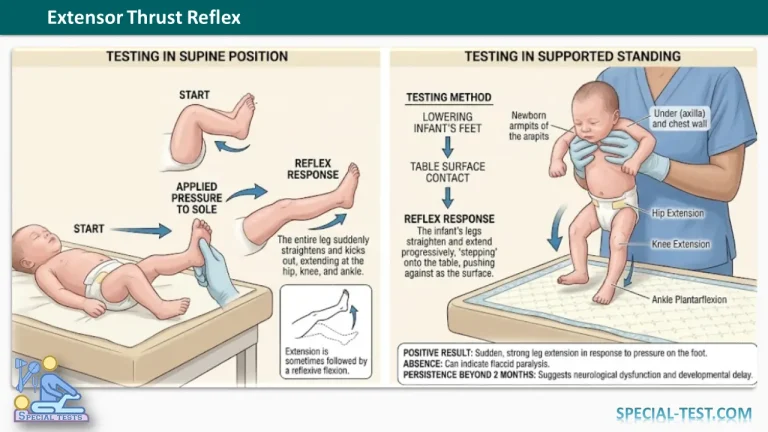
The extensor thrust reflex is a primitive neurological reflex assessed during the neurological examination of newborns and young infants. It is elicited by applying pressure to the sole of the foot, producing a sudden extension of the lower limb. This reflex provides information about early motor responses and may contribute to the assessment of neurological function during infancy.
The extensor thrust reflex is traditionally described as being present at birth and normally disappearing by approximately 2 months of age. An absent response in a newborn may raise concern for impaired motor function, including flaccid paralysis, while persistence beyond the expected age may warrant further evaluation for neurological dysfunction or delayed central nervous system (CNS) maturation.
Primitive reflexes are important components of the neonatal neurological examination. Their presence, strength, symmetry, and evolution with age help clinicians assess early neurological development. However, an individual reflex should never be interpreted in isolation; findings must be considered alongside muscle tone, spontaneous movements, developmental milestones, and other neurological signs.
What Is the Extensor Thrust Reflex Used For?
The extensor thrust reflex is used as part of the neurological examination of newborns and young infants to assess reflex motor responses of the lower extremities.
Its clinical applications include:
- Assessment of early neurological function: The response provides information about the infant’s ability to generate a reflex extension of the lower limb following plantar stimulation.
- Evaluation of motor impairment: An absent or markedly reduced response may prompt assessment for weakness, abnormal muscle tone, peripheral motor dysfunction, or other neurological abnormalities.
- Screening for developmental abnormalities: Persistence of the reflex beyond the expected age may indicate delayed maturation or dysfunction of the CNS, particularly when accompanied by abnormal tone, delayed milestones, or other persistent primitive reflexes.
- Contribution to the neonatal neurological examination: The reflex can be assessed alongside other primitive reflexes and observations of posture, spontaneous movement, and limb symmetry.
Research on primitive reflex profiles has demonstrated that the persistence and developmental patterns of certain reflexes can help distinguish infants with typical neurological development from those at increased risk of neurological abnormalities. Nevertheless, the extensor thrust reflex alone cannot establish a diagnosis of cerebral palsy or another neurological disorder.
How to Perform the Extensor Thrust Reflex Test
The extensor thrust reflex can be elicited using two commonly described examination techniques.
Method 1: Plantar Stimulation With the Lower Limb Flexed
- Position the infant comfortably and support the lower extremity.
- Place the hip and knee in a flexed position.
- Apply gentle, controlled pressure to the plantar surface of the infant’s foot.
- Observe the response of the entire lower limb.
- Note whether the stimulus produces a sudden extension of the leg and whether this is followed by flexion.
Normal response: The infant suddenly extends the lower limb following pressure on the sole. This extension may be followed by a flexion movement.
Method 2: Lowering the Feet Toward the Examination Table
- Hold the infant securely around the chest wall and axillae, providing adequate support for the head and trunk.
- Position the infant upright while maintaining a secure grip.
- Slowly lower the infant until the soles of the feet contact the examination table.
- Observe the lower extremities as the feet are brought into contact with the supporting surface.
- Assess whether pressure on the soles produces progressive extension of the legs, beginning distally at the feet and extending proximally.
Normal response: Contact between the soles and the examination table produces progressive extension of the lower extremities from the feet proximally.
The examiner should support the infant securely throughout the maneuver and avoid forceful pressure or sudden movements. The response should be interpreted in the context of the infant’s age, alertness, gestational history, and overall neurological examination.
What Is a Positive Extensor Thrust Reflex Result?
Interpretation depends on the infant’s age and the presence or absence of the expected response.
Normal Response
A normal response consists of sudden extension of the lower limb after plantar pressure. During the supported standing-position maneuver, progressive extension may occur as the soles contact the examination table.
The reflex is traditionally considered physiological during the neonatal period and early infancy, with expected disappearance by approximately 2 months of age.
Absent Extensor Thrust Reflex
An absent response in a newborn may be associated with impaired motor function, including flaccid paralysis. Other possible explanations include reduced muscle tone, significant weakness, neurological injury, prematurity-related differences in neurological maturation, or limitations in the examination technique.
Absence of the reflex does not independently confirm flaccid paralysis. The clinician should assess spontaneous limb movements, muscle tone, strength, symmetry, and other primitive reflexes to determine whether further investigation is necessary.
Persistent Extensor Thrust Reflex
Persistence beyond approximately 2 months of age is traditionally regarded as an abnormal finding that may suggest delayed neurological maturation or CNS dysfunction.
The significance of this finding increases when it occurs alongside other abnormalities, such as:
- Persistent primitive reflexes that should have disappeared.
- Abnormal muscle tone, including marked hypotonia or hypertonia.
- Asymmetrical spontaneous movements.
- Delayed acquisition of developmental milestones.
- Abnormal posturing or other neurological signs.
Persistent primitive reflexes have been investigated as potential indicators of neurological abnormalities in infancy, including cerebral palsy. However, the diagnostic value depends on the specific reflex, the infant’s age, and the overall clinical picture.
Clinical Significance of the Extensor Thrust Reflex
The extensor thrust reflex is one component of the broader neurological assessment used to evaluate early motor development. During infancy, the nervous system undergoes substantial maturation, with progressive changes in muscle tone, reflex activity, and voluntary motor control.
Primitive reflexes are useful because their responses change as the nervous system develops. An unexpected absence, persistence, or asymmetry may therefore alert the clinician to the need for a more detailed examination.
When an abnormal extensor thrust reflex is identified, assessment should include a review of pregnancy and birth history, gestational age, neonatal complications, muscle tone, spontaneous movements, developmental progress, and other primitive reflexes. Depending on the findings, further evaluation by a pediatrician or pediatric neurologist may be appropriate.
Importantly, the disappearance of this reflex by 2 months is a traditional clinical teaching point rather than a stand-alone diagnostic threshold. Normal neurological development should be assessed using age-appropriate standards and the complete clinical examination.
Frequently Asked Questions (FAQ)
1. What is the normal age for disappearance of the extensor thrust reflex?
The extensor thrust reflex is traditionally described as present at birth and disappearing by approximately 2 months of age. The finding should be interpreted in relation to the infant’s overall neurological development.
2. How is the extensor thrust reflex elicited?
Apply gentle pressure to the sole of the infant’s foot while the lower limb is flexed. A sudden extension of the entire leg is the expected response. Alternatively, the infant can be supported upright and the feet gently brought into contact with the examination table.
3. What does an absent extensor thrust reflex indicate?
An absent response may suggest impaired motor function, including flaccid paralysis, but it is not diagnostic by itself. Muscle tone, spontaneous movements, gestational age, and other neurological findings should also be assessed.
4. What does persistence of the extensor thrust reflex beyond 2 months mean?
Persistence beyond the traditionally expected age may indicate delayed neurological maturation or CNS dysfunction. Further assessment is particularly important when other abnormal reflexes, altered muscle tone, asymmetry, or developmental delays are present.
5. Is the extensor thrust reflex diagnostic of cerebral palsy?
No. An abnormal extensor thrust reflex alone cannot diagnose cerebral palsy. Diagnosis requires a comprehensive assessment of neurological findings, motor development, clinical history, and other relevant investigations.
6. What is the difference between the extensor thrust reflex and the stepping reflex?
The extensor thrust reflex is characterized by extension of the lower limb following pressure on the sole. The stepping reflex involves alternating stepping-like movements when an appropriately supported infant is held upright with the feet contacting a supporting surface. They are distinct responses assessed during the infant’s neurological examination.
References
- Futagi Y, Tagawa T, Otani K. Primitive reflex profiles in infants: differences based on categories of neurological abnormality. Brain and Development. 1992;14(5):294–298. PubMed
- Zafeiriou DI, Tsikoulas IG, Kremenopoulos GM. Prospective follow-up of primitive reflex profiles in high-risk infants: clues to an early diagnosis of cerebral palsy. Pediatric Neurology. 1995;13(2):148–152. PubMed
- Blasco PA. Primitive reflexes: their contribution to the early detection of cerebral palsy. Clinical Pediatrics. 1994;33(7):388–397. PubMed
- Chamarthi VS, Gunasekaran V, Daley SF. Primitive Reflexes: Comprehensive Neurological Assessment Across the Lifespan. StatPearls. Updated 2026. NCBI Bookshelf