Crossed Extension Reflex (Philippson Reflex): Examination, Clinical Significance, and Interpretation
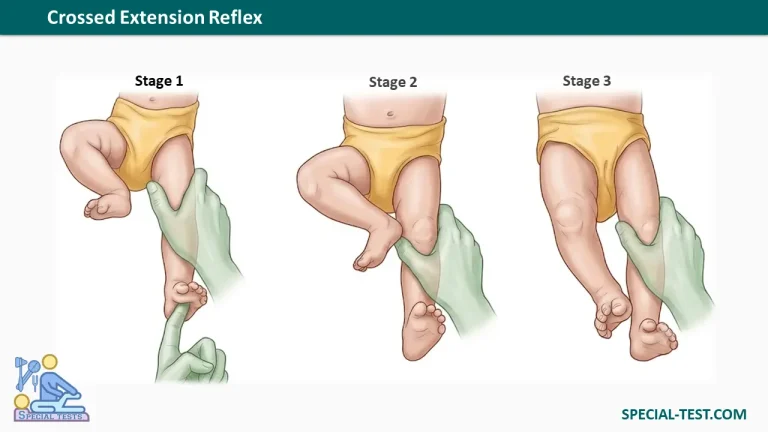
The crossed extension reflex, also known as the Philippson reflex, is a primitive neonatal reflex assessed during the neurological examination of newborns and young infants. It is a polysynaptic spinal reflex that demonstrates the interaction between sensory stimulation and coordinated motor responses in both lower limbs. This reflex is particularly useful when evaluating neonatal spinal reflex activity and the early development of the nervous system.
The crossed extension reflex is normally present at birth and typically becomes less prominent or disappears during the first 1–2 months of life. Its interpretation depends on the infant’s age, neurological status, and the findings of the rest of the examination. An absent reflex or a response that persists beyond the expected developmental period may warrant further assessment, but neither finding alone establishes a specific neurological diagnosis.
What Is the Crossed Extension Reflex Used For?
The crossed extension reflex is primarily used to assess primitive reflex activity and spinal motor responses in newborns. It involves a coordinated response in which stimulation of one lower limb produces a withdrawal response in that limb and an extension response in the opposite lower limb.
Clinical uses of the crossed extension reflex include:
- Neonatal neurological examination: Evaluating the integrity of primitive reflex pathways and spinally mediated motor responses.
- Assessment of lower-limb motor function: Observing whether sensory stimulation produces an appropriate response in both legs.
- Evaluation of possible neurological abnormalities: Identifying findings that may warrant further investigation when interpreted alongside muscle tone, spontaneous movements, deep tendon reflexes, and other primitive reflexes.
- Assessment of reflex maturation: Determining whether primitive reflex responses are consistent with the infant’s developmental age.
The crossed extension reflex is not a stand-alone diagnostic test for spinal cord injury or neurological disease. Clinical interpretation requires consideration of the infant’s gestational age, level of alertness, medical history, and associated examination findings.
Normal Age of the Crossed Extension Reflex
The crossed extension reflex is generally elicitable in newborns and normally diminishes or disappears by approximately 1–2 months of age. The exact timing may vary between infants, and reflex responses should be interpreted in the context of overall neurological development.
An absent response at birth may occur for several reasons, including reduced alertness, prematurity, differences in examination technique, or neurological or neuromuscular abnormalities. Severe motor impairment, including flaccid paralysis, is one possible concern when the reflex is absent alongside other abnormal findings, but absence alone does not establish paralysis.
Persistence beyond approximately 2 months may be associated with delayed neurological maturation or neurological dysfunction. A spinal cord lesion is one possible consideration when supported by other findings, but persistence of this reflex alone does not reliably diagnose a partial or incomplete spinal lesion.
How to Perform the Crossed Extension Reflex Test
The crossed extension reflex is examined with the infant lying supine. The examiner applies a controlled sensory stimulus to the sole of one foot while observing the responses of both lower limbs.
Patient Position
- Place the infant in the supine position on a firm, safe examination surface.
- Position the lower limbs near the midline, with the hips and knees extended as comfortably as possible.
- Ensure that the infant is sufficiently settled to permit observation of spontaneous and stimulus-evoked movements.
- Observe the resting posture, spontaneous leg movements, and baseline muscle tone before eliciting the reflex.
Examination Technique
- Gently maintain one lower limb in extension at the knee without applying excessive force.
- Apply firm but controlled pressure or stroke the plantar surface of the foot of the stabilized limb.
- Observe the stimulated limb for a withdrawal or flexion response.
- Carefully observe the opposite lower limb for an initial flexion and abduction movement followed by adduction and extension.
- Note any associated toe movements, including possible fanning of the toes.
- If necessary, repeat the examination on the opposite side, allowing the infant to settle between stimuli.
The stimulus should be sufficient to elicit a response but should not cause injury or unnecessary distress. Excessively vigorous stimulation may produce generalized movements that make interpretation difficult.
Alternative Elicitation in Neonates
A similar crossed extension response may sometimes be elicited in neonates by applying firm pressure to the inguinal region. This can produce flexion of the ipsilateral lower limb and extension of the contralateral hip and knee.
This alternative observation should be interpreted cautiously and is not a substitute for a standardized neurological examination. The plantar stimulus remains the conventional method described for eliciting the crossed extension reflex.
What Is a Positive Crossed Extension Reflex?
A positive crossed extension reflex is characterized by a coordinated motor response involving both lower limbs after stimulation of the sole of one foot.
The typical response includes the following components:
- Ipsilateral response: The stimulated lower limb flexes and withdraws away from the stimulus.
- Contralateral response: The opposite lower limb initially flexes and abducts, then adducts and extends.
- Toe response: Fanning of the toes of the stimulated foot may accompany the response.
The extension of the opposite limb is particularly important because it distinguishes the crossed extension reflex from an isolated withdrawal response.
The response reflects the activation of interconnected spinal neural circuits that coordinate activity between the two sides of the body. Sensory input from the stimulated foot activates motor pathways responsible for withdrawal of the stimulated limb while facilitating extension in the opposite limb.
Clinical Significance of Abnormal Findings
The crossed extension reflex should be interpreted according to the infant’s age and the complete neurological examination.
Absent Crossed Extension Reflex
An absent or difficult-to-elicit response may be associated with:
- Reduced alertness or an unsuitable examination state.
- Prematurity or developmental variation.
- Peripheral nerve or neuromuscular dysfunction.
- Significant weakness or flaccid paralysis.
- Abnormalities affecting spinal reflex pathways.
An absent response does not necessarily indicate neurological disease. The examiner should assess both sides, verify the technique, and evaluate other reflexes, muscle tone, and spontaneous movements.
Persistent Crossed Extension Reflex
Persistence beyond the expected period of early infancy may raise concern about abnormal neurological maturation or dysfunction. Depending on the accompanying findings, possible considerations include central nervous system disorders or spinal cord pathology.
However, the crossed extension reflex alone has insufficient diagnostic specificity to confirm a spinal lesion. Further assessment may include a comprehensive neurological examination and additional investigations when clinically indicated.
Asymmetrical Crossed Extension Reflex
A response that differs between the right and left lower limbs may suggest an underlying neurological or musculoskeletal abnormality, although technical factors and normal variation should also be considered.
The examiner should compare spontaneous movement, muscle tone, limb posture, tendon reflexes, and other primitive reflexes. Persistent asymmetry or associated weakness warrants appropriate clinical evaluation.
Neurophysiology of the Crossed Extension Reflex
The crossed extension reflex is a spinally mediated, polysynaptic response. Sensory signals generated by stimulation of the plantar surface travel through peripheral sensory nerves to the spinal cord, where interneuronal networks coordinate the motor response.
These networks facilitate withdrawal of the stimulated limb while coordinating extension of the opposite limb. This reciprocal pattern demonstrates that spinal reflex activity can involve multiple muscle groups across both sides of the body.
Although crossed extension responses are also discussed in the context of withdrawal and locomotor-related spinal circuitry, the neonatal reflex should be distinguished from the mature crossed extension responses observed in other neurological examination settings.
Difference Between the Crossed Extension Reflex and the Babinski Reflex
The crossed extension reflex and the Babinski response are different neurological findings.
- Crossed extension reflex: Stimulation of one foot produces a withdrawal response in the stimulated limb and a coordinated extension response in the opposite limb.
- Babinski response: Stimulation of the lateral plantar surface produces extension of the great toe, sometimes accompanied by fanning of the other toes.
An extensor plantar response can be physiological in infants because corticospinal pathways are still maturing. In contrast, the crossed extension reflex is characterized by the coordinated response of both lower limbs.
Correctly distinguishing these findings helps prevent misinterpretation during neonatal neurological assessment.
Frequently Asked Questions (FAQ)
1. What is the crossed extension reflex?
The crossed extension reflex, also called the Philippson reflex, is a primitive neonatal reflex in which stimulation of one foot produces flexion and withdrawal of the stimulated limb, accompanied by a coordinated extension response in the opposite lower limb.
2. At what age does the crossed extension reflex disappear?
The reflex is generally present at birth and typically diminishes or disappears by approximately 1–2 months of age. Individual variation is possible, so the response should be interpreted alongside other developmental and neurological findings.
3. How do you elicit the crossed extension reflex?
Place the infant supine with the lower limbs near the midline and extended. Stabilize one leg in extension and apply firm, controlled pressure or stroking to its plantar surface. Observe the response in both lower limbs.
4. What is a positive crossed extension reflex?
A positive response consists of flexion and withdrawal of the stimulated leg, followed by an initial flexion and abduction response and then adduction and extension of the opposite leg. Toe fanning may also occur.
5. What does an absent crossed extension reflex indicate?
An absent response may result from examination technique, reduced alertness, prematurity, or neurological or neuromuscular abnormalities. It does not independently establish flaccid paralysis or a spinal cord lesion.
6. What does persistence of the crossed extension reflex after 2 months mean?
Persistence beyond the expected developmental period may warrant further neurological assessment, particularly when accompanied by abnormal tone, weakness, asymmetry, or other abnormal reflexes. It is not, by itself, proof of a spinal cord lesion.
7. Is the crossed extension reflex the same as the Babinski reflex?
No. The crossed extension reflex involves coordinated movements of both lower limbs, whereas the Babinski response is characterized by extension of the great toe following plantar stimulation.
8. Why is the crossed extension reflex important in newborns?
It helps clinicians assess primitive spinal reflex activity and coordinated motor responses. Its greatest clinical value comes from interpretation alongside the infant’s history, developmental age, muscle tone, spontaneous movements, and other neurological examination findings.