Walking or Stepping Reflex: Examination, Technique & Clinical Significance
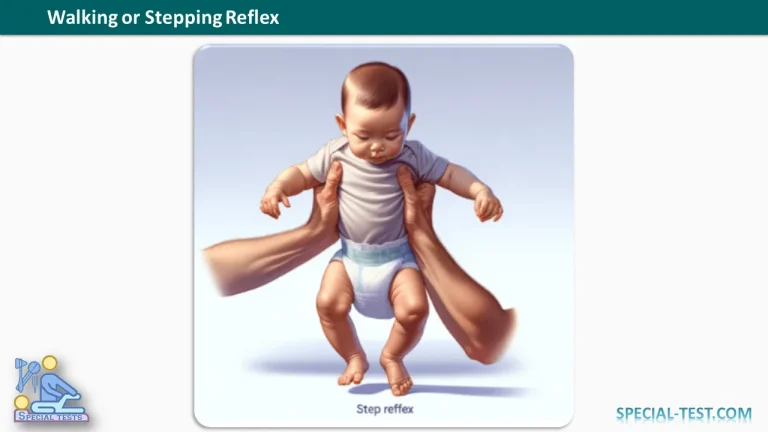
The walking or stepping reflex is a primitive neonatal reflex observed in newborns. It is elicited by holding an infant upright with adequate trunk support and allowing the soles of the feet to contact a firm surface. When the infant is gently inclined forward, alternating movements of the lower limbs may occur, resembling the movements of walking.
This reflex is part of the neurological examination of newborns and young infants. It provides information about early motor responses and the function of the nervous system. Although the stepping reflex is a normal finding during early infancy, its absence, asymmetry, or persistence beyond the expected developmental period should be interpreted alongside other neurological findings.
What Is the Walking or Stepping Reflex?
The walking reflex, also called the neonatal stepping reflex or automatic stepping reflex, is an involuntary motor response that can be elicited shortly after birth. When the infant is held upright and the feet touch a supporting surface, the legs may perform alternating flexion and extension movements that resemble a stepping pattern.
Unlike voluntary walking, this response does not require conscious intention, independent balance, or the ability to support the body’s full weight. It is a primitive motor pattern associated with early neurological development.
The stepping reflex is generally present at birth and becomes less consistently elicitable during the first one to two months of life. Its reduction is considered part of normal motor development and does not mean that the infant has lost the ability to walk in the future. Independent walking develops much later through the maturation of the nervous system, postural control, muscle strength, and coordination.
What Is the Walking or Stepping Reflex Used For?
The stepping reflex is assessed as part of the neurological examination of newborns and young infants. It can help clinicians evaluate the infant’s early motor responses and identify findings that may warrant further neurological assessment.
The examination may be useful for:
- Assessing primitive reflexes: Determining whether an expected neonatal motor response can be elicited.
- Evaluating lower-limb movement: Observing the pattern, symmetry, and coordination of the infant’s leg movements.
- Screening neurological function: Identifying abnormal findings that may require a more comprehensive neurological examination.
- Monitoring early development: Interpreting the stepping response in relation to the infant’s age and other developmental milestones.
The stepping reflex is not a stand-alone diagnostic test. An abnormal response does not establish a specific neurological diagnosis, and a normal response does not exclude all neurological disorders.
How to Perform the Walking or Stepping Reflex Test
The examination should be performed gently by a trained healthcare professional, with appropriate support for the infant’s head and trunk.
Step 1: Position the infant
Hold the infant upright, facing forward, while supporting the trunk securely. Maintain adequate control of the head and neck, particularly in newborns who cannot hold their heads independently.
Step 2: Bring the feet into contact with a surface
Allow the soles of the infant’s feet to touch a firm, flat examination table or another suitable supporting surface. The infant should remain securely supported throughout the maneuver.
Step 3: Incline the infant gently forward
Move the supported infant slightly forward so that the feet maintain contact with the surface. Avoid forcing the infant to bear weight or applying excessive pressure to the soles.
Step 4: Observe the lower-limb response
Look for alternating flexion and extension movements of the hips, knees, and ankles. The infant may appear to take several small steps as the body is moved forward.
Step 5: Assess symmetry and consistency
Observe whether both lower limbs participate in the response and whether the movements are reasonably coordinated. Interpret the findings in the context of the infant’s age, alertness, muscle tone, and overall neurological examination.
The maneuver should be stopped if the infant becomes distressed or the position cannot be maintained safely.
What Is a Positive Result?
A positive or normal stepping reflex is characterized by alternating movements of the lower limbs when the infant is held upright, the feet contact a firm surface, and the body is gently moved forward.
The response may include:
- Alternating flexion and extension of the legs.
- Repeated foot contact with the supporting surface.
- A stepping-like pattern that resembles early walking.
- Participation of both lower limbs without a persistent, obvious asymmetry.
The response does not need to propel the infant forward. The stepping pattern is a reflexive movement rather than true independent locomotion.
The reflex is usually present at birth and commonly becomes less apparent or disappears during the first one to two months. However, the timing and consistency of primitive reflexes can vary, so findings should not be interpreted using age alone.
What Does an Abnormal Walking Reflex Mean?
An abnormal stepping reflex may involve an absent response, marked asymmetry, unusual movement patterns, or persistence beyond the expected developmental period. Each finding requires clinical interpretation rather than an automatic diagnosis.
1. Absent stepping reflex
Failure to elicit the reflex in a newborn may occur for several reasons, including differences in alertness, positioning, technique, or the infant’s physiological state. It may also be associated with abnormal muscle tone, peripheral nerve dysfunction, or motor impairment.
Flaccid paralysis or significant lower-motor-neuron dysfunction can reduce or abolish motor responses. However, an absent stepping reflex alone is insufficient to diagnose paralysis or determine its cause.
2. Asymmetric stepping reflex
A marked difference between the two legs may warrant further assessment. Possible explanations include differences in limb movement, pain, musculoskeletal abnormalities, peripheral nerve injury, or neurological dysfunction.
The examiner should assess spontaneous movements, muscle tone, joint range of motion, and other neonatal reflexes before drawing conclusions.
3. Persistence beyond the expected age
The stepping reflex normally becomes less evident during early infancy. A clearly persistent primitive stepping response at approximately three to four months or later may justify a broader neurological assessment, particularly if accompanied by abnormal tone, unusual posturing, delayed motor development, or other persistent primitive reflexes.
Persistence alone does not prove neurological impairment. The clinician must consider the complete developmental and neurological picture.
Clinical Significance of the Walking Reflex
The stepping reflex is one component of the newborn neurological examination. It should be assessed together with other primitive reflexes, including the Moro reflex, rooting reflex, sucking reflex, palmar grasp reflex, and plantar grasp reflex.
A comprehensive examination also evaluates spontaneous limb movements, muscle tone, posture, symmetry, alertness, and age-appropriate developmental progress.
If the stepping response is absent, asymmetric, or unexpectedly persistent, the appropriate next step is to repeat the examination under suitable conditions and assess the infant more broadly. Additional investigations or specialist referral may be appropriate when other findings raise concern.
The reflex is most useful as part of a structured clinical assessment rather than as an isolated screening result.
Walking or Stepping Refl4ex: Key Clinical Findings
| Feature | Description |
|---|---|
| Other names | Neonatal stepping reflex, automatic stepping reflex, walking reflex |
| Type | Primitive neonatal reflex |
| Normal onset | Present at birth in most healthy term newborns |
| Eliciting stimulus | Upright positioning, foot contact with a firm surface, and gentle forward movement |
| Normal response | Alternating stepping movements of the lower limbs |
| Typical disappearance | Approximately 1–2 months; may be described as persisting to 2–3 months in some references |
| Clinical significance | Helps assess early motor responses as part of the neurological examination |
The expected age range varies slightly across references. The stepping reflex is also influenced by the infant’s behavioral state and examination technique. [1–3]
Frequently Asked Questions (FAQ)
1. What is the walking or stepping reflex in newborns?
The walking or stepping reflex is an involuntary neonatal response in which an infant makes alternating leg movements when held upright with the feet touching a firm surface and the body gently moved forward.
2. When does the stepping reflex disappear?
The stepping reflex usually becomes less evident and disappears around one to two months of age. Some clinical references describe its disappearance by two to three months. Variation in elicitation and examination conditions should be considered.
3. What does an absent stepping reflex indicate?
An absent response may result from positioning, reduced alertness, or normal variability. It can also be associated with hypotonia, peripheral nerve dysfunction, or other neurological abnormalities. The finding should be confirmed and interpreted alongside the rest of the neurological examination.
4. Is a persistent stepping reflex a sign of cerebral palsy?
Not necessarily. Persistence beyond the expected age may warrant assessment, particularly when accompanied by abnormal muscle tone, asymmetrical movements, or delayed motor milestones. The stepping reflex alone cannot diagnose cerebral palsy.
5. Is the stepping reflex the same as walking?
No. The stepping reflex is an automatic motor response, whereas independent walking requires voluntary motor control, balance, strength, postural stability, and coordination.
6. Can the stepping reflex be absent in a healthy newborn?
Yes. The response may be inconsistent and can vary with the infant’s alertness, positioning, and examination conditions. An absent response should be reassessed before it is considered abnormal.
7. How is the stepping reflex different from the plantar grasp reflex?
The stepping reflex produces alternating movements of the legs when the feet contact a supporting surface. The plantar grasp reflex produces flexion or curling of the toes when pressure is applied to the sole near the base of the toes. They are distinct primitive reflexes.
References
- Salandy S, Rai R, Gutierrez S, Ishak B, Tubbs RS. Neurological examination of the infant: A comprehensive review. Clinical Anatomy. 2019;32(6):770–777. PubMed
- Chamarthi VS, Gunasekaran V, Daley SF. Primitive Reflexes: Comprehensive Neurological Assessment Across the Lifespan. StatPearls. Updated 2026. NCBI Bookshelf
- American Academy of Pediatrics. Newborn Reflexes. HealthyChildren.org. Read the clinical overview
- Pedroso FS, Rotta NT. Neurological examination in the healthy term newborn. Arquivos de Neuro-Psiquiatria. 2003;61(2A):165–169. PubMed
- Blasco PA. Primitive reflexes: Their contribution to the early detection of cerebral palsy. Clinical Pediatrics. 1994;33(7):388–397. PubMed