Stinchfield Test (Resisted Hip Flexion Test): Procedure and Interpretation
What Is the Stinchfield Test Used For?
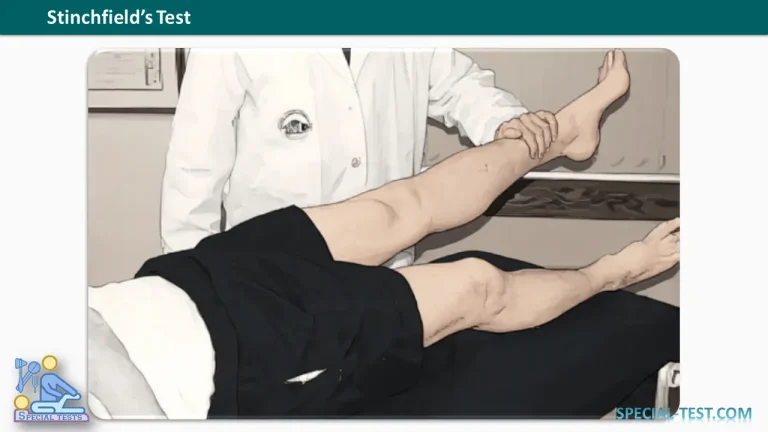
The Stinchfield test, also called the resisted hip flexion test or resisted straight leg raise, is a clinical hip examination. It helps clinicians tell the difference between intra-articular hip pathology (problems inside the hip joint) and extra-articular causes (problems outside the joint).
Hip-related problems often produce pain well beyond the hip itself. Pain may be felt in the groin, thigh, or buttock, and sometimes even in the front of the lower leg (pretibial area). Because so many structures can cause similar symptoms, a simple provocation test that helps narrow down the source is valuable during a musculoskeletal examination.
How to Perform the Stinchfield Test
The test is quick and needs no equipment. Here is the standard procedure:
- Position the patient supine. The patient lies on their back on the examination table.
- Lift the leg. The patient raises the affected leg with the knee kept straight, to roughly 30 degrees of hip flexion.
- Observe for pain. If lifting the leg alone does not reproduce symptoms, move to the next step.
- Apply resistance. The clinician presses downward on the raised leg, trying to extend the flexed hip while the patient resists the force.
- Record the pain location. Pain provoked with or without resistance is noted, with particular attention to where the patient feels it.
Where the pain is felt matters more than whether pain is present, so ask the patient to point to the exact spot.
Interpreting the Results: What Is a Positive Stinchfield Test?
A positive test is defined by reproduction of the patient’s pain, and the location points toward the likely source:
- Groin or anterior thigh pain: considered to arise from the hip joint itself.
- Buttock or lumbar spine pain: suggests the sacroiliac joint or the lumbar spine is the more likely source.
This distinction helps direct the clinician toward further assessment, whether that is hip-focused evaluation or examination of the lower back and pelvis.
Why Pain Location Matters
The hip, lumbar spine, and sacroiliac joint lie close together and can refer pain to overlapping areas. A patient who reports “hip pain” may actually have a spinal or sacroiliac problem, and the reverse is also true. Resisted hip flexion loads the hip joint and its surrounding muscles. Matching the pain pattern against the expected regions gives a useful first clue.
Limitations to Keep in Mind
No single physical examination test can confirm a diagnosis. Hip provocation maneuvers, including the Stinchfield test, are best interpreted alongside the patient’s history, the rest of the physical examination, and imaging when indicated. Research on the diagnostic validity of hip provocation maneuvers for detecting intra-articular pathology has been published in PM&R (2010) and is a good starting point for clinicians who want the evidence behind these tests. Always rely on a qualified healthcare professional for diagnosis and treatment decisions.
Frequently Asked Questions (FAQ)
What is the Stinchfield test?
It is a clinical hip test, also called the resisted hip flexion or resisted straight leg raise test, used to help distinguish intra-articular from extra-articular hip pathology.
What conditions can cause pain during the Stinchfield test?
The test is meant to help identify whether pain originates in the hip joint or elsewhere, such as the sacroiliac joint or lumbar spine. It does not diagnose a specific condition by itself.
At what angle is the leg held during the test?
The patient lifts the straight leg to about 30 degrees of hip flexion while lying on their back.
Does the knee need to be straight?
Yes. The leg is lifted without bending the knee.
What does groin pain during the test mean?
Pain in the groin or anterior thigh is considered to arise from the hip.
What does buttock or lower back pain during the test mean?
Pain in the buttock or lumbar spine suggests the sacroiliac joint or lumbar spine as the likely source rather than the hip.
Is the Stinchfield test enough to diagnose a hip problem?
No. It is one part of a full clinical assessment and should be combined with history, other examination findings, and imaging when appropriate.
Who should perform the test?
It should be performed and interpreted by a qualified clinician, such as a physician or physical therapist.
References
- Dutton’s Orthopaedic Examination, Evaluation, and Intervention, 3rd Edition.
- The Diagnostic Validity of Hip Provocation Maneuvers to Detect Intra-Articular Hip Pathology. PM&R, March 2010. PubMed
- Stinchfield Test | Orthofixar