Sacroiliac Rocking Test: Purpose, Procedure, and Interpretation
What Is the Sacroiliac Rocking Test Used For?
The Sacroiliac Rocking Test is a physical examination maneuver used to evaluate the sacroiliac (SI) joint and the sacrotuberous ligament. Clinicians use it to assess joint integrity and reproduce pain, helping to identify dysfunction or irritation in these structures, which are common sources of low back and buttock pain.
How to Perform the Sacroiliac Rocking Test
- Position the patient. The patient lies supine on the examination table.
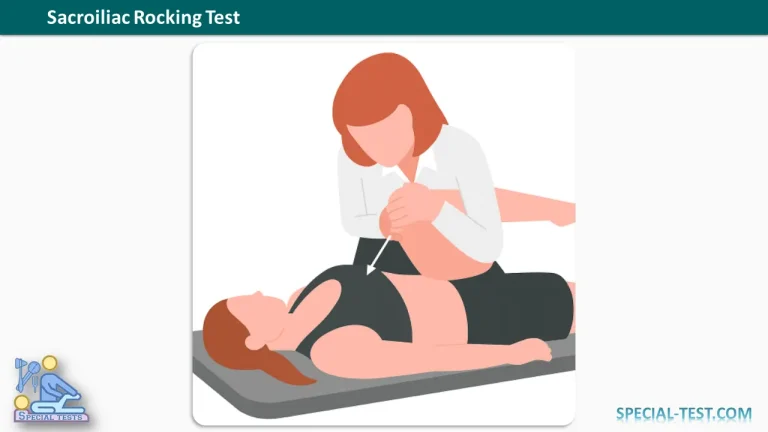
- Flex the hip and knee. The examiner fully flexes the patient’s hip and knee on the side being tested.
- Adduct the hip. The hip is moved toward the midline of the body.
- Create the rocking motion. The examiner guides the knee toward the patient’s opposite shoulder. This produces a “rocking” movement at the sacroiliac joint.
- Optional: add medial rotation. Some authors recommend adding medial (internal) rotation of the hip during flexion and adduction to increase stress on the SI joint.
- Palpate the sacrotuberous ligament. During the test, the examiner may palpate the ligament, which runs between the sacrum and the ischial tuberosity, to check for tenderness or abnormal tension.
Important: The hip and knee should have full range of motion and be free from pathology before testing. Otherwise, pain originating in these joints could be mistaken for SI joint pain and lead to a false interpretation.
What Is a Positive Result?
A positive Sacroiliac Rocking Test is indicated by:
- Pain in the SI joint region during the maneuver, which suggests sacroiliac joint dysfunction or ligamentous irritation.
- Tenderness along the sacrotuberous ligament, which may indicate that the ligament is inflamed or under stress.
As with most orthopedic tests, the result is best interpreted alongside the patient’s history and other SI joint provocation tests rather than used as a standalone diagnosis.