Kendall Test: How to Assess Rectus Femoris Contracture
What Is the Kendall Test Used For?
The Kendall Test, also known as the Rectus Femoris Contracture Test, is a physical examination maneuver used to assess shortening or contracture of the rectus femoris muscle. It is a simple, quick bedside test that needs no special equipment, only an examining table and a trained examiner.
The rectus femoris is one of the four muscles of the quadriceps group. It is the only one that crosses both the hip and the knee, so it acts as a hip flexor and a knee extensor. When it becomes tight or contracted, it can restrict movement at both joints. The Kendall Test lets the clinician check for this by watching how the knee behaves when the opposite hip is flexed.
Clinicians commonly use the test when evaluating anterior thigh tightness, limited knee flexion, or hip and knee movement problems that may involve the rectus femoris.
How to Perform the Kendall Test Step by Step
1. Position the patient
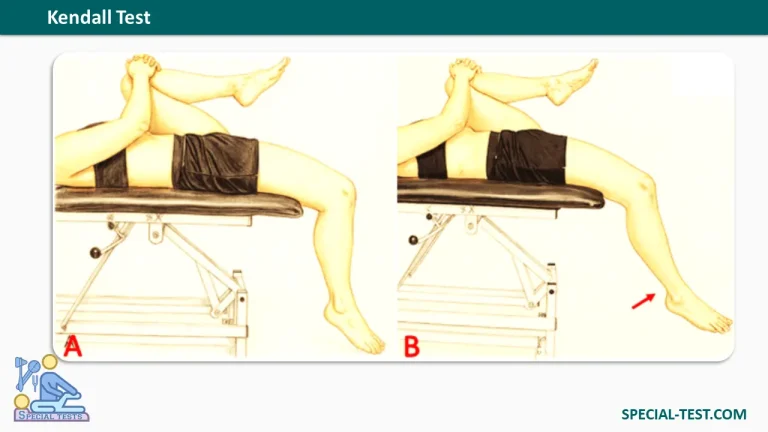
The patient lies supine on the examining table with the knees hanging over the edge. This lets the knee move freely into flexion or extension during the test.
2. Flex the opposite hip
Ask the patient to flex one knee toward the chest and hold it firmly. This is the supporting leg.
3. Observe the test limb
The opposite leg, hanging over the table edge, is the test limb. Watch the position of its knee as the other hip comes into full flexion.
4. Evaluate the knee angle
- Normal response: The test knee stays at about 90° of flexion while the opposite hip is fully flexed.
- Abnormal response: If the test knee begins to extend slightly, this suggests a rectus femoris contracture.
5. Confirm with passive flexion
The examiner may passively flex the test knee to see whether it returns naturally to 90°.
6. Palpate the muscle
Always palpate the rectus femoris during the maneuver to detect true muscle tightness. Palpation helps confirm that the knee extension comes from the muscle itself and not from another structure or from compensation.
What Is a Positive Kendall Test Result?
The Kendall Test is positive when the tested knee extends instead of holding at 90° of flexion. This points to tightness or contracture of the rectus femoris.
In practical terms:
- The knee holds at 90°: a normal result, with no sign of rectus femoris shortening.
- The knee drifts into extension: a positive result, suggesting rectus femoris contracture.
A positive result is a clinical sign, not a diagnosis. It should be interpreted together with the patient’s history, symptoms, and other examination findings. Testing both sides is good practice, since the opposite limb gives a useful comparison.
Tips for Accurate Testing
- Make sure the patient is relaxed and positioned symmetrically on the table.
- Ask the patient to hold the flexed knee firmly against the chest so the hip stays in full flexion.
- Watch the test knee closely for even small changes in angle.
- Palpate the rectus femoris throughout to confirm real muscle tension.
- Compare both legs for a more reliable assessment.
Frequently Asked Questions (FAQ)
What is the Kendall Test?
The Kendall Test, or Rectus Femoris Contracture Test, is a clinical maneuver that assesses shortening or contracture of the rectus femoris muscle.
What does the Kendall Test measure?
It checks whether the rectus femoris is tight or shortened by observing whether the test knee stays at 90° of flexion while the opposite hip is fully flexed.
How do I know if the Kendall Test is positive?
It is positive if the tested knee extends instead of holding at 90°, which suggests rectus femoris tightness or contracture.
What is the correct patient position?
The patient lies supine with the knees hanging over the edge of the examining table, so the knee can move freely into flexion or extension.
Why is palpation important during the test?
Palpating the rectus femoris during the maneuver helps detect true muscle tightness and supports the interpretation of the finding.
Is the Kendall Test enough to diagnose a muscle problem?
No. It is one part of a physical examination. Results should be interpreted with the patient’s history and other clinical findings by a qualified healthcare professional.
Should both legs be tested?
Yes. Testing both sides lets the examiner compare the findings.