Noble’s Test for Iliotibial Band Syndrome (ITBS): Procedure & Interpretation
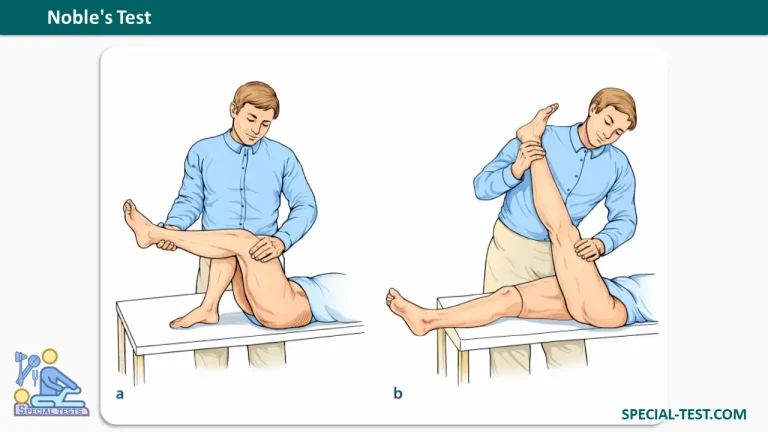
Lateral knee pain is a common complaint in runners, cyclists, and active adults, and iliotibial band syndrome (ITBS) is one of its leading causes. Noble’s Test, also known as the Noble compression test, is a simple, hands-on orthopedic special test that helps clinicians identify ITB friction at the lateral knee. This guide covers what the test is used for, how to perform it step by step, and how to interpret a positive result.
What Is Noble’s Test Used For?
Noble’s Test is used to assess for iliotibial band syndrome (ITBS), also called ITB friction syndrome. It reproduces friction between the iliotibial band and the lateral femoral epicondyle during knee flexion and extension, which is the mechanism behind the lateral knee pain typical of this condition.
How to Perform Noble’s Test: Step by Step
1. Position the patient
Place the patient supine, or side-lying with the affected leg on top.
2. Position your hands
- Use one hand to grasp the leg just above the ankle.
- Place the thumb of your other hand on the lateral epicondyle of the femur, applying firm pressure.
3. Move the knee
Slowly flex and extend the knee through approximately 0° to 90° several times, while maintaining thumb pressure over the lateral epicondyle.
4. Observe and palpate
Feel for crepitus under your thumb and ask the patient whether the movement reproduces their pain.
What Is a Positive Result?
A positive Noble’s Test is indicated by:
- Palpable snapping, rubbing, or “squeaky hinge-like” crepitus under the thumb, or
- Localized pain that increases with pressure at or just above the lateral epicondyle, often appearing at around 30° of knee flexion.
Either finding suggests ITB syndrome.
Clinical Tips
- Keep the pressure firm and consistent throughout the arc of motion.
- Note the exact angle at which symptoms appear; pain near 30° of flexion is the classic finding.
- Compare with the uninjured side.
- Use Noble’s Test alongside the patient history and other clinical findings rather than as a standalone diagnostic tool.
Frequently Asked Questions (FAQ)
What is Noble’s Test used for?
Noble’s Test is used to help diagnose iliotibial band syndrome (ITBS), a common cause of lateral knee pain.
How do you perform Noble’s Test?
The patient lies supine or side-lying with the injured side up. The examiner grasps the leg just above the ankle and slowly flexes and extends the knee from 0° to 90° several times, while pressing firmly with the thumb of the other hand over the lateral femoral epicondyle and feeling for crepitus.
What is a positive result on Noble’s Test?
A positive result is palpable snapping, rubbing, or squeaky-hinge crepitus, or localized pain that increases with pressure at or above the lateral epicondyle, often at about 30° of knee flexion. This indicates ITB syndrome.
What is another name for Noble’s Test?
It is also called the Noble compression test.
Where is the pressure applied during the test?
Pressure is applied with the thumb over the lateral epicondyle of the femur, on the outer side of the knee.
References
- Clinical Tests for the Musculoskeletal System, 3rd Edition.
- Noble’s Test | Orthofixar
- Rosenthal, Michael. (2008). Clinical Testing for Extra-Articular Lateral Knee Pain: A Modification and Combination of Traditional Tests. North American Journal of Sports Physical Therapy (NAJSPT), 3, 107-109. Link
- Read more: Iliotibial Band Syndrome