FAIR Test for Piriformis Syndrome: A Complete Guide
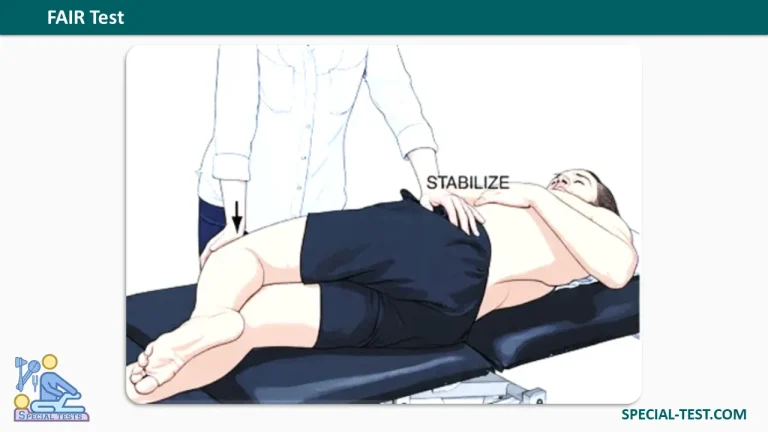
Deep buttock pain that radiates down the leg is often called sciatica, but the cause is not always the spine. Sometimes the sciatic nerve is irritated in the gluteal region, near the piriformis muscle. One of the most widely used physical exam maneuvers to evaluate this is the FAIR test.
What Is the FAIR Test Used For?
The FAIR test, short for Flexion, Adduction, and Internal Rotation, is a clinical exam used to assess whether the piriformis muscle is compressing the sciatic nerve. It is sometimes called the piriformis test. Clinicians use it when a patient has buttock pain, sciatica-like symptoms, or pain that worsens with certain hip positions.
How Is the FAIR Test Performed?
The test is done by a trained clinician in a few steps:
- Positioning: The patient lies on their side with the test leg on top.
- Hip and knee position: The hip is flexed to about 60° with the knee bent. Some descriptions use 90° of hip flexion.
- FAIR position: The leg is allowed to drop slightly into adduction (toward the midline) and internal (medial) rotation.
- Stabilization: The examiner holds the pelvis steady with one hand.
- Pressure: With the other hand, the examiner applies gentle downward pressure on the knee.
This position stretches and tightens the piriformis, which can press on the sciatic nerve running beneath or through it. Technique varies slightly between sources, so a clinician may adjust the angles.
What Does a Positive FAIR Test Mean?
How the pain shows up matters:
- Localized pain in the piriformis area suggests muscular tightness.
- Neurologic pain, such as pain radiating through the buttock or down the leg (sciatica), suggests the piriformis may be compressing the sciatic nerve.
A positive result may point to:
- Piriformis muscle tightness
- Sciatic nerve compression
- Deep gluteal syndrome
- Symptoms that appear with prolonged sitting, running, or climbing stairs
Deep gluteal syndrome is now the preferred term in many sources, because the sciatic nerve can be entrapped by structures other than the piriformis, including fibrous bands, gluteal and hamstring muscles, and the gemelli-obturator internus complex.
How Accurate Is the FAIR Test?
The best-known data come from a 10-year study by Fishman and colleagues in Archives of Physical Medicine and Rehabilitation (2002), indexed on PubMed. At a threshold of 3 standard deviations, the FAIR test showed a sensitivity of 88.1% and a specificity of 83.2%.
- Sensitivity: about 88%. It identifies most people who have the condition.
- Specificity: about 83%. It correctly rules out most people who don’t.
In that study, 79% of patients with a positive FAIR test improved by at least 50% after injection and physical therapy.
Important context: the study’s reference standard was a delayed H-reflex (a nerve conduction measure), not imaging or surgical confirmation. Some clinical reviewers note that the H-reflex is sensitive but not specific, so the FAIR test works best as one part of a full evaluation rather than a stand-alone diagnosis. Because flexion, adduction, and internal rotation also load many other hip structures, a positive result can have other explanations.
When to See a Healthcare Professional
See an orthopedic specialist, sports medicine physician, or physical therapist if you have persistent buttock pain, numbness, tingling, or leg pain that limits sitting, walking, or exercise. Seek urgent care for sudden leg weakness, loss of bladder or bowel control, or numbness in the groin area, as these can signal a more serious spinal problem. Diagnosis may involve a history, additional physical tests, imaging, or nerve studies. Do not self-diagnose from the FAIR test alone.
Frequently Asked Questions (FAQ)
What does FAIR stand for in the FAIR test?
Flexion, Adduction, and Internal Rotation, the three hip movements that put the piriformis in the position that can compress the sciatic nerve.
Is the FAIR test the same as the piriformis test?
Yes. It is commonly referred to by both names.
What is a positive FAIR test?
Pain in the piriformis region suggests muscle tightness. Radiating buttock or leg pain suggests sciatic nerve compression.
How accurate is the FAIR test?
In Fishman et al. (2002), sensitivity was about 88% and specificity about 83%. Accuracy depends on the reference standard and on other findings.
Can the FAIR test diagnose piriformis syndrome by itself?
No. It supports a diagnosis but should be combined with history, other exam tests, and sometimes imaging or electrodiagnostic testing to rule out other causes like lumbar disc problems.
Can I do the FAIR test at home?
It is best performed by a clinician. Forcing the hip into this position yourself may aggravate pain.
What conditions can cause a positive FAIR test?
Piriformis tightness, sciatic nerve compression, and deep gluteal syndrome. Symptoms often worsen with prolonged sitting, running, or stairs.
What treatments are used after a positive result?
Treatment depends on the cause. In the Fishman study, patients received injection and physical therapy, and some later had surgery. A clinician will recommend a plan based on your exam.
References
- Fishman LM, et al. Piriformis syndrome: diagnosis, treatment, and outcome, a 10-year study. Arch Phys Med Rehabil. 2002;83(3):295-301. PubMed