Duncan Ely Test: How to Perform It, Interpret Results, and Understand Its Accuracy
What Is the Duncan Ely Test Used For?
The Duncan Ely test, also called the Ely test, is a clinical examination used to assess tightness of the rectus femoris muscle at the hip joint. The rectus femoris is part of the quadriceps and crosses both the hip and the knee. Because of this, a tight or contracted rectus femoris can limit how far the knee bends when the hip is extended.
Clinicians use the test for children and adults with suspected rectus femoris contracture or spasticity. It is especially common in cerebral palsy assessment, where rectus femoris dysfunction can affect walking.
How to Perform the Duncan Ely Test
The test is quick, needs no equipment, and is done on an examination table.
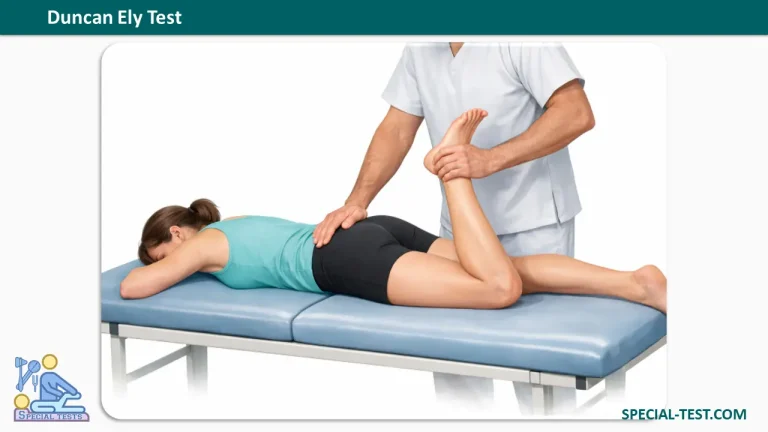
- Position the patient prone. The patient lies face down with both knees kept in extension.
- Flex the knee passively. The examiner bends the knee on the side being tested. The patient should stay relaxed and not actively move the leg.
- Observe the hip and pelvis. The examiner watches what the hip and pelvis do as the knee flexes.
- Compare both sides. The opposite limb is tested the same way for comparison.
Passive movement matters. If the patient resists or contracts the muscles, the result is harder to interpret.
What Is a Normal Result?
In a normal test, there is no motion of the hip or pelvis while the knee flexes completely. The rectus femoris has enough length to allow full knee flexion without pulling the hip into flexion.
What Is a Positive Duncan Ely Test?
In patients with rectus femoris contracture, complete passive knee flexion causes involuntary flexion at the hip. The buttocks lift off the examination table. This happens because the shortened or spastic muscle pulls on the pelvis as the knee is bent, which shows that the rectus femoris is limiting motion at the hip and knee.
The opposite side is always tested for comparison. This helps separate a true abnormality from normal individual variation.
How Accurate Is the Duncan Ely Test?
According to Orthofixar, the reported test accuracy is:
- Sensitivity: 56–59%
- Specificity: 64–85%
With sensitivity in this range, the test can miss some patients who have rectus femoris tightness. Specificity is somewhat higher, so a positive result is more informative. Because of these limits, the Duncan Ely test is best used as part of a full clinical evaluation, not as a stand-alone diagnostic tool.
Duncan Ely Test in Cerebral Palsy and Gait Assessment
Published research has examined the test in cerebral palsy. Lee et al. (2015) studied its reliability and validity for assessing rectus femoris spasticity in patients with cerebral palsy. Marks et al. (2003) looked at its clinical utility for rectus femoris dysfunction during the swing phase of gait. Both studies are listed on PubMed and in Developmental Medicine & Child Neurology. They show why the test is used when clinicians evaluate how rectus femoris behavior may affect walking.
Key Takeaways
- The Duncan Ely test assesses rectus femoris tightness at the hip.
- The patient lies prone, and the examiner passively flexes the knee.
- A normal result shows no hip or pelvic motion.
- A positive result shows involuntary hip flexion, with the buttocks rising from the table.
- Reported sensitivity is 56–59% and specificity is 64–85%.
- It should be interpreted alongside other clinical findings.
Frequently Asked Questions (FAQ)
1. What is the Duncan Ely test?
It is a physical examination test used to assess rectus femoris muscle tightness at the hip joint.
2. Is the Duncan Ely test the same as the Ely test?
Yes. “Ely test” and “Duncan Ely test” refer to the same examination.
3. What position is the patient in for the test?
The patient lies prone, with knees kept in extension, before the examiner passively flexes the knee.
4. What does a positive Duncan Ely test look like?
Complete passive knee flexion causes involuntary hip flexion, and the buttocks lift off the table.
5. What does a negative result mean?
The hip and pelvis stay still while the knee fully flexes, which suggests no significant rectus femoris tightness.
6. How accurate is the test?
Reported sensitivity is 56–59% and specificity is 64–85%, so the test is useful but imperfect.
7. Why is the other leg tested too?
Testing both sides gives a baseline for comparison and helps the examiner judge whether the finding is abnormal.
8. Can the test be used in cerebral palsy?
Yes. Studies have evaluated it for rectus femoris spasticity and dysfunction in people with cerebral palsy.
9. Can I use this test to self-diagnose?
No. It should be performed and interpreted by a qualified healthcare professional as part of a complete assessment.
References
- Orthofixar. Duncan Ely Test. https://orthofixar.com/special-test/duncan-ely-test/
- Lee SY, Sung KH, Chung CY, et al. Reliability and validity of the Duncan-Ely test for assessing rectus femoris spasticity in patients with cerebral palsy. Dev Med Child Neurol. 2015;57:963–968. https://doi.org/10.1111/dmcn.12761
- Marks MC, Alexander J, Sutherland DH, Chambers HG. Clinical utility of the Duncan-Ely test for rectus femoris dysfunction during the swing phase of gait. Dev Med Child Neurol. 2003;45(11):763–768. PMID: 14580132