Prone Hip Extension Test (Staheli Test): Purpose, Technique and Interpretation
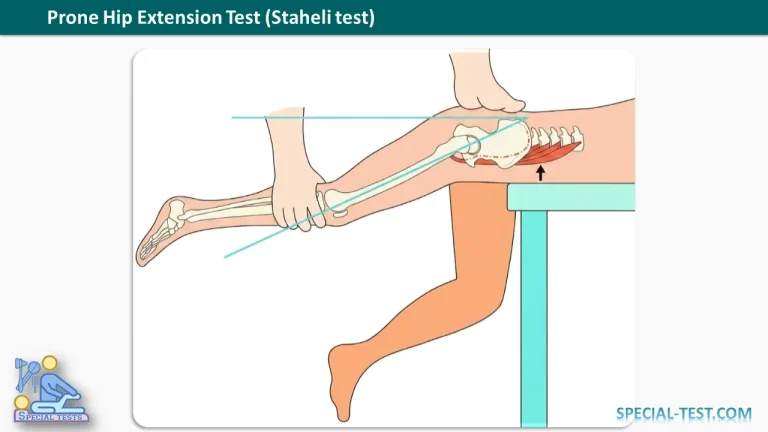
The Prone Hip Extension Test, also known as the Staheli test, is a clinical examination used to measure hip flexion contracture. Described by Lynn Staheli in 1977, it remains a practical, equipment-light way to assess hip extension in children and adults, especially those with neuromuscular conditions such as cerebral palsy.
What Is the Prone Hip Extension Test (Staheli Test) Used For?
- The test evaluates hip flexion contracture, a limitation in how far the hip can extend.
- It is commonly called the Staheli test.
- It can also be performed in patients with bilateral hip pathology, where both hips are affected.
How to Perform the Prone Hip Extension Test (Staheli Test)
- Set up the table. A regular padded examination table is sufficient.
- Position the patient. The patient lies prone with both hips flexed comfortably over the end of the examination couch.
- Expose the back. The patient should be adequately undressed so the examiner can clearly see the back and pelvis.
- Secure the opposite limb. The other leg can be held between the examiner’s knees, rested on a stool, or allowed to hang from the edge of the table.
- Extend the thigh. The examiner slowly extends the thigh being tested while keeping the other hand on the pelvis to detect the first sign of pelvic movement.
How to Interpret the Result
- The point at which the pelvis begins to rise marks the end of true hip extension and the start of compensatory movement at the spine.
- At that point, measure the angle between an imaginary horizontal line parallel to the trunk and the thigh. This angle is the degree of hip flexion contracture.
Frequently Asked Questions (FAQ)
What is the Staheli test?
The Staheli test is another name for the Prone Hip Extension Test, a physical examination used to measure hip flexion contracture.
What does the Prone Hip Extension Test measure?
It measures the amount of hip flexion deformity by identifying how far the hip can extend before the pelvis starts to rise.
Does the patient need special equipment for the test?
No. A regular padded examination table is enough.
How is the test position set up?
The patient lies prone with both hips flexed over the end of the table. The opposite limb is supported by the examiner’s knees, a stool, or the table edge.
What does a positive result look like?
A positive result is the angle between the thigh and a line parallel to the trunk at the moment the pelvis begins to rise. This angle represents the hip flexion contracture.
Why does the pelvis rising matter?
Pelvic rise shows that hip extension has reached its limit and the movement is being taken up by the spine instead.
Can the test be used when both hips are affected?
Yes. It can be performed in patients with bilateral hip pathology.
References
- Staheli LT. The prone hip extension test: a method of measuring hip flexion deformity. Clin Orthop Relat Res. 1977 Mar-Apr;(123):12-5. PMID: 852171.
- Moon S, Choi Y, Chung C, Sung K, Cho B, Chung M, Kim J, Yoo M, Lee H, Park MS. Normative Values of Physical Examinations Commonly Used for Cerebral Palsy. Yonsei Med J. 2017;58(6):1170. doi:10.3349/ymj.2017.58.6.1170. Link