Wrist Range of Motion (ROM): Normal Values, Measurement Techniques & Special Tests
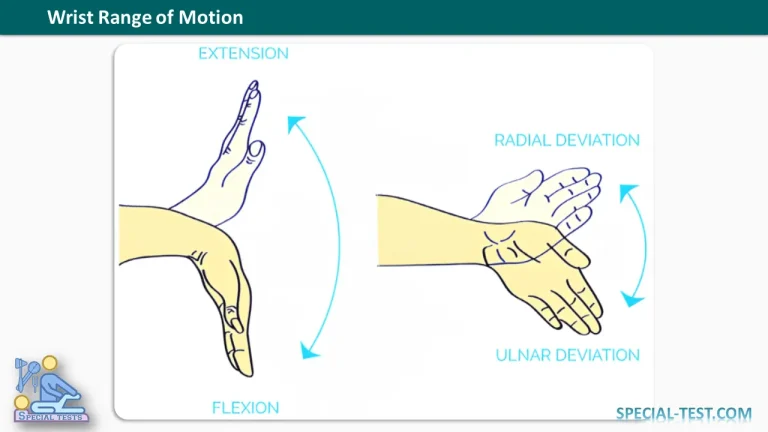
Wrist range of motion (ROM) is an essential component of orthopedic assessment, physical therapy, and hand rehabilitation. Measuring wrist mobility helps healthcare professionals identify joint stiffness, evaluate musculoskeletal injuries, monitor recovery, and assess functional limitations affecting daily activities.
A comprehensive wrist examination includes measuring wrist flexion, extension, radial deviation, and ulnar deviation. Clinicians should also assess active and passive movements, compare both wrists, and perform appropriate special tests when specific injuries or disorders are suspected.
Understanding normal wrist ROM values and proper measurement techniques is particularly important when evaluating patients with distal radius fractures, wrist sprains, tendon disorders, arthritis, or postoperative stiffness.
What Is Wrist Range of Motion?
Wrist range of motion refers to the angular movement available at the wrist joint complex, primarily through the radiocarpal and midcarpal joints.
The wrist performs four principal movements:
- Wrist flexion: Bending the palm toward the inner surface of the forearm.
- Wrist extension (dorsiflexion): Moving the back of the hand toward the posterior surface of the forearm.
- Radial deviation: Moving the hand sideways toward the thumb.
- Ulnar deviation: Moving the hand sideways toward the little finger.
Forearm pronation and supination are commonly evaluated during the same examination, although these movements primarily occur at the proximal and distal radioulnar joints rather than the wrist itself.
Normal Wrist Range of Motion: Reference Values
Normal wrist ROM varies according to age, individual anatomy, measurement technique, and other patient-specific factors.
The following ranges are commonly used as clinical reference values.
| Wrist Movement | Normal ROM | Description |
|---|---|---|
| Wrist flexion | 70°–85° | Palm moves toward the forearm |
| Wrist extension | 60°–75° | Back of hand moves toward the forearm |
| Radial deviation | 15°–20° | Hand moves toward the thumb |
| Ulnar deviation | 30°–40° | Hand moves toward the little finger |
These values are consistent with published goniometric literature, although some clinical references report slightly wider or narrower ranges.
1. Wrist Flexion ROM
Normal wrist flexion is approximately 70° to 85°.
Wrist flexion occurs when the palm moves toward the anterior forearm. This motion is important for dressing, personal hygiene, and positioning the hand during functional activities.
Restricted wrist flexion may occur following immobilization, distal radius fractures, arthritis, tendon injuries, or capsular contracture.
2. Wrist Extension ROM
Normal wrist extension is approximately 60° to 75°.
Wrist extension is essential for weight-bearing activities, pushing movements, and maintaining an effective grip.
Limited extension may affect tasks such as pushing up from a chair, performing push-ups, or placing the palm flat on a surface.
3. Radial Deviation ROM
Normal radial deviation is approximately 15° to 20°.
This movement occurs when the wrist moves toward the radial or thumb side of the forearm.
Radial deviation contributes to hand positioning during gripping and manipulating objects. Painful radial deviation may require further examination of the scaphoid, radial-sided ligaments, and surrounding tendons.
4. Ulnar Deviation ROM
Normal ulnar deviation is approximately 30° to 40°.
Ulnar deviation moves the hand toward the little-finger side and typically allows a greater angular excursion than radial deviation.
Pain during this movement may be associated with conditions involving the triangular fibrocartilage complex (TFCC), ulnar-sided tendons, or other wrist structures.
How to Measure Wrist Range of Motion With a Goniometer
A universal goniometer is a commonly used instrument for measuring wrist joint angles. Standardized positioning helps improve measurement consistency during clinical examinations and follow-up assessments.
Measuring Wrist Flexion and Extension
- Position the patient comfortably with the forearm supported on a table.
- Keep the forearm pronated, with the hand extending beyond the edge of the table.
- Position the goniometer axis near the triquetral region on the ulnar side of the wrist.
- Align the stationary arm with the lateral midline of the ulna.
- Align the moving arm with the fifth metacarpal.
- Ask the patient to flex or extend the wrist without substituting forearm or finger movement.
- Record the maximum comfortable movement in degrees.
Measuring Radial and Ulnar Deviation
- Place the patient’s forearm in pronation with the wrist supported in a neutral position.
- Position the goniometer over the dorsal wrist.
- Align the stationary arm with the dorsal midline of the forearm.
- Align the moving arm with the third metacarpal.
- Ask the patient to move the hand toward the thumb for radial deviation.
- Repeat toward the little finger for ulnar deviation.
- Document the angular movement and any associated pain.
Consistent positioning, stabilization, and instrument alignment are essential for reliable comparisons.
Active vs. Passive Wrist Range of Motion
Wrist mobility is assessed using both active and passive range of motion.
Active Range of Motion (AROM) refers to movement performed independently by the patient using their own muscles. It assesses voluntary movement, coordination, and tolerance of motion.
Passive Range of Motion (PROM) refers to movement produced by the examiner while the patient relaxes. It helps evaluate available joint mobility and resistance from soft tissues or joint structures.
Clinical Interpretation
- AROM more restricted than PROM: May suggest pain inhibition, muscle weakness, tendon dysfunction, or impaired motor control.
- Both AROM and PROM restricted: May indicate capsular stiffness, swelling, soft-tissue contracture, or a structural limitation.
- Pain near the end of movement: May reflect irritation of muscles, tendons, ligaments, or joint structures.
- Painful clicking or instability: May warrant assessment of ligamentous injury or other intra-articular pathology.
These findings help narrow the differential diagnosis but cannot independently identify a specific disorder.
Important Wrist Special Tests
In addition to measuring wrist ROM, orthopedic clinicians may perform targeted special tests based on the patient’s symptoms and suspected diagnosis.
Finkelstein Test
The Finkelstein test is used when de Quervain tenosynovitis is suspected.
It involves positioning the thumb in palmar flexion and applying controlled ulnar deviation to provoke pain along the first dorsal extensor compartment.
Reproduction of the patient’s characteristic pain near the radial styloid supports the clinical suspicion of de Quervain disease.
The Finkelstein maneuver should be distinguished from the more provocative Eichhoff test, which is commonly confused with it.
Phalen Test
The Phalen test evaluates symptoms associated with carpal tunnel syndrome.
The patient maintains wrist flexion, commonly with the backs of the hands pressed together, for up to 60 seconds.
Reproduction of numbness or tingling in the median nerve distribution suggests possible median nerve compression.
Tinel Sign
Tinel testing involves gently tapping over the median nerve at the volar wrist.
A positive response consists of tingling or electric-shock-like sensations radiating into the median nerve distribution.
Watson Scaphoid Shift Test
The Watson test assesses suspected scapholunate instability.
The examiner applies controlled pressure over the scaphoid tubercle while moving the wrist between ulnar and radial deviation.
A painful clunk or abnormal shift compared with the opposite wrist may suggest scapholunate ligament dysfunction.
Special tests should be interpreted alongside the history, physical examination, and imaging when indicated. No individual provocative test is sufficiently reliable to diagnose every wrist disorder on its own.
Why Measuring Wrist ROM Matters in Rehabilitation
Repeated wrist ROM measurements provide objective information about recovery following injury, surgery, or immobilization.
They help clinicians:
- Establish an initial functional baseline.
- Identify restricted movement patterns.
- Evaluate rehabilitation progress.
- Monitor changes in joint mobility.
- Determine whether treatment goals are being achieved.
- Document outcomes following orthopedic procedures.
Importantly, full anatomical wrist ROM is not required for every daily activity.
Research into functional wrist motion demonstrates that many daily tasks can be completed using less than the maximum available joint movement. However, the mobility required varies according to the activity, especially for occupations and sports that involve gripping, loading, or extreme wrist positions.
Clinical Tips for Accurate Wrist ROM Assessment
For effective wrist examinations, clinicians should follow several important principles.
Compare both wrists: Assess the unaffected side when appropriate to establish an individual reference.
Measure active movement first: Observe voluntary movement before considering passive assessment.
Maintain consistent positioning: Changes in forearm rotation can influence wrist ROM measurements.
Record pain and symptoms: Document whether the patient experiences discomfort, weakness, clicking, or stiffness.
Use the same measurement technique: Consistency improves the usefulness of serial examinations.
Avoid forceful assessment after acute trauma: If fracture, dislocation, or significant instability is suspected, prioritize appropriate medical evaluation rather than provocative movement testing.
Frequently Asked Questions (FAQs)
1. What is the normal range of motion of the wrist?
Normal wrist ROM is commonly approximately 70°–85° of flexion, 60°–75° of extension, 15°–20° of radial deviation, and 30°–40° of ulnar deviation. Individual values can vary.
2. What is the difference between wrist flexion and extension?
Wrist flexion moves the palm toward the forearm, whereas wrist extension moves the back of the hand toward the forearm. Both movements are necessary for normal hand function.
3. How is wrist ROM measured?
Wrist ROM is commonly measured with a universal goniometer. The examiner stabilizes the forearm, positions the instrument along anatomical landmarks, and records each movement in degrees.
4. What causes limited wrist range of motion?
Common causes include fractures, prolonged immobilization, arthritis, swelling, tendon disorders, ligament injuries, and joint stiffness. The specific cause depends on the history and examination findings.
5. What is functional wrist range of motion?
Functional wrist ROM is the movement required to perform specific daily activities. It is generally less than maximal anatomical motion, although the amount needed depends on the task.
6. Which special tests are used during wrist examination?
Common wrist examination maneuvers include the Finkelstein test for suspected de Quervain tenosynovitis, Phalen and Tinel tests for possible carpal tunnel syndrome, and the Watson test for scapholunate instability.
7. Is wrist range of motion the same for everyone?
No. Wrist mobility can vary with anatomy, age, previous injuries, pain, and measurement position. Comparing both sides is often more informative than relying exclusively on population reference values.
8. When should limited wrist movement be medically evaluated?
Persistent or worsening wrist stiffness, significant pain, numbness, weakness, or difficulty using the hand should be assessed by a qualified healthcare professional. Following an injury, deformity, marked swelling, or suspected fracture requires prompt medical evaluation.
Conclusion
Accurate assessment of wrist range of motion is fundamental to orthopedic diagnosis, physical therapy, and hand rehabilitation.
Understanding normal wrist flexion, extension, radial deviation, and ulnar deviation provides a useful reference for identifying mobility restrictions and monitoring recovery.
A complete wrist examination should combine standardized goniometric measurements, active and passive movement assessment, bilateral comparison, and clinically appropriate special tests.
By interpreting ROM findings alongside symptoms and functional limitations, healthcare professionals can make more informed clinical decisions and develop individualized rehabilitation plans.
References
- NCBI / PubMed Central. Reliability and Concurrent Validity of a New iPhone Goniometric Application for Measuring Active Wrist Range of Motion. Read study
- NCBI Bookshelf. Wrist Arthritis – StatPearls. Includes normal wrist ROM values and physical examination considerations. Read reference
- Orthofixar. Hand & Wrist Movements and ROM (Extension and Flexion). Read article
- PubMed. Functional Ranges of Motion of the Wrist Joint. Journal of Hand Surgery, 1991. Read study
- PubMed. Variation of Grip Strength and Wrist Range of Motion With Forearm Rotation in Healthy Young Volunteers. Read study
- NCBI Bookshelf. De Quervain Tenosynovitis – StatPearls. Read reference
- PubMed. Diagnostic Test Accuracy of Provocative Maneuvers for the Diagnosis of Carpal Tunnel Syndrome: A Systematic Review and Meta-Analysis. Read study
- Orthofixar. Watson Test (Scaphoid Shift Test): Procedure, Interpretation and Accuracy. Read article
- NCBI Bookshelf. Finkelstein Sign – StatPearls. Read reference