Watson Test (Scaphoid Shift Test): Procedure & Accuracy
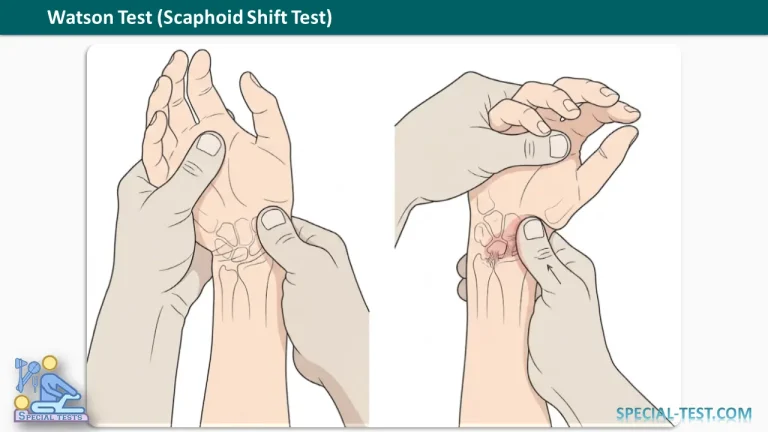
The Watson Test, also known as the Scaphoid Shift Test, is a clinical examination technique used to assess scapholunate ligament injuries and scaphoid instability in the wrist. It evaluates the dynamic stability of the scaphoid bone and helps identify abnormal movement between the scaphoid and lunate bones.
The test is commonly performed by orthopedic surgeons, hand specialists, physiotherapists, and other healthcare professionals when evaluating patients with wrist pain, clicking, or suspected carpal instability.
A positive Watson Test may indicate scapholunate ligament insufficiency, particularly when painful dorsal displacement of the scaphoid produces a palpable or audible clunk.
What Is the Watson Test Used For?
The primary purpose of the Watson Scaphoid Shift Test is to evaluate the integrity of the scapholunate interosseous ligament (SLIL), an important stabilizing structure connecting the scaphoid and lunate bones.
The scapholunate ligament maintains coordinated movement between these two carpal bones during wrist motion. When this ligament becomes stretched, partially torn, or completely ruptured, abnormal movement may develop, resulting in scapholunate instability.
The Watson Test is particularly useful when evaluating patients with:
- Suspected scapholunate ligament tears.
- Dorsal or radial-sided wrist pain.
- Painful wrist clicking or clunking.
- Reduced grip strength following a wrist injury.
- Suspected dynamic scapholunate instability.
- Persistent wrist symptoms after a fall onto an outstretched hand.
Although the test is primarily associated with scapholunate ligament injuries, a positive response does not independently confirm a ligament tear. Other wrist abnormalities, including dorsal ganglion cysts and scaphoid pathology, may produce similar symptoms.
How to Perform the Watson Test (Scaphoid Shift Test)
The Watson Test is performed by applying controlled pressure to the palmar aspect of the scaphoid while moving the wrist from ulnar deviation toward radial deviation.
Step-by-Step Procedure
- Patient Position: The patient sits facing the examiner with the elbow flexed approximately 90 degrees and supported on a table. The forearm is positioned comfortably, allowing the examiner to control wrist movement.
- Examiner Position: The examiner grasps the patient’s wrist with one hand, placing the thumb over the palmar prominence of the distal scaphoid, also called the scaphoid tubercle. The remaining fingers provide counterpressure around the distal radius.
- Initial Wrist Position: The patient’s wrist is positioned in ulnar deviation with slight extension.
- Apply Scaphoid Pressure: The examiner maintains firm, controlled pressure over the scaphoid tubercle in a dorsally directed manner, restricting the normal flexion of the scaphoid.
- Move the Wrist: Using the other hand to grasp the metacarpals, the examiner gradually moves the wrist from ulnar deviation into radial deviation with slight flexion while maintaining thumb pressure.
- Assess Scaphoid Movement: If the scapholunate ligament is incompetent, the proximal pole of the scaphoid may subluxate dorsally over the rim of the distal radius.
- Release Pressure: The examiner releases thumb pressure and observes whether the scaphoid reduces into its normal position, producing a painful click or palpable clunk.
- Compare Both Wrists: The same maneuver should be performed on the opposite wrist to identify differences in pain, movement, or mechanical symptoms.
Important: The Watson Test should be performed carefully by a trained healthcare professional. Excessive force or inappropriate manipulation may aggravate an existing wrist injury.
What Is a Positive Watson Test?
A positive Watson Test is characterized by painful abnormal movement of the scaphoid during wrist manipulation.
The characteristic findings include:
- Pain over the dorsal or dorsoradial aspect of the wrist.
- A palpable or audible clunk as the scaphoid subluxates or reduces.
- Abnormal dorsal translation of the proximal scaphoid.
- Reproduction of the patient’s familiar wrist symptoms.
- Asymmetrical findings compared with the unaffected wrist.
The combination of pain and a palpable clunk is more clinically meaningful than an isolated painless click.
In individuals with scapholunate ligament insufficiency, the proximal scaphoid may shift dorsally during radial deviation and return toward its normal alignment when the examiner releases pressure.
What Does a Negative Watson Test Mean?
A negative Watson Test occurs when the scaphoid moves smoothly without painful subluxation or a significant mechanical clunk.
However, a negative result does not completely exclude scapholunate ligament injury, particularly in patients with partial ligament tears, subtle instability, or persistent symptoms.
Watson Test Sensitivity and Specificity
The diagnostic accuracy of the Watson Test has been investigated in clinical studies comparing physical examination findings with wrist arthroscopy.
A frequently cited study by LaStayo and Howell (1995) evaluated provocative wrist examination tests in 50 patients with wrist pain.
The reported diagnostic accuracy of the Scaphoid Shift Test was:
| Diagnostic measure | Result |
|---|---|
| Sensitivity | 69% |
| Specificity | 66% |
| Positive predictive value | 48% |
| Negative predictive value | 78% |
Interpretation of Test Accuracy
Sensitivity of 69%: Approximately 69% of patients with the target injury identified by arthroscopic examination had a positive test in this study.
Specificity of 66%: Approximately 66% of patients without the target injury had a negative test.
These findings suggest that the Watson Test offers moderate diagnostic accuracy and should not be used as the sole method of diagnosing scapholunate ligament injuries.
Importantly, diagnostic accuracy differs between studies.
A larger investigation published in 2022 evaluated 447 patients undergoing wrist arthroscopy. It reported an overall sensitivity of 50%, increasing to 61% among patients specifically referred for suspected scapholunate ligament injury. Sensitivity increased to 66% for more severe ligament lesions.
Therefore, the traditional 69% sensitivity and 66% specificity values should be understood as findings from one study, rather than universal measures of test performance.
Clinical Significance of the Watson Test
The Watson Test is an important component of the physical examination for suspected scapholunate instability, but its findings must be interpreted alongside the patient’s history, symptoms, and additional clinical investigations.
Patients with scapholunate ligament injuries may experience pain when gripping objects, performing push-ups, lifting weights, or placing pressure through an extended wrist.
Clinical assessment may also include palpation of the scapholunate interval, the scapholunate ballottement test, evaluation of grip strength, and assessment of wrist range of motion.
When clinical suspicion persists, additional investigations may include:
- Plain wrist radiographs: To evaluate carpal alignment and identify fractures or widening of the scapholunate interval.
- Stress radiographs: To identify dynamic scapholunate instability that may not be visible on routine X-rays.
- Magnetic resonance imaging (MRI): To investigate suspected ligament damage and associated soft-tissue abnormalities.
- Wrist arthroscopy: To directly visualize the scapholunate ligament and assess the extent of injury when clinically indicated.
Early recognition of clinically significant scapholunate ligament injuries is important because untreated instability can contribute to progressive carpal dysfunction and degenerative wrist changes.
Watson Test: Frequently Asked Questions (FAQs)
1. What does the Watson Test assess?
The Watson Test assesses scaphoid stability and the functional integrity of the scapholunate ligament. It helps identify abnormal motion of the scaphoid during wrist movement.
2. What does a positive Scaphoid Shift Test indicate?
A positive Scaphoid Shift Test suggests possible scapholunate ligament insufficiency or scaphoid instability. Pain associated with an abnormal clunk is particularly significant, but additional evaluation is required to establish the diagnosis.
3. Is the Watson Test painful?
The Watson Test may reproduce dorsal wrist pain in patients with scapholunate ligament injuries or other wrist abnormalities. In a stable, asymptomatic wrist, the maneuver generally produces smooth movement with little or no discomfort.
4. Can the Watson Test diagnose a complete scapholunate ligament tear?
No. Although painful scaphoid subluxation can raise suspicion of a significant ligament injury, the Watson Test cannot reliably determine whether a tear is partial or complete. Imaging and, in selected cases, wrist arthroscopy may be necessary.
5. What is the difference between the Watson Test and the scapholunate ballottement test?
The Watson Test assesses dynamic scaphoid instability during radial and ulnar deviation of the wrist. The scapholunate ballottement test evaluates abnormal movement between the scaphoid and lunate by applying directed forces to the carpal bones.
Both may be used during the evaluation of suspected scapholunate ligament injuries.
6. Can healthy individuals have a positive Watson Test?
Yes. Painless scaphoid clicking or increased carpal mobility may occur in individuals without clinically significant ligament injuries. For this reason, comparison with the opposite wrist and assessment of associated pain are essential.
7. Is a negative Watson Test enough to rule out scapholunate ligament injury?
No. The Watson Test has limited sensitivity, and some patients with confirmed scapholunate ligament injuries may have a negative examination. Persistent symptoms or a strongly suggestive injury history may require further investigation.
Conclusion
The Watson Test (Scaphoid Shift Test) is a valuable clinical maneuver for assessing scapholunate ligament integrity and dynamic scaphoid instability.
It is performed by applying pressure over the palmar scaphoid tubercle while moving the wrist from ulnar deviation into radial deviation. A positive result typically involves painful dorsal scaphoid subluxation, often accompanied by a palpable or audible clunk.
Although one commonly cited study reported a sensitivity of 69% and specificity of 66%, subsequent research demonstrates that diagnostic performance varies across patient populations and injury severity.
For reliable clinical decision-making, the Watson Test should be interpreted as part of a comprehensive wrist examination rather than a standalone diagnostic investigation.
References
- LaStayo P, Howell J. Clinical provocative tests used in evaluating wrist pain: a descriptive study. Journal of Hand Therapy. 1995;8(1):10–17. PubMed – PMID: 7742888
- Watson HK, Ashmead D, Makhlouf MV. Examination of the scaphoid. Journal of Hand Surgery American Volume. 1988;13(5):657–660. PubMed – PMID: 3241033
- Relevance of the Scaphoid Shift Test for the Investigation of Scapholunate Ligament Injuries. A study evaluating the diagnostic performance of the Watson Test in 447 patients. PubMed – PMID: 36362552 | NCBI Full Text
- Scapholunate Ligament Injuries. Review of clinical examination, diagnostic imaging, and management of scapholunate ligament injuries. NCBI PubMed Central
- Current Concepts in Scapholunate Instability Without Arthritic Changes. Review discussing clinical presentation, diagnostic assessment, and scapholunate instability. NCBI PubMed Central
- Orthofixar. Watson Test (Scaphoid Shift Test): Procedure, Interpretation and Accuracy. Orthofixar – Watson Test