Traction-Shift Test for Thumb CMC Arthritis: Procedure, Positive Signs & Accuracy
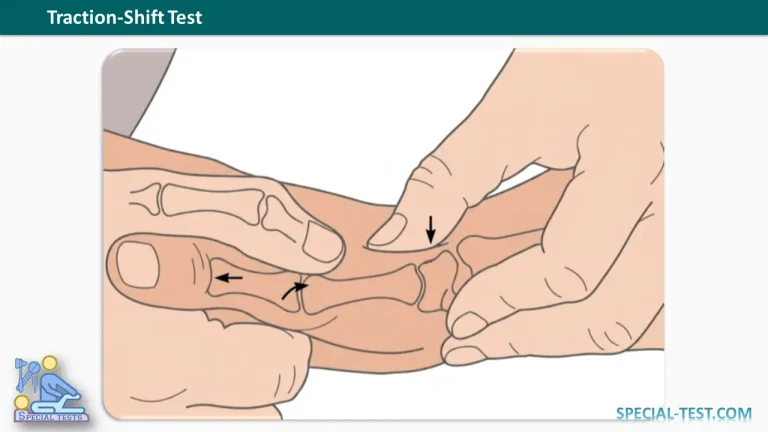
The Traction-Shift Test, also known as the Subluxation-Relocation Test, is a clinical examination maneuver used to evaluate osteoarthritis of the first carpometacarpal (CMC) joint, commonly called thumb basal joint arthritis. This orthopedic special test helps clinicians identify painful degenerative changes and abnormal joint movement at the base of the thumb.
Thumb CMC osteoarthritis is a frequent cause of thumb pain, reduced grip strength, and difficulty performing everyday activities such as opening jars, turning keys, and pinching objects.
The Traction-Shift Test is particularly useful during the physical examination of patients with suspected thumb CMC arthritis. Research has demonstrated a sensitivity of 66.7% and specificity of 100% in one prospective case-control study, suggesting that a positive result can provide valuable diagnostic information.
What Is the Traction-Shift Test?
The Traction-Shift Test is a provocative orthopedic examination technique designed to assess the first CMC joint, which is formed by the trapezium bone and the base of the first metacarpal.
This saddle-shaped joint allows the thumb to perform important movements, including opposition, abduction, flexion, and extension. However, its mobility and mechanical loading can contribute to degenerative joint changes.
The test combines longitudinal traction with controlled pressure and movement of the first metacarpal to reproduce symptoms associated with thumb CMC osteoarthritis.
The primary indication for the Traction-Shift Test is suspected osteoarthritis of the thumb carpometacarpal joint.
It may also help clinicians evaluate painful joint instability or subluxation associated with degenerative changes.
How to Perform the Traction-Shift Test
The Traction-Shift Test should be performed gently by a trained healthcare professional to avoid unnecessary pain or injury.
Patient Position
The patient is seated comfortably with the affected arm relaxed. The examiner supports the patient’s forearm and wrist to maintain a stable position during the examination.
Examiner Position and Procedure
- Stabilize the wrist and forearm: The examiner supports the patient’s forearm and wrist with one hand, preventing unwanted movement during the maneuver.
- Grasp the first metacarpal: Using the opposite hand, the examiner firmly but gently holds the distal portion (head) of the first metacarpal.
- Apply longitudinal traction: The examiner applies gentle traction along the longitudinal axis of the first metacarpal while simultaneously extending the patient’s thumb.
- Apply dorsal pressure: At the same time, the examiner uses their thumb to exert controlled pressure against the dorsal aspect of the base of the first metacarpal, near the CMC joint.
- Assess the patient’s response: The examiner observes whether the maneuver reproduces pain at the thumb base and whether crepitus or abnormal joint movement is present.
Some descriptions of the subluxation-relocation technique additionally use alternating dorsal and palmar pressure over the metacarpal base to provoke controlled subluxation and relocation of the joint.
The examiner should avoid excessive force and discontinue the maneuver if severe discomfort occurs.
What Is a Positive Traction-Shift Test?
A positive Traction-Shift Test is characterized by reproduction of the patient’s familiar pain at the base of the thumb during the maneuver. Crepitus may also be detected.
Common positive findings include:
- Pain: Localized pain over the first CMC joint during traction and shifting.
- Crepitus: A palpable grinding, crackling, or grating sensation during joint movement.
- Painful joint translation: Discomfort accompanying subluxation and relocation of the first metacarpal base.
These findings suggest possible degenerative changes within the thumb CMC joint.
Crepitus can accompany cartilage deterioration and irregular joint surfaces, although its presence alone does not establish a diagnosis of osteoarthritis.
A positive Traction-Shift Test should therefore be interpreted alongside the patient’s symptoms, physical examination findings, and radiographic assessment.
Traction-Shift Test Accuracy: Sensitivity and Specificity
The diagnostic performance of the Traction-Shift Test was evaluated by Choa, Parvizi, and Giele in a prospective case-control study published in the Journal of Hand Surgery (European Volume) in 2014.
The researchers compared the Traction-Shift Test with the Thumb CMC Grind Test in 30 patients with thumb CMC osteoarthritis and 30 unaffected controls.
Diagnostic Accuracy Results
| Diagnostic Parameter | Traction-Shift Test |
|---|---|
| Sensitivity | 66.7% |
| Specificity | 100% |
| Positive Predictive Value | 100% |
| Negative Predictive Value | 75% |
What Do These Results Mean?
Sensitivity of 66.7%: The test correctly identified approximately two-thirds of patients who had thumb CMC osteoarthritis. Consequently, a negative result cannot reliably exclude the condition.
Specificity of 100%: None of the unaffected participants in this particular study had a false-positive result. This does not mean that the test will always have perfect specificity in other populations.
Positive Predictive Value of 100%: Every positive test in the study occurred in a participant with thumb CMC osteoarthritis.
Negative Predictive Value of 75%: Among participants who tested negative, 75% were unaffected.
Importantly, predictive values depend on disease prevalence and patient selection. The findings from this relatively small case-control study should not be interpreted as universal diagnostic performance estimates.
Traction-Shift Test vs. Thumb CMC Grind Test
The Thumb CMC Grind Test is another commonly used clinical examination maneuver for diagnosing arthritis at the base of the thumb.
Unlike the Traction-Shift Test, which primarily uses traction and controlled joint translation, the Grind Test involves axial compression and rotation of the first metacarpal against the trapezium.
In the 2014 study, the following results were reported:
| Parameter | Traction-Shift Test | Grind Test |
|---|---|---|
| Sensitivity | 66.7% | 30% |
| Specificity | 100% | 96.7% |
| Positive Predictive Value | 100% | 90% |
| Negative Predictive Value | 75% | 58% |
The Traction-Shift Test demonstrated higher sensitivity and specificity than the Grind Test in this study.
However, these findings do not establish that the Traction-Shift Test is superior to every other examination technique. Additional maneuvers, including the lever, thumb extension, and pressure-shear tests, have also been investigated for diagnosing CMC osteoarthritis.
Clinical Significance of the Traction-Shift Test
The Traction-Shift Test provides a useful assessment of patients who present with pain around the thumb base.
Typical symptoms of thumb CMC osteoarthritis include pain during pinching and gripping, tenderness over the joint, stiffness, reduced hand function, and sometimes visible swelling or deformity.
During clinical evaluation, the examiner should also consider other potential causes of thumb or radial-sided wrist pain, such as De Quervain’s tenosynovitis or other musculoskeletal conditions.
Although a positive result supports suspicion of thumb CMC osteoarthritis, the Traction-Shift Test should not be used as a standalone diagnostic method.
A comprehensive assessment may include medical history, joint palpation, evaluation of thumb mobility and stability, additional provocative tests, and plain radiographs.
Radiographic severity does not always correlate closely with symptoms, so clinical findings and patient-reported limitations remain essential.
Frequently Asked Questions (FAQ)
1. What is the Traction-Shift Test used for?
The Traction-Shift Test is primarily used to assess suspected osteoarthritis of the first carpometacarpal joint of the thumb. It helps identify pain and abnormal joint movement associated with degeneration at the thumb base.
2. What indicates a positive Traction-Shift Test?
A positive result occurs when the maneuver reproduces familiar pain localized to the first CMC joint. Crepitus or painful joint shifting may also be observed, supporting the suspicion of thumb CMC arthritis.
3. What is the sensitivity of the Traction-Shift Test?
The reported sensitivity is 66.7%, based on a prospective case-control study involving 30 patients with thumb CMC osteoarthritis and 30 unaffected controls. A negative result does not definitively rule out arthritis.
4. What is the specificity of the Traction-Shift Test?
The test demonstrated 100% specificity in the 2014 study. However, this figure reflects the study sample and should not be assumed to apply to every clinical population.
5. Is the Traction-Shift Test better than the Grind Test?
In the study by Choa and colleagues, the Traction-Shift Test had higher sensitivity and specificity than the traditional Thumb CMC Grind Test. Nevertheless, test selection should consider the complete clinical examination and the available evidence.
6. Can the Traction-Shift Test confirm thumb arthritis?
A positive result provides supportive evidence for thumb CMC osteoarthritis but cannot establish the diagnosis alone. The clinician should correlate the test with symptoms, physical examination findings, and radiographs when appropriate.
7. Is the Traction-Shift Test painful?
The maneuver may temporarily reproduce pain in patients with thumb CMC arthritis. It should be performed carefully, using gentle controlled forces, and stopped if significant discomfort occurs.
8. What is the difference between the Traction-Shift Test and the Grind Test?
The Traction-Shift Test uses longitudinal traction and controlled translation of the first metacarpal to reproduce symptoms. In contrast, the Grind Test applies compression and rotation to the CMC joint. Both assess possible thumb basal joint osteoarthritis using different mechanical stresses.
Conclusion
The Traction-Shift Test is a valuable orthopedic special test for evaluating suspected thumb CMC osteoarthritis. By combining longitudinal traction, thumb extension, and controlled pressure over the first metacarpal base, the maneuver can reproduce joint pain and reveal crepitus or painful instability.
With a reported sensitivity of 66.7% and specificity of 100% in one prospective case-control study, the test demonstrated promising diagnostic performance compared with the conventional Grind Test.
However, a negative test does not exclude osteoarthritis, and positive findings should always be interpreted within a comprehensive clinical assessment.
References
- Choa RM, Parvizi N, Giele HP. A prospective case-control study to compare the sensitivity and specificity of the grind and traction-shift (subluxation-relocation) clinical tests in osteoarthritis of the thumb carpometacarpal joint. J Hand Surg Eur Vol. 2014;39(3):282–285.
PubMed – PMID: 24127463 - Orthofixar. Traction-Shift Test of the Thumb: Procedure, Positive Findings, and Test Reliability.
Orthofixar – Traction-Shift Test - Zarb RM, Sasor SE. Physical Examination and Radiographic Staging of Thumb Carpometacarpal Arthritis. Hand Clin. 2022;38(2):141–148.
PubMed – PMID: 35465932 - Evaluation of Physical Examination Tests for Thumb Basal Joint Osteoarthritis.
PubMed – PMID: 27418899 - Psychometric Properties of Body Structures and Function Measures in Non-Surgical Thumb CMC OA: A Systematic Review.
NCBI PubMed Central – PMC10867279 - The Diagnostic Clinical Value of Thumb Metacarpal Grind, Pressure-Shear, Flexion, and Extension Tests for Carpometacarpal Osteoarthritis.
PubMed – PMID: 29150383