Yeoman Test: Procedure, Positive Signs & SI Joint Accuracy
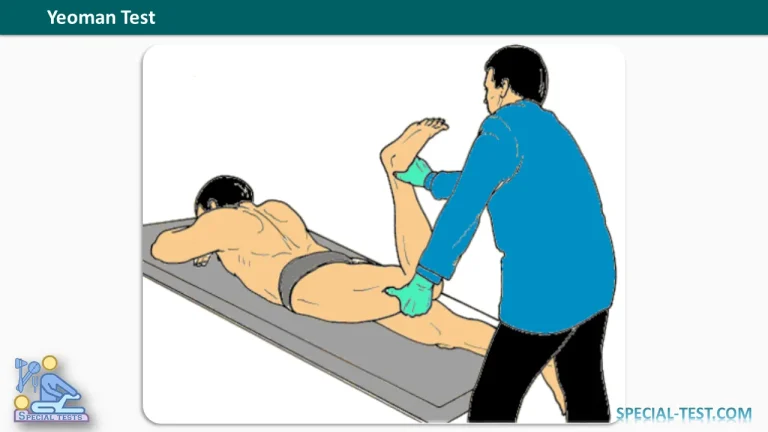
The Yeoman Test is an orthopedic physical examination maneuver used to assess sacroiliac joint (SI joint) pain and possible anterior sacroiliac ligament involvement. It is commonly performed during the evaluation of patients experiencing lower back pain, buttock discomfort, or suspected sacroiliac joint dysfunction.
The examination involves passive hip extension while the patient lies prone with the knee flexed to approximately 90 degrees. This movement applies mechanical stress to structures surrounding the sacroiliac joint and may reproduce the patient’s symptoms.
Although the Yeoman Test can provide useful clinical information, it should not be used alone to establish a definitive diagnosis of sacroiliac joint pathology.
What Is the Yeoman Test Used For?
The primary purpose of the Yeoman Test is to assess pain potentially originating from the sacroiliac joint, particularly structures surrounding its anterior ligaments.
The sacroiliac joints connect the sacrum, located at the base of the spine, to the iliac bones of the pelvis. These joints help transfer forces between the spine and lower extremities while providing pelvic stability.
The Yeoman Test may be included in a clinical examination when evaluating:
- Sacroiliac joint pain: Reproduction of familiar pain over the posterior pelvis may suggest involvement of the SI joint complex.
- Sacroiliac ligament irritation: The maneuver places tension on structures associated with the anterior sacroiliac ligaments.
- Lower back and buttock pain: The test may help investigate possible pain generators during a comprehensive musculoskeletal assessment.
- Hip-related symptoms: Hip extension may provoke discomfort associated with hip pathology or tight anterior hip musculature.
- Femoral nerve irritation: Tingling or abnormal sensation in the anterior thigh during the maneuver may suggest neural tension.
Because several anatomical structures are stressed simultaneously, a positive result cannot independently identify the precise source of pain.
How to Perform the Yeoman Test
The Yeoman Test is performed with the patient lying face down on an examination table. A qualified healthcare professional should conduct the maneuver using controlled movements.
Step-by-Step Procedure
- Patient positioning: Ask the patient to lie in the prone position, with both lower extremities extended and the pelvis supported on the examination table.
- Knee flexion: Flex the knee of the affected lower extremity to approximately 90 degrees.
- Pelvic stabilization: Stabilize the pelvis on the tested side to minimize excessive pelvic movement during hip extension.
- Hip extension: Gently lift the patient’s thigh away from the examination table while maintaining knee flexion. This produces passive hip extension.
- Symptom assessment: Ask the patient whether the movement reproduces their familiar pain, and identify the precise location and nature of the symptoms.
- Comparison: Repeat the maneuver on the opposite side when clinically appropriate to compare symptom responses.
The movement should be gradual and controlled. Excessive force or aggressive hip hyperextension is unnecessary and may aggravate symptoms.
Biomechanical Principle
The Yeoman Test places tension on several structures surrounding the pelvis, hip, and lumbar spine.
Traditionally, the maneuver is described as initially stressing the posterior structures of the sacroiliac joint before transferring greater tension toward the anterior sacroiliac ligaments as hip extension progresses.
However, this biomechanical explanation does not establish that the test selectively isolates the anterior sacroiliac ligaments.
Other structures affected during the examination may include the hip joint, lumbar spine, iliopsoas muscle, rectus femoris, and femoral nerve.
What Is a Positive Yeoman Test?
A positive Yeoman Test is generally defined as reproduction of the patient’s familiar pain in the sacroiliac joint region during passive hip extension.
The location and characteristics of the provoked symptoms are important when interpreting the examination.
1. Pain Over the Sacroiliac Joint
Pain localized near the posterior sacroiliac joint may suggest irritation of the SI joint complex or surrounding ligamentous structures.
Traditionally, reproduction of pain in this region has been associated with anterior sacroiliac ligament involvement.
However, the examination cannot confirm a specific ligament injury or establish sacroiliitis without additional clinical assessment.
2. Pain in the Lumbar Spine
Pain reproduced primarily in the lower back rather than the sacroiliac region may indicate that lumbar structures contribute to the patient’s symptoms.
Potential sources include lumbar facet joints and other mechanical causes of lower back pain.
Additional spinal examination procedures are necessary to investigate these possibilities.
3. Pain in the Anterior Hip or Thigh
Discomfort over the anterior hip or thigh may reflect tension involving the hip joint or anterior thigh musculature.
For example, reduced flexibility of the rectus femoris or hip flexor muscles may influence the patient’s response during the maneuver.
This finding should not automatically be interpreted as sacroiliac joint dysfunction.
4. Anterior Thigh Paresthesia
Tingling, burning, or abnormal sensation in the anterior thigh during testing may suggest femoral nerve tension or irritation.
Neurological symptoms require further assessment, including appropriate evaluation of sensation, muscle strength, and reflexes.
Yeoman Test Sensitivity and Specificity
The diagnostic accuracy of the Yeoman Test has been investigated in clinical research, with findings that differ from some commonly quoted educational figures.
Commonly Reported Accuracy
Some orthopedic educational references report the following values:
- Sensitivity: 93%
- Specificity: 89%
These values are listed by Orthofixar, but they should not be treated as universally established estimates of the Yeoman Test’s diagnostic accuracy.
Evidence From Clinical Research
A study by Nejati et al. (2020), published in the Journal of Chiropractic Medicine, evaluated physical examination tests for suspected sacroiliac joint dysfunction.
The researchers examined 48 selected patients and compared physical examination findings with responses to diagnostic sacroiliac joint blocks.
For the Yeoman Test, the study reported:
| Diagnostic Measure | Result |
|---|---|
| Sensitivity | 64.1% |
| Specificity | 33.3% |
| Positive predictive value | 80.6% |
| Negative predictive value | 17.6% |
These results suggest that the Yeoman Test has limited diagnostic value as an isolated examination maneuver in the studied population.
The relatively low specificity indicates that patients without a positive diagnostic SI joint block may still experience pain during the Yeoman Test.
Because the study included a relatively small, selected patient population, its findings should also be interpreted cautiously.
Can the Yeoman Test Reliably Diagnose SI Joint Pain?
Current evidence does not support relying on the Yeoman Test alone to confirm sacroiliac joint pain.
A systematic review and meta-analysis published by Saueressig et al. (2021) found that even combinations of sacroiliac joint pain provocation tests have limitations when used to confirm the SI joint as the source of pain.
The review suggested that negative results from a cluster of provocation tests may be more useful for reducing suspicion of SI joint pain than positive findings are for confirming it.
Importantly, those pooled findings relate to test clusters rather than the Yeoman Test individually.
Yeoman Test vs. Other Sacroiliac Joint Tests
The Yeoman Test is one of several clinical maneuvers that may be used to assess potential sacroiliac joint pain.
Other commonly used tests include:
- FABER Test (Patrick’s Test): Combines hip flexion, abduction, and external rotation to assess pain involving the hip or sacroiliac region.
- Gaenslen Test: Applies opposing forces through the lower extremities to stress structures around the pelvis and sacroiliac joints.
- Thigh Thrust Test: Applies a controlled force through the femur to provoke symptoms associated with the sacroiliac joint.
- Sacroiliac Compression Test: Uses directed pressure through the pelvis to assess reproduction of familiar SI joint pain.
- Sacroiliac Distraction Test: Applies outward pressure through the anterior pelvis to stress the sacroiliac region.
Clinical guidelines commonly emphasize the combined use of several pain provocation tests rather than reliance on a single maneuver.
A frequently recommended cluster includes thigh thrust, distraction, compression, Gaenslen, and FABER tests.
The Yeoman Test can serve as an additional examination finding, but it is not part of that standard five-test cluster.
Clinical Importance and Limitations
The Yeoman Test is relatively simple to perform and requires no specialized equipment. It may provide useful information about symptom reproduction during hip extension.
However, clinicians should recognize several limitations.
First, the maneuver does not exclusively stress the sacroiliac joint. It may reproduce symptoms arising from the lumbar spine, hip joint, surrounding musculature, or neural structures.
Second, a positive finding does not establish the underlying diagnosis or distinguish reliably between intra-articular SI joint pathology and other causes of pelvic pain.
Third, the patient’s medical history, pain distribution, neurological findings, and results of additional physical examination procedures remain essential.
When diagnostic uncertainty persists, clinicians may consider imaging to investigate alternative pathology or image-guided diagnostic sacroiliac joint injections in appropriately selected patients.
Clinical takeaway: The Yeoman Test is best regarded as a supplementary pain provocation maneuver rather than a definitive diagnostic test for sacroiliac joint dysfunction.
Frequently Asked Questions (FAQ)
1. What does the Yeoman Test assess?
The Yeoman Test assesses whether passive hip extension reproduces symptoms potentially associated with the sacroiliac joint, particularly its surrounding ligamentous structures. It also stresses structures around the hip and lumbar spine.
2. How do you perform the Yeoman Test?
The patient lies prone with the knee flexed to approximately 90 degrees. The examiner stabilizes the pelvis and gently raises the thigh from the examination table to extend the hip while monitoring for reproduction of pain.
3. What indicates a positive Yeoman Test?
A positive result generally occurs when the maneuver reproduces the patient’s familiar pain over the sacroiliac joint region. Pain occurring elsewhere requires careful interpretation because it may arise from other musculoskeletal structures.
4. What is the sensitivity of the Yeoman Test?
Although a sensitivity of 93% is sometimes quoted in orthopedic educational resources, Nejati et al. (2020) reported a sensitivity of 64.1% when the test was compared with sacroiliac joint blocks.
5. What is the specificity of the Yeoman Test?
Some sources report 89% specificity. However, the 2020 study by Nejati and colleagues reported 33.3% specificity, indicating substantial potential for false-positive results in the selected study population.
6. Can a positive Yeoman Test confirm sacroiliitis?
No. A positive Yeoman Test cannot independently diagnose sacroiliitis. Clinical history, examination findings, and appropriate additional investigations are necessary to determine whether inflammatory sacroiliac joint disease is present.
7. Is the Yeoman Test the same as the Gaenslen Test?
No. Both are used in the evaluation of sacroiliac joint pain, but the techniques differ. The Yeoman Test involves passive hip extension with the patient prone, whereas the Gaenslen Test typically involves the patient lying supine with one hip flexed and the opposite hip extended.
8. Why might the Yeoman Test cause anterior thigh pain?
Anterior thigh pain may result from tension on the rectus femoris, hip flexor muscles, or other anterior hip structures. Tingling or altered sensation may suggest neural involvement, including possible femoral nerve tension.
9. Is the Yeoman Test reliable for diagnosing sacroiliac joint dysfunction?
The Yeoman Test has limited evidence supporting its diagnostic accuracy as a standalone examination. Clinicians generally obtain more meaningful information by combining findings from the medical history, physical examination, and multiple sacroiliac pain provocation tests.
Conclusion
The Yeoman Test is a clinical orthopedic examination maneuver used to evaluate potential sacroiliac joint pain through controlled passive hip extension with the knee flexed.
Reproduction of familiar pain over the sacroiliac region may raise suspicion of SI joint involvement, while lumbar pain, hip discomfort, or anterior thigh paresthesia may indicate alternative sources of symptoms.
Although some educational references report high sensitivity and specificity, published clinical research has identified substantially lower diagnostic accuracy.
Therefore, the Yeoman Test should be interpreted as part of a comprehensive musculoskeletal examination and should not be used independently to confirm sacroiliac joint pathology.
References
- Orthofixar. Yeoman Test: Procedure, Positive Findings, Sensitivity and Specificity. Updated January 2026. Orthofixar – Yeoman Test
- Nejati P, Sartaj E, Imani F, et al. Accuracy of the Diagnostic Tests of Sacroiliac Joint Dysfunction. Journal of Chiropractic Medicine. 2020;19(1):28–37. DOI: 10.1016/j.jcm.2019.12.002. PubMed – PMID: 33192189 | NCBI Full Text
- Successful Diagnosis of Sacroiliac Joint Dysfunction. Journal of Pain Research. 2021. NCBI – Full Article
- Saueressig T, Owen PJ, Diemer F, Zebisch J, Belavy DL. Diagnostic Accuracy of Clusters of Pain Provocation Tests for Detecting Sacroiliac Joint Pain: Systematic Review With Meta-analysis. Journal of Orthopaedic & Sports Physical Therapy. 2021;51(9):422–431. DOI: 10.2519/jospt.2021.10469. PubMed – PMID: 34210160
- McCormick ZL, et al. Consensus Practice Guidelines on Sacroiliac Joint Complex Pain From a Multispecialty, International Working Group. Pain Medicine. 2025;26(12):817–917. NCBI – Full Article