Three-Phase Hyperextension Test (Mennell Sign): Procedure, Positive Results, and Clinical Interpretation
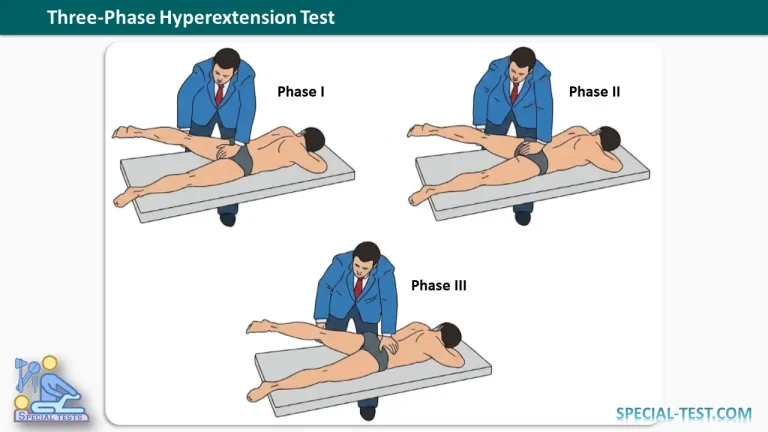
The Three-Phase Hyperextension Test, also known as the Mennell Test, is a clinical orthopedic examination used to help differentiate pain originating from the hip joint, sacroiliac (SI) joint, or lumbar spine. The test involves passive hip extension while the examiner stabilizes different anatomical structures to assess pain reproduction and regional mobility.
This orthopedic special test is particularly useful during the clinical evaluation of patients presenting with lower back pain, buttock pain, sacroiliac joint discomfort, or restricted hip movement.
Although the entire procedure is sometimes called the Mennell Test, the term Mennell sign is more specifically associated with the second phase, which evaluates the sacroiliac joint region.
What Is the Purpose of the Three-Phase Hyperextension Test?
The primary purpose of the Three-Phase Hyperextension Test is to help identify the possible anatomical source of pain involving three regions:
- Hip joint: To investigate hip pathology, restricted hip extension, or muscle tightness involving the iliopsoas and rectus femoris.
- Sacroiliac joint: To evaluate pain associated with sacroiliac joint irritation, inflammation, or possible mobility abnormalities.
- Lumbar spine: To investigate symptoms potentially related to the lumbosacral junction, lumbar segmental dysfunction, or other lumbar disorders.
By changing the position of the stabilizing hand during each phase, the examiner alters the mechanical stresses applied to the pelvis, sacroiliac joint, and lower lumbar spine.
The findings may help guide further clinical examination but cannot independently establish a definitive diagnosis.
How to Perform the Three-Phase Hyperextension Test
The patient lies in the prone position (face down) on an examination table, with both lower limbs extended and relaxed.
The examiner stands beside the leg being tested and performs three sequential phases of passive hip extension.
Phase 1: Hip Joint Assessment
The first phase primarily evaluates the hip joint and surrounding soft tissues.
Procedure:
- Position the patient prone with the knee of the tested leg extended.
- Stabilize the ipsilateral ilium (pelvic bone) using one hand to minimize pelvic movement.
- Grasp and support the patient’s extended lower limb with the other hand.
- Slowly lift the leg into passive hip hyperextension.
- Observe the available range of motion and ask whether the movement reproduces pain.
Positive finding:
Pain during this phase may suggest a hip-related disorder or shortening of the hip flexor muscles, particularly the iliopsoas or rectus femoris.
Restricted extension may also be associated with soft-tissue tightness or protective muscle guarding. These findings should be correlated with other hip examination tests.
Phase 2: Sacroiliac Joint Assessment (Mennell Sign)
The second phase focuses on the sacroiliac joint and is traditionally associated with the Mennell sign.
Procedure:
- Maintain the patient in the prone position.
- Place the stabilizing hand over the sacrum, oriented parallel to the sacroiliac joint.
- Support the patient’s extended leg with the opposite hand.
- Slowly raise the leg into passive hip hyperextension.
- Assess whether the movement reproduces pain around the sacroiliac joint or posterior pelvis.
Positive finding:
Pain reproduced in the sacroiliac region during this phase may suggest sacroiliac joint irritation or dysfunction.
Possible associated conditions include:
- Sacroiliac joint pain or mechanical irritation.
- Sacroiliac joint mobility abnormalities.
- Inflammatory sacroiliitis.
- Axial spondyloarthritis, including ankylosing spondylitis.
However, a positive Mennell sign does not confirm sacroiliitis or ankylosing spondylitis. These conditions require additional clinical assessment and, when appropriate, laboratory investigations or imaging.
Phase 3: Lumbar Spine and Lumbosacral Junction Assessment
The third phase assesses symptoms potentially originating from the lower lumbar spine and lumbosacral junction.
Procedure:
- Keep the patient prone with the tested lower limb extended.
- Place the heel of one hand over the region of the fifth lumbar vertebra (L5) to stabilize the lower lumbar spine.
- Using the opposite hand, passively extend the patient’s leg at the hip.
- Observe the patient’s response and identify any pain reproduced in the lower back.
- If clinically appropriate, reposition the stabilizing hand progressively toward higher lumbar segments to assess additional regions.
Positive finding:
Pain during this phase may suggest a symptomatic disorder involving the lumbosacral junction.
Potential contributors include:
- Lumbar segmental mobility restrictions.
- Lumbar facet joint irritation.
- Mechanical lower back pain.
- Intervertebral disc-related conditions.
Importantly, the test cannot independently identify a lumbar disc protrusion, disc extrusion, or specific vertebral lesion.
How to Interpret the Three-Phase Hyperextension Test Results
Under normal conditions, the examination should not reproduce the patient’s familiar pain.
Traditional descriptions of the test indicate that the hip may demonstrate approximately 10–20 degrees of extension beyond neutral, although actual movement varies between individuals.
The sacroiliac joint normally permits only limited movement, while the lumbar spine can accommodate some elastic extension.
Positive Test Findings by Phase
| Test Phase | Stabilized Structure | Possible Clinical Significance |
|---|---|---|
| Phase 1 | Ilium (pelvis) | Hip pathology or hip flexor muscle tightness |
| Phase 2 | Sacrum | Sacroiliac joint irritation, sacroiliitis, or SI joint-related pain |
| Phase 3 | Lower lumbar spine (L5) | Lumbosacral dysfunction or mechanical lumbar pain |
A positive Three-Phase Hyperextension Test is generally characterized by reproduction of the patient’s familiar pain during one or more phases.
The examiner should document the precise location, intensity, and nature of the symptoms, as well as any differences between the right and left sides.
A negative result means that the maneuver does not reproduce the patient’s typical pain. However, a negative result does not completely exclude hip, sacroiliac, or lumbar spine pathology.
Clinical Significance and Diagnostic Accuracy
The Three-Phase Hyperextension Test provides a structured approach to the assessment of lower back, pelvic, and hip pain.
Nevertheless, its findings must be interpreted cautiously because the maneuver may place mechanical stress on multiple anatomical structures simultaneously.
High-quality evidence establishing the sensitivity and specificity of the exact three-phase procedure is limited. Therefore, it should not be regarded as a definitive diagnostic tool.
Research investigating sacroiliac joint examination has demonstrated that combining several pain provocation tests is generally more informative than relying on a single maneuver.
A systematic review and meta-analysis published in the Journal of Orthopaedic & Sports Physical Therapy in 2021 found that clusters of sacroiliac joint provocation tests had limited ability to confirm SI joint pain, although negative clusters were more useful for reducing the likelihood of SI joint involvement.
For a comprehensive clinical evaluation, clinicians may combine the Mennell Test with other examinations, including:
- FABER (Patrick) Test.
- Gaenslen’s Test.
- Sacroiliac Joint Compression Test.
- Sacroiliac Joint Distraction Test.
- Thigh Thrust Test.
Neurological examination, lumbar spine assessment, and additional hip mobility tests may also be necessary depending on the patient’s symptoms.
Precautions and Clinical Considerations
The Three-Phase Hyperextension Test should be performed by a qualified healthcare professional familiar with musculoskeletal examination techniques.
Movements should be slow and controlled, avoiding excessive lumbar extension or forceful hip manipulation.
The examiner should stop the test if the patient experiences severe pain, increasing neurological symptoms, or significant discomfort.
Additional caution is necessary in patients with suspected fractures, recent spinal or hip surgery, severe osteoporosis, or conditions associated with spinal instability.
The test is a component of clinical assessment rather than a replacement for medical history, physical examination, or appropriate diagnostic investigations.
Frequently Asked Questions (FAQs)
1. What Is the Three-Phase Hyperextension Test Used For?
The Three-Phase Hyperextension Test is used to help differentiate whether pain may be associated with the hip joint, sacroiliac joint, or lumbar spine. It is commonly included in examinations for lower back pain, pelvic discomfort, and hip mobility restrictions.
2. What Is a Positive Mennell Sign?
A positive Mennell sign traditionally refers to pain reproduced in the sacroiliac joint region during the second phase of the Three-Phase Hyperextension Test, when the sacrum is stabilized and the leg is passively extended. It suggests possible SI joint involvement but is not diagnostic on its own.
3. What Position Is Used for the Three-Phase Hyperextension Test?
The patient is positioned prone, lying face down on an examination table. The examiner raises the extended lower limb while stabilizing the ilium, sacrum, or lumbar spine, depending on the phase being performed.
4. What Is the Difference Between the Mennell Test and the FABER Test?
The Mennell Test uses passive hip extension with sacral stabilization to provoke symptoms around the sacroiliac joint.
The FABER Test involves hip flexion, abduction, and external rotation. It may provoke pain associated with hip or sacroiliac joint disorders.
Both are orthopedic examination maneuvers, but neither can independently establish a definitive diagnosis.
5. Can the Three-Phase Hyperextension Test Diagnose Ankylosing Spondylitis?
No. Pain during the sacroiliac phase may occur in patients with inflammatory sacroiliitis, including those with ankylosing spondylitis. However, the diagnosis of axial spondyloarthritis requires assessment of clinical features and, when indicated, laboratory tests and imaging studies.
6. Can This Test Identify a Lumbar Disc Herniation?
The third phase may reproduce pain associated with lumbar spine disorders, including some disc-related conditions. However, a positive result does not confirm a herniated disc. Additional neurological assessment and appropriate imaging may be necessary when a disc lesion is suspected.
7. What Does a Negative Three-Phase Hyperextension Test Mean?
A negative test means that passive hip extension does not reproduce the patient’s familiar pain during the three examination phases. This finding may help the clinician narrow the differential diagnosis, but it does not definitively exclude disorders of the hip, sacroiliac joint, or lumbar spine.
Conclusion
The Three-Phase Hyperextension Test (Mennell Test) is a traditional orthopedic examination maneuver used to assess symptoms associated with the hip, sacroiliac joint, and lumbar spine.
The test consists of three phases: stabilization of the ilium for hip assessment, stabilization of the sacrum for sacroiliac joint assessment, and stabilization of the lumbar spine for evaluation of the lumbosacral region.
Pain reproduced during a particular phase may suggest involvement of the corresponding anatomical region. However, because the diagnostic accuracy of the exact procedure is not well established, results should always be interpreted alongside the patient’s medical history, other physical examination findings, and any necessary investigations.
References
- OrthoFixar. Three Phase Hyperextension Test: Procedure, Clinical Interpretation, and Mennell Sign. Updated March 2025. Read on OrthoFixar.
- Sacroiliac Joint Pain. StatPearls. NCBI Bookshelf. Discussion of clinical evaluation, differential diagnosis, and sacroiliac joint provocation tests. Read on NCBI.
- Saueressig T, Owen PJ, Diemer F, Zebisch J, Belavy DL. Diagnostic Accuracy of Clusters of Pain Provocation Tests for Detecting Sacroiliac Joint Pain: Systematic Review With Meta-analysis. J Orthop Sports Phys Ther. 2021;51(9):422–431. PubMed PMID: 34210160.
- McCormick ZL, et al. Consensus Practice Guidelines on Sacroiliac Joint Complex Pain From a Multispecialty, International Working Group. Pain Medicine. 2025;26(12):817–917. PubMed PMID: 41318933.
- Spondyloarthritis in Over 16s: Diagnosis and Management. NICE Clinical Guideline NG65. NCBI Bookshelf. Read on NCBI.