Prone Instability Test: Purpose, Procedure, Positive Findings, & Clinical Significance
What Is the Prone Instability Test?
The Prone Instability Test (PIT) is an orthopedic physical examination used to assess suspected lumbar segmental instability in patients experiencing mechanical or chronic low back pain. It evaluates whether activating the spinal stabilizing muscles reduces pain produced by pressure over the lumbar vertebrae.
Lumbar segmental instability refers to abnormal or poorly controlled movement between adjacent vertebral segments. It may be associated with impaired muscular stabilization, degenerative spinal changes, and recurrent episodes of mechanical low back pain.
The Prone Instability Test compares the patient’s pain response during two conditions: when the lumbar muscles are relatively relaxed and when they are actively engaged.
A reduction in pain during muscle activation suggests that muscular stabilization may influence the patient’s symptoms. However, the test should be interpreted alongside other clinical findings rather than used as definitive evidence of structural instability.
What Is the Prone Instability Test Used For?
The primary purpose of the lumbar Prone Instability Test is to help clinicians evaluate whether impaired segmental stabilization contributes to a patient’s low back pain.
Physical therapists and orthopedic clinicians commonly use this examination when assessing patients with:
- Chronic or recurrent mechanical low back pain.
- Suspected functional lumbar segmental instability.
- Difficulty controlling lumbar movements during physical activities.
- Pain associated with certain spinal positions or movements.
- Possible impairment of lumbar stabilizing muscle function.
The test may also contribute to clinical decision-making when selecting patients for lumbar stabilization exercises and motor control rehabilitation.
Importantly, it does not independently establish the presence of excessive vertebral motion or identify the exact anatomical structure responsible for pain.
How to Perform the Prone Instability Test
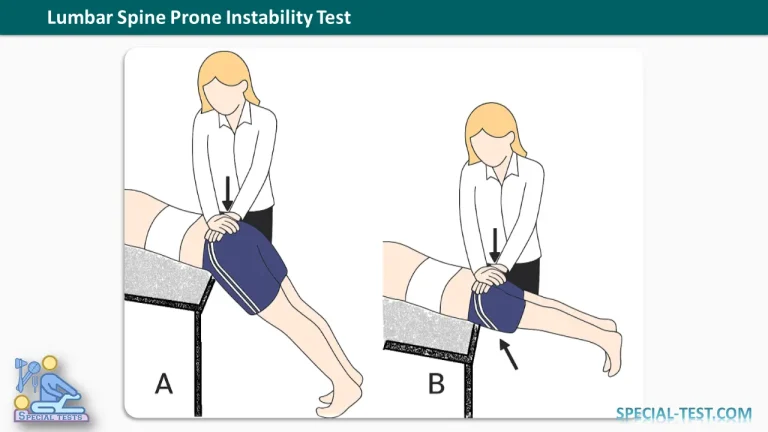
The Prone Instability Test is performed with the patient lying face down on an examination table. The examiner compares the patient’s pain response before and during active contraction of the lumbar stabilizing musculature.
Step-by-Step Procedure
- Patient positioning: Ask the patient to lie prone on the examination table, with the trunk and pelvis supported and both legs extending beyond the edge of the table. The feet should rest comfortably on the floor.
- Initial pressure application: With the patient’s legs relaxed, the examiner applies controlled posterior-to-anterior pressure over the lumbar spinous processes, assessing the relevant spinal segments.
- Assessment of pain: The patient reports whether the pressure reproduces their familiar low back pain. The examiner identifies and records the painful lumbar segment or segments.
- Activation of stabilizing muscles: Ask the patient to lift both legs slightly off the floor while maintaining the prone position. This movement activates the lumbar extensor muscles and associated trunk stabilizers.
- Repeat pressure application: While the patient’s legs remain elevated, the examiner reapplies comparable pressure over the previously painful lumbar segment.
- Comparison of findings: Compare the patient’s pain response between the relaxed position and the active muscle contraction position to determine whether the test is positive or negative.
The examiner should use consistent pressure during both phases and avoid producing unnecessary discomfort. The test should be performed by a trained healthcare professional.
What Is a Positive Prone Instability Test?
A positive Prone Instability Test occurs when posterior-to-anterior pressure over a lumbar segment reproduces pain while the patient’s feet are resting on the floor, but the pain decreases significantly or disappears when the patient lifts their legs.
This response suggests that active muscular contraction may improve the functional stability or mechanical support of the painful lumbar region.
During leg elevation, activation of the lumbar extensors and other trunk muscles can increase spinal stiffness and alter the mechanical response to the applied pressure.
A positive finding is therefore consistent with a possible contribution from impaired lumbar stabilization or motor control.
However, a positive result does not conclusively diagnose lumbar segmental instability, and it cannot establish structural vertebral instability without further assessment.
What Is a Negative Prone Instability Test?
The Prone Instability Test is generally considered negative when:
- Posterior-to-anterior pressure does not reproduce the patient’s familiar lumbar pain.
- Pain persists without meaningful improvement when the legs are lifted.
- Muscle activation does not change the patient’s pain response during the examination.
A negative result suggests that the patient’s symptoms are not relieved by the muscular activation used during the test.
Nevertheless, a negative Prone Instability Test does not exclude lumbar instability or other causes of low back pain.
Clinical Significance of the Prone Instability Test
The Prone Instability Test may provide useful information about the relationship between lumbar muscle activation and mechanical low back pain.
Its clinical applications include evaluating suspected functional lumbar instability, assessing pain modification with muscular activation, and contributing to rehabilitation planning.
A positive result may encourage the clinician to investigate motor control deficits and consider an individualized exercise program involving trunk stabilization, lumbar extensor strengthening, and progressive functional movement training.
Research by Hicks and colleagues identified the Prone Instability Test as one of several examination findings associated with a favorable response to lumbar stabilization exercises.
However, subsequent research has not consistently validated these findings as a reliable method for predicting treatment success. Consequently, treatment selection should be based on the patient’s overall presentation rather than the test result alone.
Diagnostic Accuracy and Reliability
Although the Prone Instability Test is frequently used in musculoskeletal examinations, research has demonstrated important limitations in its diagnostic performance.
A 2015 literature review examining clinical tests for lumbar instability reported the following estimates for the Prone Instability Test:
- Sensitivity: 71%.
- Specificity: 57%.
These findings suggest that the test has limited ability to distinguish patients with lumbar instability from those without it when used independently.
Research has also shown considerable variation in interexaminer reliability.
A 2003 study reported excellent interrater reliability, with a kappa value of 0.87. In contrast, a 2011 study reported a substantially lower kappa value of 0.10, indicating poor agreement between examiners.
Differences in examiner technique, pressure application, patient selection, and interpretation of pain responses may contribute to these inconsistent findings.
A systematic review published in 2019 concluded that available evidence does not support relying on the Prone Instability Test or other individual segmental motion tests as standalone diagnostic procedures.
Therefore, the test is best regarded as one component of a comprehensive lumbar spine assessment.
Prone Instability Test in Clinical Practice
When evaluating a patient with chronic low back pain, clinicians should interpret the Prone Instability Test alongside the patient’s medical history, symptom characteristics, neurological examination, and other relevant musculoskeletal assessments.
Additional findings, such as aberrant lumbar movement patterns, painful catching during movement, and altered motor control, may help develop a more complete clinical picture.
Where structural instability is strongly suspected, further medical evaluation and appropriately selected imaging may be necessary.
The main clinical value of the Prone Instability Test is its ability to demonstrate whether active spinal muscle engagement modifies mechanically provoked lumbar pain. This information can contribute to individualized rehabilitation planning, but it should never replace a comprehensive assessment.
Frequently Asked Questions (FAQ)
1. What does the Prone Instability Test assess?
The Prone Instability Test assesses whether activation of the lumbar stabilizing muscles reduces pain caused by pressure over the lumbar vertebrae. It helps clinicians investigate suspected functional lumbar segmental instability in patients with mechanical low back pain.
2. What indicates a positive Prone Instability Test?
A positive result occurs when lumbar pressure produces pain while the patient’s feet rest on the floor, but the pain decreases or disappears when both legs are lifted. This suggests that active muscular stabilization influences the patient’s symptoms.
3. Which muscles are activated during the Prone Instability Test?
Lifting the legs activates the lumbar extensor muscles, including the erector spinae and multifidus, along with other trunk and hip muscles involved in maintaining the elevated position. Their coordinated activity can increase spinal stiffness.
4. Is the Prone Instability Test reliable?
Research findings are inconsistent. Some studies have demonstrated good to excellent agreement between examiners, whereas others have reported poor reliability. The test should therefore be interpreted with additional clinical findings rather than used alone.
5. Can the Prone Instability Test diagnose lumbar instability?
No. Although a positive result may suggest a contribution from impaired lumbar stabilization, it cannot independently confirm functional or structural lumbar instability. A complete clinical examination is required, with imaging considered when clinically appropriate.
6. What is the difference between a positive and negative Prone Instability Test?
A positive test demonstrates a reduction or disappearance of pressure-induced lumbar pain during active leg elevation. A negative test indicates that the pain does not meaningfully improve, or that the initial pressure does not reproduce the patient’s familiar symptoms.
7. Does a positive Prone Instability Test mean the patient needs stabilization exercises?
Not necessarily. A positive finding may support considering lumbar stabilization or motor control exercises, but treatment decisions should incorporate functional limitations, patient preferences, other examination findings, and response to rehabilitation.
8. Can the Prone Instability Test be used for chronic low back pain?
Yes. The test is commonly used during clinical evaluations of patients with chronic or recurrent mechanical low back pain, particularly when functional lumbar segmental instability or impaired muscular control is suspected.
References
- Orthofixar – Lumbar Spine Prone Instability Test.
- Hicks GE, et al. Interrater reliability of clinical examination measures for identification of lumbar segmental instability. Archives of Physical Medicine and Rehabilitation. 2003. PubMed PMID: 14669195.
- Hicks GE, et al. Preliminary development of a clinical prediction rule for determining which patients with low back pain will respond to a stabilization exercise program. Archives of Physical Medicine and Rehabilitation. 2005. PubMed PMID: 16181938.
- Ravenna MM, et al. Low interrater reliability of examiners performing the prone instability test. Archives of Physical Medicine and Rehabilitation. 2011. PubMed PMID: 21621668.
- A literature review of clinical tests for lumbar instability in low back pain: validity and applicability in clinical practice. 2015. PubMed PMID: 25866618.
- Evidence and recommendations for the use of segmental motion testing for patients with low back pain: a systematic review. 2019. PubMed PMID: 31733430.
- Rabin A, et al. A clinical prediction rule to identify patients with low back pain who are likely to experience short-term success following lumbar stabilization exercises: a randomized controlled validation study. 2014. PubMed PMID: 24261926.