Pheasant Test – Purpose, Procedure, Positive Signs & Clinical Significance
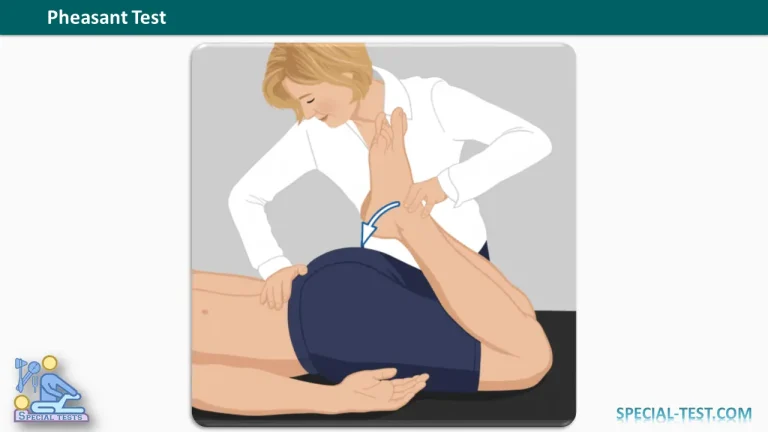
The Pheasant Test is an orthopedic physical examination maneuver used to assess possible lumbar spinal instability, nerve root irritation, and extension-related lower back pain. It involves placing the patient in a prone position while applying controlled pressure to the lumbar spine and passively flexing the knees toward the buttocks.
The test is intended to reproduce symptoms associated with mechanical stress on the lumbar spine, particularly when lumbar extension contributes to pain or neurological symptoms.
Although some clinical resources refer to the Pheasant Test as the Prone Instability Test, these names are not consistently interchangeable. The conventional Prone Instability Test involves a different examination technique and interpretation. [1, 4]
What Is the Pheasant Test Used For?
The primary purpose of the Pheasant Test is to evaluate whether mechanical loading or extension of the lumbar spine reproduces the patient’s familiar symptoms.
Clinicians may use this examination when assessing patients with suspected:
- Lumbar segmental instability: Abnormal movement or inadequate mechanical control between adjacent lumbar vertebrae.
- Lumbar nerve root irritation: Irritation or compression of spinal nerve roots that may produce radiating pain, tingling, or neurological symptoms.
- Lumbar spondylolisthesis: Forward displacement of one vertebra relative to another, which may be associated with mechanical back pain or nerve compression.
- Lumbar disc pathology: Intervertebral disc disorders that may contribute to mechanical or radicular symptoms.
- Extension-sensitive low back pain: Symptoms aggravated by movements or positions that increase lumbar extension.
The maneuver helps clinicians assess the patient’s response to spinal loading. However, a positive finding cannot independently establish the presence of any particular spinal disorder.
How to Perform the Pheasant Test
The Pheasant Test should be performed by a qualified healthcare professional familiar with lumbar spine examination techniques.
Patient Position
The patient lies prone (face down) on a firm examination table, with the trunk and lower extremities supported. The lumbar muscles should remain as relaxed as possible throughout the examination.
Examiner Position
The examiner stands beside the examination table.
One hand is placed over the posterior lumbar region to apply controlled posterior-to-anterior pressure, while the other hand is used to guide passive knee flexion.
Test Procedure
- Position the patient: Ask the patient to lie comfortably in the prone position with the lower extremities relaxed.
- Stabilize the lumbar spine: Place one hand over the posterior lumbar region and apply gentle, controlled pressure in an anterior direction.
- Flex the knees: With the opposite hand, passively bend both knees, gradually moving the heels toward the buttocks.
- Increase the movement progressively: Continue knee flexion within the patient’s comfortable range while maintaining appropriate lumbar pressure.
- Observe the response: Ask the patient whether the maneuver produces familiar lower back pain, buttock pain, or radiating symptoms into either leg.
- Record the findings: Document the location, intensity, distribution, and nature of the symptoms.
The maneuver may increase mechanical stress on the lumbar region, particularly when knee flexion and hip positioning contribute to lumbar extension.
Important: The heels do not need to touch the buttocks. Avoid forcing the knees or lumbar spine beyond a comfortable range of motion.
What Is a Positive Pheasant Test?
The Pheasant Test is considered positive when the maneuver reproduces the patient’s familiar pain or radiating symptoms, particularly when these symptoms are associated with lumbar extension.
Possible positive findings include:
- Reproduction of lower back pain during the maneuver.
- Pain radiating from the lumbar spine into one or both legs.
- Increased symptoms consistent with the patient’s usual lumbar or radicular complaints.
- Reproduction or worsening of previously reported neurological symptoms.
A positive response may raise clinical suspicion of lumbar segmental instability or nerve root irritation.
However, a positive Pheasant Test does not confirm lumbar instability, disc herniation, spondylolisthesis, or nerve compression.
The significance of the result depends on the patient’s history, neurological examination, associated findings, and, when indicated, diagnostic imaging.
Why Does the Pheasant Test Cause Pain?
The Pheasant Test places mechanical stress on structures associated with the lumbar spine.
During the maneuver, lumbar extension and posterior-to-anterior loading may provoke symptoms arising from sensitive spinal structures.
In patients with certain lumbar disorders, extension-related loading may increase discomfort involving the posterior spinal elements or aggravate pre-existing nerve root irritation.
An early study by Herron and Pheasant, published in Spine in 1980, described prone knee-flexion provocative testing in patients with lumbar disc protrusion. The authors examined neurological responses, including changes in reflexes and muscle strength, associated with mechanically induced neural compression. [2]
Nevertheless, pain reproduction is nonspecific. Similar symptoms can arise from several musculoskeletal or neurological sources, so the test must be interpreted cautiously.
Pheasant Test vs. Prone Instability Test
Although these examination names are sometimes used interchangeably, their procedures and positive findings differ in commonly described clinical protocols.
Pheasant Test: The patient lies prone while the examiner applies lumbar pressure and passively flexes the knees. The examiner observes whether the maneuver reproduces the patient’s familiar lumbar or radiating symptoms.
Prone Instability Test: The patient lies prone with the trunk supported on the examination table and the feet initially resting on the floor. The examiner applies posterior-to-anterior pressure to the lumbar spine to identify painful segments. The patient then lifts the legs off the floor to activate the spinal stabilizing muscles, and the pressure is repeated.
The conventional Prone Instability Test is positive when pain provoked during the relaxed position decreases substantially after activation of the stabilizing musculature. [4]
Importantly, a 2022 diagnostic study evaluated the Pheasant Test and prone segmental instability testing as separate clinical examinations. [3]
Pheasant Test Accuracy and Clinical Reliability
Research suggests that the Pheasant Test has limited diagnostic accuracy when used alone to identify lumbar spinal instability.
A 2022 study published in Musculoskeletal Science and Practice evaluated 202 patients with chronic low back pain. Researchers compared five clinical lumbar instability tests, including the Pheasant Test, with flexion-extension radiography.
The study found that the individual tests had very limited ability to distinguish patients with radiographic lumbar instability from those without it.
Combining selected clinical findings produced only modest improvements in diagnostic performance. [3]
Therefore, clinicians should not rely exclusively on the Pheasant Test to diagnose lumbar instability.
A more comprehensive assessment may include lumbar range-of-motion examination, neurological testing, assessment of abnormal spinal movements, and other lumbar instability tests. Imaging may be considered when clinically indicated.
Precautions and Contraindications
The Pheasant Test should be performed carefully because the maneuver may aggravate symptoms in patients with sensitive spinal structures.
Particular caution is necessary in individuals with recent lumbar trauma, suspected spinal fracture, severe osteoporosis, known spinal infection or malignancy, or significant neurological deficits.
The examiner should avoid excessive force and discontinue the test if severe pain or concerning neurological symptoms develop.
Patients with progressive weakness, new bowel or bladder dysfunction, or saddle anesthesia require urgent medical assessment rather than provocative spinal testing.
Frequently Asked Questions (FAQ)
1. What is the Pheasant Test used to diagnose?
The Pheasant Test is used as part of the clinical assessment of suspected lumbar segmental instability and extension-related nerve root irritation. It cannot independently diagnose a specific spinal condition.
2. What does a positive Pheasant Test indicate?
A positive result occurs when the examination reproduces familiar lumbar pain or radiating symptoms. This may suggest sensitivity to lumbar extension or mechanical loading, but additional examination is needed to identify the cause.
3. Is the Pheasant Test the same as the Prone Instability Test?
Not necessarily. Although some educational resources use the terms interchangeably, the conventional Prone Instability Test involves repeating lumbar pressure after active leg elevation. The Pheasant Test commonly involves passive knee flexion combined with lumbar pressure.
4. Can the Pheasant Test identify a herniated lumbar disc?
The test may reproduce symptoms in patients with disc-related nerve root irritation, but it cannot reliably confirm or exclude a lumbar disc herniation. Neurological examination and appropriate imaging are more useful when disc pathology is suspected.
5. What is the difference between the Pheasant Test and the femoral nerve stretch test?
Both involve prone knee flexion, but their clinical purposes and techniques differ. The femoral nerve stretch test primarily evaluates possible upper lumbar nerve root or femoral nerve irritation, whereas the Pheasant Test emphasizes symptom reproduction during lumbar mechanical loading.
6. Is the Pheasant Test reliable for lumbar instability?
Current evidence does not support using the Pheasant Test as a stand-alone diagnostic tool for lumbar instability. Its results should be combined with other clinical findings.
7. Can a negative Pheasant Test rule out lumbar spinal instability?
No. A negative result means that the maneuver did not reproduce the relevant symptoms during that examination. It does not exclude lumbar instability, radiculopathy, or other causes of lower back pain.
Conclusion
The Pheasant Test is a lumbar spine provocative examination maneuver used to evaluate symptoms associated with lumbar extension, possible segmental instability, and nerve root irritation.
During the test, the patient lies prone while the examiner applies controlled lumbar pressure and passively bends the knees toward the buttocks.
A positive finding involves reproduction of familiar lumbar pain or radiating symptoms.
However, available research indicates that the Pheasant Test has limited diagnostic accuracy when used alone. For this reason, it should be incorporated into a comprehensive clinical assessment rather than used as a definitive diagnostic procedure.
References
- Orthofixar. The Pheasant Test: Provoking Lumbar Spinal Stenosis Symptoms. Orthofixar. https://orthofixar.com/special-test/pheasant-test/
- Herron LD, Pheasant HC. Prone knee-flexion provocative testing for lumbar disc protrusion. Spine (Phila Pa 1976). 1980;5(1):65–67. PubMed – PMID: 6444765
- Seyedhoseinpoor T, et al. Combining clinical exams can better predict lumbar spine radiographic instability. Musculoskeletal Science and Practice. 2022;58:102504. PubMed – PMID: 35063746
- Delitto A, et al. Low Back Pain: Clinical Practice Guidelines Linked to the International Classification of Functioning, Disability, and Health from the Orthopaedic Section of the American Physical Therapy Association. Journal of Orthopaedic & Sports Physical Therapy. 2012. NCBI – PubMed Central
- Berry JA, et al. A Review of Lumbar Radiculopathy, Diagnosis, and Treatment. Cureus. 2019. NCBI – PubMed Central
- Orthofixar. Prone Knee Flexion Test: Differentiate Lumbar Spine vs Sacroiliac Pain. https://orthofixar.com/special-test/prone-knee-flexion-test/