Milgram Test: Purpose, Procedure, Positive Signs & Clinical Interpretation
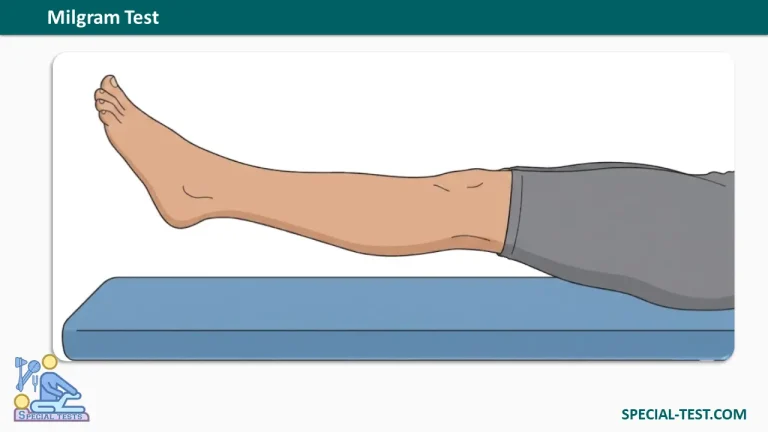
The Milgram Test, also known as the Milgram Test of the Spine, is an orthopedic physical examination maneuver used to assess possible lumbar spine pathology. It is traditionally associated with identifying conditions that may involve increased intrathecal pressure, lumbar intervertebral disc herniation, or irritation of the lumbosacral nerve roots.
The test involves raising both straight legs slightly above the examination table and maintaining the position for a specified period. Reproduction of lower back pain or neurological symptoms may suggest an underlying spinal disorder requiring further clinical evaluation.
Although the Milgram Test is commonly described in orthopedic examination resources, a positive result alone cannot confirm lumbar disc herniation, nerve root compression, or a space-occupying spinal lesion.
What Is the Purpose of the Milgram Test?
The primary purpose of the Milgram Test is to assess for possible lumbar spine pathology, particularly conditions that may produce pain during sustained bilateral straight-leg elevation.
The test may contribute to the clinical evaluation of:
- Lumbar disc herniation: A protruding or herniated intervertebral disc may irritate or compress adjacent spinal nerve roots.
- Lumbosacral nerve root irritation: Mechanical irritation of lumbar or sacral nerve roots can produce lower back pain, radiating leg pain, tingling, or numbness.
- Space-occupying lesions: Certain abnormalities within the spinal canal may affect neural structures, although the Milgram Test cannot establish their presence.
- Lumbar mechanical pain: The maneuver may reproduce symptoms arising from stressed spinal or surrounding musculoskeletal structures.
The test is traditionally thought to increase intrathecal pressure indirectly through muscular effort and mechanical loading. However, it does not directly measure intrathecal pressure or identify the precise anatomical cause of pain.
How to Perform the Milgram Test
The Milgram Test should be performed by a qualified healthcare professional as part of a comprehensive lumbar spine examination.
Step 1: Patient Position
Position the patient supine (lying face upward) on a firm examination table, with both legs extended and the body relaxed.
Step 2: Bilateral Leg Elevation
Ask the patient to raise both legs simultaneously approximately 5–10 cm (2–4 inches) above the table.
Step 3: Maintain Knee Extension
Instruct the patient to keep both knees straight throughout the maneuver, without bending them to reduce the effort required.
Step 4: Hold the Position
Ask the patient to maintain the elevated leg position for 30 seconds, provided the maneuver remains tolerable.
Step 5: Observe Symptoms
During the examination, assess whether the patient develops lower back pain, radiating leg pain, tingling, or difficulty maintaining the position.
The examiner should document symptom location, severity, onset, and whether the patient can complete the maneuver.
Some published descriptions use a leg elevation of approximately 6 inches and a holding period of 15–30 seconds. Therefore, the technique should be documented when comparing examination findings.
What Is a Positive Milgram Test?
A positive Milgram Test is traditionally identified when the maneuver reproduces lumbosacral pain. Some clinical descriptions also consider the test positive when the patient cannot maintain the required position or develops symptoms in the lower limbs.
Potential positive findings include:
- Reproduction or worsening of lower back pain.
- Radiating pain into one or both lower extremities.
- Tingling or other neurological symptoms during leg elevation.
- Inability to maintain both straight legs above the table for 30 seconds.
A positive finding may raise suspicion of lumbar pathology, particularly when accompanied by neurological abnormalities or symptoms consistent with lumbar radiculopathy.
However, an inability to hold the position may also result from abdominal muscle weakness, hip flexor fatigue, deconditioning, or pain unrelated to nerve root compression.
Consequently, difficulty completing the maneuver should not automatically be interpreted as evidence of a herniated disc or spinal canal lesion.
Clinical Significance and Interpretation
The Milgram Test is based on the principle that simultaneous elevation of both legs places increased mechanical demands on the lumbar spine and associated musculature.
Historically, this maneuver has been used to investigate pain potentially associated with increased pressure within the spinal canal.
A positive Milgram Test may be clinically relevant when the patient also presents with:
- Lower back pain accompanied by leg symptoms.
- Pain radiating along a suspected lumbar or sacral nerve root distribution.
- Altered sensation or muscle weakness.
- Abnormal neurological examination findings.
Nevertheless, the test is nonspecific, and its diagnostic accuracy has not been adequately established through high-quality validation studies.
Research on lumbar spine examination consistently indicates that individual physical tests generally have limited ability to identify the exact cause of low back pain.
For this reason, clinicians should interpret Milgram Test findings alongside the patient’s medical history, neurological examination, and other appropriate clinical tests.
Milgram Test vs. Straight Leg Raise Test
Although both maneuvers involve elevation of the lower limbs, they differ in their execution and clinical purpose.
The Milgram Test requires the patient to actively raise both straight legs simultaneously and maintain the position. This produces sustained muscular effort and mechanical loading of the lumbar region.
In contrast, the Straight Leg Raise (SLR) Test, also called the Lasègue Test, typically involves the examiner passively lifting one extended leg while evaluating the reproduction of symptoms associated with lumbosacral nerve irritation.
The SLR test is more extensively studied and is commonly included in clinical guidelines for evaluating suspected lumbar radicular pain.
Neither test should be used independently to establish a definitive diagnosis.
Precautions and Limitations
The Milgram Test places considerable demand on the lumbar spine and abdominal musculature. It should therefore be performed cautiously in patients with acute or severe lower back pain, suspected disc pathology, or significant physical limitations.
The examination should be discontinued if severe pain or concerning neurological symptoms develop.
Important limitations include the absence of well-established sensitivity and specificity estimates, the possibility of false-positive findings caused by muscular weakness, and the inability to distinguish between different spinal disorders.
Patients presenting with new bladder or bowel dysfunction, saddle anesthesia, or progressive neurological weakness require urgent medical assessment for possible cauda equina syndrome rather than reliance on provocative orthopedic tests.
Frequently Asked Questions (FAQs)
1. What is the Milgram Test used for?
The Milgram Test is used during lumbar spine examination to assess possible spinal pathology. It is traditionally associated with detecting pain that may arise from intervertebral disc abnormalities, nerve root irritation, or other lumbosacral conditions.
2. How do you perform the Milgram Test?
The patient lies supine and raises both straight legs approximately 5–10 cm above the examination table. The patient attempts to maintain this position for 30 seconds while the examiner observes for pain, neurological symptoms, or inability to sustain the position.
3. What indicates a positive Milgram Test?
A positive result typically involves reproduction of lumbosacral pain during the maneuver. Some clinical descriptions also include radiating leg symptoms or an inability to maintain the elevated leg position for 30 seconds.
4. Does a positive Milgram Test confirm a herniated disc?
No. A positive Milgram Test does not definitively diagnose lumbar disc herniation. Similar findings may occur with muscular weakness, mechanical lower back pain, or other spinal disorders. Additional clinical assessment is necessary.
5. What is the difference between the Milgram Test and the Straight Leg Raise Test?
The Milgram Test involves actively lifting both legs and holding them above the examination table. The Straight Leg Raise Test involves passive elevation of one leg by the examiner and is primarily used in the assessment of suspected lumbosacral radicular symptoms.
6. How long should the patient hold the legs during the Milgram Test?
The commonly described holding period is 30 seconds, although some clinical references describe a duration of 15–30 seconds.
7. Can the Milgram Test detect cauda equina syndrome?
No. The Milgram Test cannot reliably diagnose or exclude cauda equina syndrome. Patients with suspected cauda equina compression require urgent medical evaluation and typically emergency MRI.
8. Is the Milgram Test reliable for diagnosing lumbar spine disorders?
There is insufficient high-quality evidence establishing the sensitivity, specificity, or overall diagnostic accuracy of the Milgram Test. It should be regarded as a supplementary clinical maneuver rather than a standalone diagnostic investigation.
References
- Orthofixar – Milgram Test of the Spine. Clinical description, examination technique, and interpretation.
- Miller KJ, et al. Combination Testing in Orthopedic and Neurologic Physical Examination: A Proposed Model. Journal of Chiropractic Medicine. 2007.
- Mathieu J, et al. Diagnosis Value of Patient Evaluation Components Applicable in Primary Care Settings for the Diagnosis of Low Back Pain. Journal of Clinical Medicine. 2023.
- Khorami AK, et al. Recommendations for Diagnosis and Treatment of Lumbosacral Radicular Pain: A Systematic Review of Clinical Practice Guidelines. Journal of Clinical Medicine. 2021.
- Hennessy O, et al. Assessment and Early Investigation of Cauda Equina Syndrome: A Systematic Review. European Spine Journal. 2025.