Soto-Hall Test – Purpose, Procedure, Positive Result & Clinical Significance
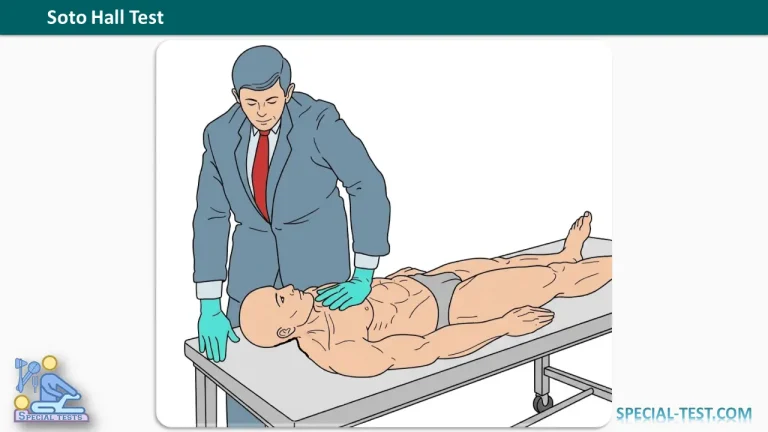
The Soto-Hall Test is an orthopedic physical examination maneuver used to assess cervical spine function and identify possible abnormalities involving the bones, ligaments, and surrounding soft tissues of the neck. It is a nonspecific cervical spine test that involves active and passive neck flexion to evaluate pain responses and potential musculoskeletal dysfunction.
The test is commonly described in orthopedic examination textbooks and is relevant to clinicians assessing patients with neck pain, cervical stiffness, or suspected cervicothoracic dysfunction.
Although a positive Soto-Hall Test may suggest an underlying cervical spine disorder, the findings are not sufficiently specific to establish a definitive diagnosis. Therefore, the test should be interpreted alongside the patient’s medical history, neurological examination, and other appropriate clinical assessments.
What Is the Purpose of the Soto-Hall Test?
The primary purpose of the Soto-Hall Test is to assess pain associated with cervical spine flexion and identify potential involvement of the posterior cervical structures.
During the examination, the cervical spine is gently flexed, placing tension on structures along the posterior aspect of the neck.
The test may help identify findings consistent with:
- Cervical ligament injury: Pain associated with stretching of injured or irritated posterior cervical ligaments.
- Cervical muscle tightness: A pulling sensation during active neck flexion that may reflect restricted flexibility of the posterior neck muscles.
- Cervical sprain or strain: Pain associated with musculoskeletal injuries involving the neck.
- Cervical or upper thoracic structural disorders: Localized pain that may warrant further investigation of the spinal structures.
Importantly, the Soto-Hall Test cannot independently confirm a cervical fracture, ligament tear, or other structural injury.
How to Perform the Soto-Hall Test
The Soto-Hall Test is performed with the patient lying supine on an examination table. It involves an active movement followed by gentle passive cervical flexion.
Step-by-Step Procedure
- Patient positioning: Ask the patient to lie comfortably on their back (supine position) with the head and neck initially in a neutral position.
- Active cervical flexion: Instruct the patient to lift the head slightly and bring the chin toward the sternum as far as comfortably possible.
- Observation: During active neck flexion, assess whether the patient experiences pain, tightness, or a pulling sensation in the posterior cervical region.
- Passive cervical flexion: The examiner supports the patient’s head and gently moves it forward, increasing cervical flexion within a comfortable range.
- Sternal stabilization: Simultaneously, the examiner places the other hand over the sternum and applies gentle downward pressure to stabilize the upper trunk.
- Symptom assessment: Observe and ask about any pain reproduced during passive flexion, particularly pain localized to the posterior cervical spine or cervicothoracic junction.
The examiner should perform all movements slowly and avoid excessive force. The procedure must be stopped if significant pain, neurological symptoms, or unusual discomfort develops.
Clinical precaution: The Soto-Hall Test should not be performed when an acute cervical fracture or spinal instability is suspected. Patients with significant recent cervical trauma require an appropriate trauma assessment before any provocative neck movement.
What Is a Positive Soto-Hall Test?
A positive Soto-Hall Test traditionally occurs when passive cervical flexion produces pain in the posterior aspect of the neck, particularly when the sternum is stabilized.
This finding may indicate irritation or dysfunction involving the cervical spinal structures.
Interpretation of Positive Findings
1. Pain During Passive Cervical Flexion
Localized posterior neck pain reproduced during passive flexion may suggest involvement of cervical ligaments, joints, or other spinal structures.
Traditional descriptions associate this response with possible bony or ligamentous disorders. However, pain alone cannot reliably distinguish ligament injury from muscular or other musculoskeletal causes.
2. Pulling Pain During Active Cervical Flexion
A pulling sensation across the posterior neck during active flexion may be associated with shortening, tightness, or reduced flexibility of the posterior cervical muscles.
This response is generally considered less specific for structural cervical injury and may reflect muscular restriction.
3. Severe or Sharp Cervical Pain
Marked pain during neck flexion requires further clinical assessment. The examiner should discontinue the maneuver and evaluate the patient’s symptoms rather than force additional movement.
What Does a Negative Soto-Hall Test Mean?
A negative result occurs when active and passive cervical flexion do not reproduce relevant posterior neck pain.
However, a negative Soto-Hall Test does not exclude cervical spine pathology. Additional clinical assessment may still be necessary, particularly when symptoms persist or concerning neurological findings are present.
Clinical Significance of the Soto-Hall Test
The Soto-Hall Test may be incorporated into a comprehensive cervical spine examination to evaluate mechanical pain associated with neck movement.
Cervical flexion affects multiple anatomical structures, including muscles, ligaments, joints, intervertebral discs, and neural tissues. Consequently, symptoms reproduced during the test may originate from more than one structure.
A published discussion of orthopedic and neurological examination techniques identifies the Soto-Hall Test as a cervical flexion maneuver traditionally associated with cervical or upper thoracic pain.
Nevertheless, the diagnostic accuracy of the Soto-Hall Test has not been adequately established through high-quality validation studies. Reliable sensitivity and specificity estimates are not available to support using the test independently to diagnose cervical fractures or ligament injuries.
A comprehensive examination should also consider cervical range of motion, neurological function, muscle strength, reflexes, sensation, and other findings relevant to the patient’s symptoms.
Soto-Hall Test vs. Other Cervical Spine Special Tests
Although several orthopedic tests assess cervical spine abnormalities, each examines a different clinical feature.
| Clinical Test | Primary Purpose |
|---|---|
| Soto-Hall Test | Nonspecific assessment of cervical pain during flexion |
| Spurling Test | Assessment of suspected cervical nerve root irritation or radiculopathy |
| Cervical Distraction Test | Evaluation of symptom changes during cervical traction |
| Cervical Flexion-Rotation Test | Assessment of upper cervical rotation, particularly C1–C2 dysfunction |
| Craniocervical Flexion Test | Assessment of deep cervical flexor muscle performance |
These tests are not interchangeable. Their clinical usefulness depends on the patient’s symptoms and the condition being investigated.
Precautions and Limitations
The Soto-Hall Test should only be performed by an appropriately trained healthcare professional after evaluating whether cervical movement is safe.
The test should be avoided when there is suspicion of an unstable cervical injury, particularly following significant trauma.
Additional caution is necessary when patients present with severe unexplained neck pain, progressive limb weakness, gait disturbances, or other symptoms that may indicate neurological involvement.
In patients with suspected traumatic cervical spine injury, validated assessment approaches such as the Canadian C-Spine Rule and NEXUS criteria are more appropriate for guiding imaging decisions than the Soto-Hall Test.
The test also has important diagnostic limitations:
- It does not identify a specific injured ligament or vertebra.
- A positive finding cannot confirm a cervical fracture.
- A negative result cannot exclude significant cervical pathology.
- Its sensitivity, specificity, and inter-examiner reliability have not been adequately established.
Frequently Asked Questions (FAQ)
1. What is the Soto-Hall Test used for?
The Soto-Hall Test is used as a nonspecific assessment of cervical spine function. It helps clinicians evaluate pain associated with neck flexion and identify findings that may indicate muscular, ligamentous, or other cervical spine dysfunction.
2. How is the Soto-Hall Test performed?
The patient lies supine and actively lifts the head toward the sternum. The examiner then gently increases cervical flexion while applying light pressure to the sternum to stabilize the upper trunk. The patient’s response to the movement is assessed.
3. What indicates a positive Soto-Hall Test?
A positive Soto-Hall Test is traditionally indicated by pain in the posterior cervical region during passive neck flexion. This may suggest irritation involving cervical spinal structures but does not establish a specific diagnosis.
4. What does pulling pain during active neck flexion indicate?
A pulling sensation during active flexion may be associated with tightness or reduced flexibility of the posterior neck muscles. However, this symptom alone cannot confirm muscle shortening or exclude other causes of neck discomfort.
5. Can the Soto-Hall Test diagnose a cervical spine fracture?
No. Although the test has historically been described in relation to possible bony or ligamentous injuries, it cannot reliably diagnose or exclude a cervical fracture. Suspected fractures require appropriate clinical evaluation and imaging when indicated.
6. Is the Soto-Hall Test the same as the Spurling Test?
No. The Soto-Hall Test primarily assesses pain during cervical flexion, whereas the Spurling Test is a provocative examination used to evaluate suspected cervical radiculopathy by reproducing nerve root-related symptoms.
7. Is the Soto-Hall Test safe?
The test may be performed as part of a clinical examination when cervical movement is considered safe. It should not be performed in patients with suspected unstable cervical spine injuries or significant acute trauma before appropriate medical assessment.
8. How accurate is the Soto-Hall Test?
The diagnostic accuracy of the Soto-Hall Test is not well established. There is insufficient high-quality evidence to provide reliable sensitivity or specificity estimates. Therefore, it should be considered an adjunct to a broader clinical examination rather than a standalone diagnostic test.
References
- Buckup K. Clinical Tests for the Musculoskeletal System: Examinations, Signs, Phenomena. 3rd Edition. Thieme.
- Miller KJ, Sittler MD, Corricelli DM, et al. Combination testing in orthopedic and neurologic physical examination: a proposed model. Journal of Chiropractic Medicine. 2007;6(4):163–171. PubMed PMID: 19674712.
- Nordin M, Carragee EJ, Hogg-Johnson S, et al. Assessment of neck pain and its associated disorders: results of the Bone and Joint Decade Task Force. Spine. 2008;33(4 Suppl)–S122. PubMed PMID: 18204385.
- Hariharan KV, Timko MG, Bise CG, et al. Inter-examiner reliability study of physical examination procedures to assess the cervical spine. Chiropractic & Manual Therapies. 2021;29:20. PubMed PMID: 34127016.
- Baratloo A, Ahmadzadeh K, Forouzanfar MM, et al. NEXUS vs. Canadian C-Spine Rule in predicting cervical spine injuries: a systematic review and meta-analysis. Archives of Academic Emergency Medicine. 2023;11(1). PubMed PMID: 37840870.
- OrthoFixar. Spine Examination: Cervical, Thoracic, and Lumbar Spine. OrthoFixar – Spine Examination.