Grip and Release Test: Procedure, Positive Sign, and Cervical Myelopathy Assessment
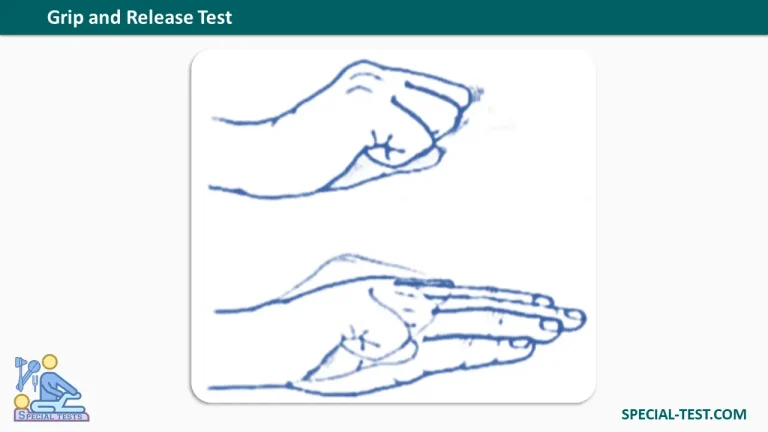
The Grip and Release Test, also known as the 10-Second Grip and Release Test or 10-Second Finger Grip and Release Test, is a simple clinical examination used to assess hand dexterity and screen for neurological dysfunction associated with cervical myelopathy.
Cervical myelopathy occurs when the cervical spinal cord becomes compressed or damaged, potentially affecting motor coordination, muscle strength, sensation, and walking ability. One of its characteristic clinical manifestations is impaired fine motor control of the hands, sometimes referred to as myelopathy hand.
The Grip and Release Test evaluates the patient’s ability to repeatedly make a fist and fully extend the fingers within 10 seconds. A reduced number of repetitions, poor coordination, or abnormal movement patterns may indicate cervical spinal cord dysfunction.
What Is the Grip and Release Test Used For?
The primary purpose of the Grip and Release Test is to screen for cervical myelopathy by assessing rapid, repetitive hand movements.
The test helps clinicians evaluate:
- Hand dexterity: The ability to perform rapid, coordinated finger movements.
- Motor coordination: The smooth transition between finger flexion and extension.
- Neurological impairment: Possible dysfunction of the motor pathways within the cervical spinal cord.
- Functional deterioration: Changes in hand movement performance during clinical follow-up.
Patients with degenerative cervical myelopathy may experience difficulty with everyday activities such as buttoning shirts, writing, manipulating small objects, or holding utensils.
The test is particularly useful when these complaints are associated with neck symptoms, hand numbness, weakness, or gait imbalance.
How to Perform the 10-Second Grip and Release Test
The Grip and Release Test requires no specialized medical equipment other than a stopwatch or timer.
Step-by-Step Procedure
- Patient positioning: Ask the patient to sit or stand comfortably, with the forearm supported or held in a stable position and the wrist approximately neutral.
- Starting position: Instruct the patient to fully extend the fingers and prepare to make a fist.
- Finger flexion: Ask the patient to close the hand completely into a fist.
- Finger extension: Instruct the patient to open the hand and fully extend the fingers.
- Rapid repetition: Ask the patient to alternate between full finger flexion and extension as quickly as possible for 10 seconds.
- Count repetitions: Record the total number of complete grip-and-release cycles performed during the 10-second period.
- Observe movement quality: Assess the speed, rhythm, coordination, range of finger motion, and any excessive wrist movements.
Each complete sequence of making a fist and reopening the fingers counts as one grip-and-release cycle.
The examination can be performed separately on both hands to identify asymmetry or differences in hand dexterity.
What Is a Positive Grip and Release Test?
A positive Grip and Release Test suggests impaired hand dexterity that may be associated with cervical myelopathy.
Traditionally, healthy adults are expected to complete approximately 20 or more grip-and-release cycles within 10 seconds.
The following findings may indicate an abnormal result:
- Fewer than 20 cycles: Inability to complete the traditionally expected number of repetitions.
- Slow hand movements: Reduced speed when repeatedly opening and closing the fingers.
- Impaired coordination: Irregular, hesitant, or poorly controlled finger movements.
- Incomplete finger extension: Difficulty fully opening the hand between repetitions.
- Compensatory wrist movements: Excessive wrist flexion or extension during attempted finger movements.
- Asymmetrical performance: A noticeable difference between the right and left hands.
A patient with cervical myelopathy may struggle to maintain smooth, rapid finger movements because spinal cord dysfunction interferes with motor control.
However, a positive result is not diagnostic of cervical myelopathy on its own.
Interpretation of Grip and Release Test Results
| Test finding | Clinical interpretation |
|---|---|
| 20 or more complete cycles | Traditionally considered within the expected range |
| Fewer than 20 cycles | May indicate reduced hand dexterity |
| Incomplete or irregular movements | Suggests impaired motor coordination |
| Excessive wrist compensation | May indicate difficulty controlling isolated finger movements |
| Markedly reduced performance | Raises concern for substantial hand dysfunction |
Important: The 20-cycle threshold is a traditional screening benchmark, not a universal normal value. Age and sex influence performance, and some healthy older adults complete fewer than 20 cycles.
A study involving 1,230 healthy volunteers demonstrated that the number of grip-and-release repetitions decreases significantly with age. Therefore, test findings should be interpreted using the patient’s age, clinical presentation, and other neurological examination findings.
Clinical Significance in Cervical Myelopathy
The Grip and Release Test is particularly relevant to degenerative cervical myelopathy (DCM), a condition commonly caused by age-related degenerative changes that narrow the cervical spinal canal and compress the spinal cord.
Such changes may include cervical spondylosis, intervertebral disc herniation, ligamentous thickening, and ossification of spinal ligaments.
Cervical spinal cord compression may disrupt neurological pathways responsible for controlling rapid finger movements. As a result, affected patients can develop hand weakness, clumsiness, decreased finger coordination, and difficulty completing repetitive movements.
Research supports the usefulness of this test as a supplementary screening tool.
A 2024 study evaluating the 10-second Grip and Release Test reported a sensitivity of 80.12% and specificity of 74.29% at a 20-cycle threshold in its study population.
Another investigation demonstrated that combining the Grip and Release Test with a grip-strength assessment improved screening performance, producing a sensitivity of 88.2% and specificity of 78.1%.
These findings suggest that the test can contribute useful clinical information, particularly when combined with other neurological assessments.
Limitations of the Grip and Release Test
Although the Grip and Release Test is quick, inexpensive, and easy to perform, several limitations should be considered.
First, reduced hand dexterity is not specific to cervical myelopathy. Peripheral nerve disorders, arthritis, pain, previous hand injuries, and other neurological diseases may also impair performance.
Second, age-related changes influence the number of repetitions an individual can perform.
Third, patients with early or mild cervical myelopathy may demonstrate relatively preserved hand function despite underlying spinal cord compression.
For these reasons, clinicians should not rely on the Grip and Release Test alone to establish or exclude a diagnosis of cervical myelopathy.
Additional examinations may include the Hoffmann sign, finger escape sign, deep tendon reflexes, Babinski sign, muscle-strength testing, and gait assessment.
When cervical myelopathy is clinically suspected, magnetic resonance imaging (MRI) of the cervical spine is an essential investigation for identifying spinal cord compression.
Frequently Asked Questions (FAQ)
1. What does the Grip and Release Test assess?
The Grip and Release Test assesses rapid hand movements, finger dexterity, and motor coordination. It is commonly used to identify hand dysfunction associated with cervical myelopathy.
2. How many grip-and-release repetitions are considered normal?
Traditionally, approximately 20 or more complete repetitions in 10 seconds are considered normal. However, the expected number varies with age and sex, so the result must be interpreted in the appropriate clinical context.
3. What does a positive Grip and Release Test indicate?
A positive test indicates reduced hand dexterity or abnormal finger movement patterns. This may raise suspicion of cervical myelopathy, particularly when accompanied by hand numbness, weakness, hyperreflexia, or gait abnormalities.
4. Can the Grip and Release Test diagnose cervical myelopathy?
No. The test is a screening and functional assessment tool rather than a definitive diagnostic investigation. Diagnosis requires compatible clinical findings and appropriate imaging, usually cervical spine MRI.
5. What is the difference between the Grip and Release Test and the Grip Strength Test?
The Grip and Release Test evaluates the speed and coordination of repetitive finger movements, while the Grip Strength Test measures the force generated by the hand, typically using a dynamometer. Both tests assess different aspects of hand function and may provide complementary information.
6. Can a patient have cervical myelopathy with a normal Grip and Release Test?
Yes. A normal result does not completely exclude cervical myelopathy. Some patients, particularly those with mild or early disease, may maintain relatively normal hand dexterity. Clinical evaluation should consider the entire neurological examination and associated symptoms.
7. When should a patient with an abnormal Grip and Release Test receive further evaluation?
Further neurological assessment is appropriate when abnormal hand movements occur alongside progressive hand weakness, loss of dexterity, numbness, balance problems, or difficulty walking. Suspected cervical myelopathy warrants prompt medical assessment and consideration of cervical MRI. Rapidly worsening neurological deficits require urgent evaluation.
Conclusion
The 10-Second Grip and Release Test is a practical bedside examination used to assess hand dexterity and detect possible neurological impairment associated with cervical myelopathy.
The examination involves rapidly making and releasing a fist for 10 seconds while counting complete repetitions and observing movement quality.
Performing fewer than 20 cycles is traditionally considered an abnormal screening finding, although age-related variation and individual factors must be considered.
A positive result should increase clinical suspicion of cervical myelopathy when supported by other neurological signs and symptoms. The test should always be interpreted alongside a comprehensive neurological examination and appropriate cervical spine imaging.
References
- Orthofixar. 10-Seconds Grip and Release Test: How to Perform and Interpret for Cervical Myelopathy. Orthofixar.
- Cervical Spondylosis: Recognition, Differential Diagnosis, and Management. Western Journal of Medicine. 2001. NCBI PubMed Central.
- Yukawa Y, et al. Quantifiable Tests for Cervical Myelopathy; 10-s Grip and Release Test and 10-s Step Test: Standard Values and Aging Variation from 1230 Healthy Volunteers. Journal of Orthopaedic Science. 2013;18(4):509–513. PubMed.
- Kobayashi H, et al. Development of a Novel Diagnostic Support Tool for Degenerative Cervical Myelopathy Combining 10-s Grip and Release Test and Grip Strength: A Pilot Study. 2022. NCBI PubMed Central.
- Ye Y, et al. Deep Learning-Enhanced Hand Grip and Release Test for Degenerative Cervical Myelopathy: Shortening Assessment Duration to 6 Seconds. Neurospine. 2024. PubMed.
- Liang G, et al. Classifying Hand Dexterity Impairment in Degenerative Cervical Myelopathy With 10-Second Grip and Release Test. Spine. 2024;49(7):500–505. PubMed.
- Milligan J, et al. Degenerative Cervical Myelopathy: Diagnosis and Management in Primary Care. Canadian Family Physician. 2019. NCBI PubMed Central.