Babinski Test: How to Perform It, Normal vs Positive Results and Interpretation
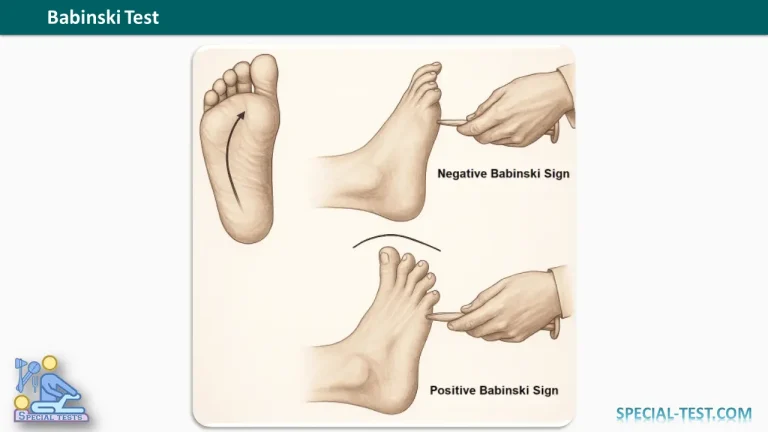
The Babinski test, also called the plantar reflex or Babinski sign, is one of the most widely used bedside neurological tests. Joseph Babinski described it in 1896, and clinicians still use it to screen for dysfunction of the corticospinal tract [1,2]. It needs no equipment beyond a blunt, pointed object, and it takes seconds to perform.
What the Babinski Test Is Used For
The test checks the integrity of the corticospinal (pyramidal) tract. The corticospinal tract normally modulates the segmental spinal reflex that controls the toes. When the tract is damaged, that modulation is lost, and the reflex pattern changes from flexor to extensor [1]. Damage anywhere along the tract can produce an abnormal response [2].
An abnormal response points to a metabolic or structural problem in the corticospinal system above the level of the reflex arc [1]. The normal motor response is mediated through the S1 root and the tibial nerve [2].
How to Perform the Babinski Test
- Position the patient. The patient lies supine or sits with the legs extended, relaxed, with the foot accessible.
- Explain the test. Tell the patient they will feel a firm stroke on the sole.
- Stimulate the sole. Use a blunt pointed object, such as the handle of a reflex hammer or a wooden stick. Start at the heel and run it forward along the lateral border of the foot. Then curve medially across the metatarsal pads toward the base of the big toe [2].
- Apply firm pressure. The stroke should be firm but not painful. Observe the great toe and the other toes as you stroke.
The test is easy to elicit, but poor technique can make a result look falsely positive or negative. Research has examined how the type, pattern and force of stimulation affect the accuracy of the plantar response [2]. The receptive field for the response can also be quite large [1].
Normal vs Positive Babinski Result
Normal (negative) response. In healthy adults, the toes curl downward in plantar flexion. This flexor response indicates normal upper motor neuron function and an intact corticospinal tract [1,2].
Positive Babinski sign (extensor plantar response). The big toe extends upward (dorsiflexion), and the other toes may fan out (abduct). This indicates dysfunction of the upper motor neuron pathway [1,2].
Neutral response. Sometimes there is no response at all. This does not rule out pathology [2].
Interpreting Bilateral and Unilateral Findings
- Bilateral positive sign: suggests bilateral upper motor neuron involvement, such as a bilateral brain or spinal cord process.
- Unilateral positive sign: suggests a lesion affecting the corticospinal tract on that side’s pathway. Cerebral lesions produce a contralateral sign. Spinal lesions below the decussation produce an ipsilateral sign.
Editorial correction for your original draft: the original text says a unilateral sign may indicate a lower motor neuron lesion. This is not accurate. The extensor plantar response reflects corticospinal (upper motor neuron) dysfunction [1,2]. I removed that line.
Babinski Sign in Infants
An extensor plantar response is common in early infancy, and it fades as the corticospinal tract matures. Neurologists broadly agree that an extensor response persisting beyond roughly the sixth to twelfth month of life indicates structural or metabolic corticospinal dysfunction [1]. In older children and adults, a positive sign is considered abnormal.
Limitations and Pitfalls
- Not always present with a tract lesion. The sign appears when the “leg fibres” of the pyramidal tract are involved, and proven pyramidal damage can occasionally coexist with a normal plantar response [1].
- Can occur without structural damage. Temporary pyramidal dysfunction, such as after a seizure, with intoxication, or during deep sleep or narcosis, can produce an extensor response.
- Interpretation can be subjective. The great toe movement can be slight, inconsistent or masked by voluntary withdrawal.
- Related signs. Many variants of the Babinski sign exist. These alternative maneuvers likely work through a similar mechanism [2]. The Hoffmann reflex in the upper limb is considered the closest equivalent [2].
For these reasons, the Babinski test should be combined with tone, power, reflexes and the rest of the neurological examination, and with imaging when indicated.
Frequently Asked Questions (FAQ)
1. What does the Babinski test check?
It checks the integrity of the corticospinal tract, the main motor pathway from the brain to the spinal cord [2].
2. What is a normal Babinski result in adults?
Plantar flexion, with the toes curling downward. This is also called a negative Babinski sign [1,2].
3. What does a positive Babinski sign mean?
The big toe extends upward and the other toes may fan out. It suggests upper motor neuron or corticospinal tract dysfunction [1,2].
4. Is a positive Babinski sign normal in babies?
Yes, early in infancy. A persistent extensor response after about six to twelve months is considered abnormal [1].
5. Can a positive Babinski sign be caused by a lower motor neuron lesion?
No. It reflects upper motor neuron (corticospinal) dysfunction [1,2].
6. Can the Babinski sign be positive without a structural lesion?
Yes. Temporary dysfunction, for example after a seizure or during intoxication or deep sleep, can produce it, so interpret it in clinical context [2].
7. Does a normal Babinski response rule out a corticospinal lesion?
No. A neutral or flexor response does not exclude pathology [1,2].
8. What is the upper-limb equivalent of the Babinski sign?
The Hoffmann reflex is considered its nearest equivalent [2].
References
- Walker HK, Hall WD, Hurst JW, eds. Clinical Methods: The History, Physical, and Laboratory Examinations. Chapter 73, The Plantar Reflex. NCBI Bookshelf. https://www.ncbi.nlm.nih.gov/books/NBK397/
- StatPearls. Babinski Reflex. NCBI Bookshelf. https://www.ncbi.nlm.nih.gov/books/NBK519009/