Femoral Shear Test: Procedure, Positive Results, and SI Joint Assessment
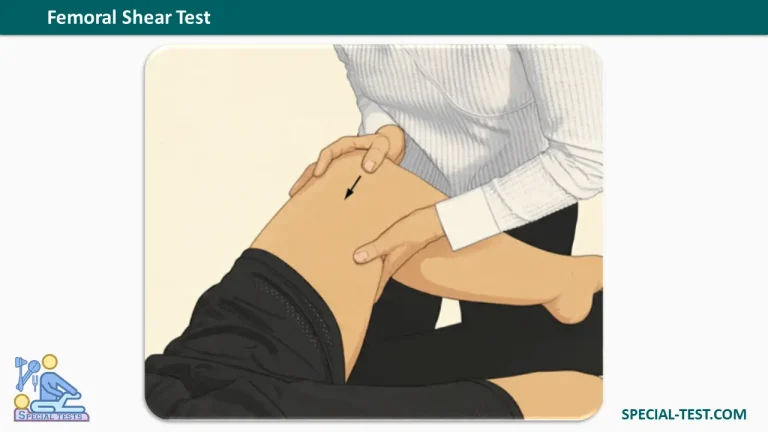
The Femoral Shear Test, also known as the Posterior Shear Test (POSH Test), is a physical examination maneuver used to assess pain originating from the sacroiliac (SI) joint. It is commonly performed during the evaluation of patients experiencing lower back pain, buttock discomfort, or suspected sacroiliac joint dysfunction.
The test involves applying a controlled force through the femur to produce shear stress across the sacroiliac joint. Reproduction of the patient’s characteristic pain in the SI joint region suggests that the joint complex may contribute to their symptoms.
The Femoral Shear Test is closely related to the Thigh Thrust Test, another established sacroiliac joint pain provocation maneuver. Although these names are frequently used interchangeably, descriptions of patient positioning vary between clinical examination techniques. orthofixar.com+2
What Is the Purpose of the Femoral Shear Test?
The primary purpose of the Femoral Shear Test is to identify whether mechanical loading of the sacroiliac joint reproduces the patient’s familiar pain.
The sacroiliac joints connect the sacrum, located at the base of the spine, to the iliac bones of the pelvis. These joints play an important role in transmitting forces between the spine and lower extremities.
Healthcare professionals may perform the Femoral Shear Test to:
- Evaluate suspected sacroiliac joint-related pain in patients with persistent lower back or buttock symptoms.
- Reproduce pain associated with mechanical irritation of the SI joint complex.
- Help distinguish possible SI joint pain from other musculoskeletal causes when combined with additional examination findings.
- Support clinical decision-making alongside other SI joint provocation tests, such as the FABER, Gaenslen, compression, and distraction tests.
Importantly, the maneuver is a pain provocation test rather than a direct measurement of sacroiliac joint stability or structural integrity. A positive finding does not independently establish a specific anatomical abnormality. NCBI Bookshelf+1
How to Perform the Femoral Shear Test
The Femoral Shear Test is performed with the patient lying on an examination table. The examiner applies a controlled posteriorly directed force through the femur to stress the sacroiliac joint.
Step-by-step procedure
1. Patient position: Ask the patient to lie in the supine position (face upward) on a firm examination table.
2. Examiner position: Stand beside the patient on the side being examined, ensuring comfortable access to the hip and knee.
3. Hip positioning: In the described Femoral Shear Test variation, the patient’s hip and thigh are slightly flexed, abducted, and externally rotated, approximately 45° from the midline.
4. Knee stabilization: Support the patient’s knee and maintain controlled positioning of the lower extremity throughout the maneuver.
5. Application of force: Gradually apply a posteriorly directed pressure through the long axis of the femur. The force should be controlled and increased only as tolerated.
6. Sacroiliac joint loading: The transmitted force produces anterior-to-posterior shear stress across the ipsilateral sacroiliac joint.
7. Assessment: Ask whether the maneuver reproduces the patient’s usual pain and identify its exact location.
This positioning corresponds to the Femoral Shear Test variation described by Orthofixar. In the more commonly studied thigh thrust or posterior shear technique, the hip is typically flexed to approximately 90°, with slight adduction, while the examiner supports the pelvis or sacrum and applies an axial force through the femur. orthofixar.com+1
The examination should be performed by a trained healthcare professional, avoiding excessive force or unnecessary aggravation of symptoms.
What Is a Positive Femoral Shear Test?
A positive Femoral Shear Test occurs when the applied force reproduces the patient’s familiar pain over the sacroiliac joint region, typically near the posterior pelvis or deep buttock on the tested side.
A positive result may suggest:
- Sacroiliac joint-related pain.
- Mechanical irritation of structures within or surrounding the SI joint.
- A possible contribution from the sacroiliac joint complex to the patient’s lower back or pelvic symptoms.
However, a positive test does not confirm sacroiliitis, inflammation, joint instability, or a particular structural lesion. Other conditions affecting the lumbar spine, hip, and surrounding soft tissues may produce overlapping symptoms.
Pain location is clinically important. Reproduction of familiar posterior pelvic pain is more consistent with a positive SI joint provocation response than isolated anterior hip or groin pain, which may require further assessment for hip pathology. NCBI Bookshelf+1
Femoral Shear Test Clinical Accuracy and Reliability
The diagnostic accuracy of the Femoral Shear Test depends on the examination technique, patient population, and reference standard used in clinical studies.
Research evaluating the thigh thrust/posterior shear maneuver suggests that it can be useful as part of a broader clinical assessment. Nevertheless, no single SI joint pain provocation test is sufficiently accurate to establish the diagnosis independently.
In a 2005 study by Laslett and colleagues, a combination of at least three positive findings among six SI joint provocation tests demonstrated 94% sensitivity and 78% specificity when compared with responses to diagnostic anesthetic injections.
A subsequent 2021 systematic review and meta-analysis found that positive clusters of SI joint provocation tests had limited ability to confirm SI joint pain. Negative clusters were generally more useful for reducing the likelihood that the SI joint was the primary pain source.
These findings highlight the importance of interpreting a positive Femoral Shear Test in combination with the patient’s clinical history, pain distribution, physical examination, and, when appropriate, further diagnostic evaluation. PubMed+1
Other Sacroiliac Joint Tests Used With the Femoral Shear Test
The Femoral Shear Test is frequently included in a cluster of SI joint provocation maneuvers.
| Clinical test | Examination principle |
|---|---|
| Femoral Shear / Thigh Thrust Test | Produces anterior-to-posterior shear stress through the femur |
| FABER (Patrick’s) Test | Positions the hip in flexion, abduction, and external rotation |
| Gaenslen’s Test | Applies rotational stress to the pelvis using opposing hip positions |
| SI Joint Compression Test | Applies compression through the lateral pelvis |
| SI Joint Distraction Test | Produces stress across the anterior pelvic structures |
| Sacral Thrust Test | Applies anteriorly directed pressure over the sacrum |
Combining these tests provides a broader assessment of symptom reproduction than relying on an isolated maneuver. The findings should still be interpreted cautiously because even a positive test cluster cannot definitively establish the source of pain. PubMed+2
Clinical Significance of the Femoral Shear Test
The Femoral Shear Test is a practical component of musculoskeletal examinations performed by orthopedic clinicians, physiotherapists, and other qualified healthcare professionals.
Its main clinical value lies in determining whether controlled mechanical loading reproduces the patient’s characteristic symptoms. This information can help guide further evaluation of lower back pain and suspected sacroiliac joint disorders.
If the patient’s history and examination findings strongly suggest SI joint pain, a clinician may consider further evaluation or an image-guided diagnostic anesthetic injection in selected cases. Imaging may also be appropriate when another condition, including inflammatory or structural pathology, is suspected.
The Femoral Shear Test should therefore be considered a supportive clinical assessment tool, not a standalone diagnostic test for sacroiliac joint dysfunction. PMC+1
Frequently Asked Questions (FAQs)
1. What is the Femoral Shear Test used for?
The Femoral Shear Test is used to evaluate suspected sacroiliac joint-related pain. It applies mechanical shear stress across the SI joint to determine whether the maneuver reproduces the patient’s characteristic lower back or buttock pain.
2. What does a positive Femoral Shear Test indicate?
A positive result occurs when the examination reproduces familiar pain over the sacroiliac joint. This finding raises suspicion of SI joint-related pain but does not independently confirm sacroiliac dysfunction, inflammation, or structural damage.
3. Is the Femoral Shear Test the same as the Thigh Thrust Test?
The terms Femoral Shear Test, Posterior Shear Test, and Thigh Thrust Test are commonly used for closely related SI joint provocation maneuvers. However, some descriptions use different hip positions. The conventional thigh thrust procedure generally involves approximately 90° of hip flexion and posteriorly directed force through the femur.
4. How accurate is the Femoral Shear Test?
The diagnostic accuracy varies among studies. Research suggests that the thigh thrust/posterior shear maneuver provides more useful clinical information when combined with other sacroiliac joint provocation tests. A single positive finding is insufficient to establish a definitive diagnosis.
5. What is the difference between the Femoral Shear Test and the FABER Test?
The Femoral Shear Test primarily applies a posteriorly directed force through the femur to stress the SI joint. The FABER Test positions the hip in flexion, abduction, and external rotation before applying controlled pressure. Both may reproduce sacroiliac joint pain, but the FABER Test also places stress on the hip joint.
6. Can the Femoral Shear Test diagnose sacroiliitis?
No. Although patients with sacroiliitis may experience pain during the maneuver, a positive Femoral Shear Test cannot confirm inflammatory sacroiliitis. Clinical evaluation and appropriate imaging or laboratory investigations may be necessary when an inflammatory condition is suspected.
7. What does a negative Femoral Shear Test mean?
A negative result indicates that the maneuver did not reproduce the patient’s characteristic SI joint pain. However, one negative result does not completely exclude sacroiliac joint-related pain. A combination of negative provocation tests provides stronger evidence against the SI joint as the primary pain source.
Conclusion
The Femoral Shear Test is a valuable sacroiliac joint pain provocation maneuver used during the clinical assessment of lower back and pelvic pain. By applying a controlled posteriorly directed force through the femur, the examiner evaluates whether mechanical stress across the SI joint reproduces the patient’s familiar symptoms.
A positive Femoral Shear Test suggests possible SI joint-related pain, but it should always be interpreted in the context of the patient’s history and other examination findings. Combining this test with additional sacroiliac joint provocation maneuvers can improve clinical assessment and help guide appropriate diagnostic and treatment decisions.
References
- 1. OrthoFixar. Femoral Shear Test: Provoking and Confirming Sacroiliac Joint Pain. Revised July 2026. https://orthofixar.com/special-test/femoral-shear-test/
- 2. OrthoFixar. Thigh Thrust Test for SI Joint Dysfunction: Sensitivity, Specificity & Procedure. https://orthofixar.com/special-test/thigh-thrust-test/
- 3. Laslett M, Aprill CN, McDonald B, Young SB. Diagnosis of sacroiliac joint pain: validity of individual provocation tests and composites of tests. Manual Therapy. 2005;10(3):207–218. PubMed – PMID: 16038856
- 4. Saueressig T, Owen PJ, Diemer F, Zebisch J, Belavy DL. Diagnostic Accuracy of Clusters of Pain Provocation Tests for Detecting Sacroiliac Joint Pain: Systematic Review With Meta-analysis. J Orthop Sports Phys Ther. 2021;51(9):422–431. PubMed – PMID: 34210160
- 5. Nejati P, et al. Accuracy of the Diagnostic Tests of Sacroiliac Joint Dysfunction. J Chiropr Med. 2020;19(1):28–37. NCBI – PMC7646135
- 6. Abdollahi S, Sheikhhoseini R, Rahimi M, Huddleston WE. The sacroiliac dysfunction and pain is associated with history of lower extremity sport related injuries. BMC Sports Sci Med Rehabil. 2023;15:36. NCBI – PMC10029172
- 7. Sacroiliac Joint Pain. StatPearls. National Center for Biotechnology Information, NCBI Bookshelf. https://www.ncbi.nlm.nih.gov/books/NBK470299/