Elvey Test (Upper Limb Tension Test): Purpose, Procedure, Positive Signs & Clinical Significance
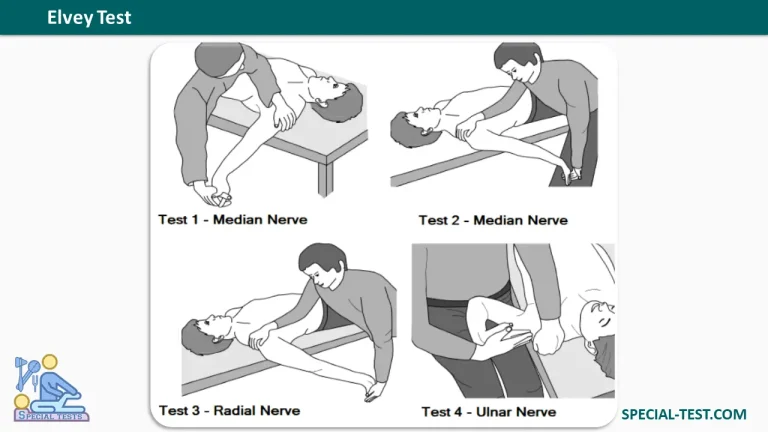
The Elvey Test, also known as the Upper Limb Tension Test (ULTT) or Upper Limb Neurodynamic Test (ULNT), is a clinical examination used to assess neural mechanosensitivity in the upper extremity. It is commonly performed in patients with suspected cervical radiculopathy, neck pain, and radiating arm symptoms.
Originally described by Robert Elvey, the test uses controlled movements of the shoulder, elbow, forearm, wrist, and fingers to place mechanical stress on the brachial plexus and peripheral nerves. It helps clinicians determine whether familiar symptoms are influenced by neural loading.
The Elvey Test is often compared to the Straight Leg Raise Test (Lasègue Test) used in the assessment of lumbar radiculopathy. Both are neurodynamic examinations designed to evaluate the response of neural tissues to mechanical loading. [1]
What Is the Purpose of the Elvey Test?
The primary purpose of the Elvey Test is to help identify neural involvement in patients experiencing neck pain, shoulder discomfort, arm pain, numbness, tingling, or other neurological symptoms.
The test may be useful when evaluating:
- Cervical radiculopathy: Irritation or compression of cervical nerve roots that may cause radiating upper-limb symptoms.
- Peripheral nerve disorders: Conditions affecting the median, radial, or ulnar nerves.
- Neural mechanosensitivity: Increased sensitivity of peripheral nerves or associated neural structures to movement and mechanical loading.
- Brachial plexus involvement: Possible irritation of neural structures supplying the upper extremity.
Although the Elvey Test provides valuable clinical information, it cannot independently establish the location or cause of nerve pathology. Results must be interpreted alongside the patient’s medical history, neurological examination, and other clinical findings. [2]
How to Perform the Elvey Test
The Elvey Test consists of four examination variations that preferentially load different neural structures.
Patient Position
- Position the patient in a supine position on the examination table.
- Initially maintain the cervical spine in a neutral position.
- The examiner stabilizes or controls the shoulder girdle with one hand while using the other hand to position the upper extremity.
- Apply movements progressively and observe the onset, location, and intensity of symptoms.
- Examine the unaffected side first when appropriate, then compare the findings with the symptomatic side.
The examiner may also use cervical lateral flexion as a structural differentiation maneuver to determine whether changes in neural loading modify the patient’s symptoms.
Important: The sequence of movements varies across published testing protocols. The following descriptions represent commonly taught Elvey Test variations. [1, 3]
Elvey Test 1: Median Nerve Bias (ULTT1)
This variation primarily emphasizes the median nerve and related neural structures, including contributions from the C5, C6, and C7 nerve roots.
Procedure:
- Depress and stabilize the shoulder girdle.
- Abduct the shoulder to approximately 110 degrees.
- Extend the wrist, fingers, and thumb.
- Supinate the forearm.
- Position the shoulder in external rotation as required by the testing protocol.
- Gradually extend the elbow.
- Assess symptom changes with gentle cervical lateral flexion toward and away from the tested side.
Nerve bias: Median nerve, anterior interosseous nerve, and C5–C7 neural contributions.
This is one of the most frequently studied upper limb neurodynamic tests in patients with suspected cervical radiculopathy.
Elvey Test 2: Median, Musculocutaneous, and Axillary Nerve Bias (ULTT2A)
The second variation emphasizes different components of the brachial plexus and upper-extremity peripheral nerves.
Procedure:
- Position the shoulder at approximately 10 degrees of abduction.
- Stabilize or depress the shoulder girdle.
- Extend the elbow.
- Supinate the forearm.
- Extend the wrist, fingers, and thumb.
- Gradually externally rotate the shoulder.
Some variations increase shoulder abduction to approximately 40 degrees when emphasizing the axillary nerve.
Nerve bias: Median, musculocutaneous, and axillary nerves.
The examiner evaluates whether these movements reproduce or modify the patient’s familiar neurological symptoms.
Elvey Test 3: Radial Nerve Bias (ULTT2B)
This variation preferentially places mechanical stress on the radial nerve.
Procedure:
- Depress and stabilize the shoulder girdle.
- Position the shoulder in slight abduction, approximately 10 degrees in the described variation.
- Internally rotate the shoulder.
- Extend the elbow.
- Pronate the forearm.
- Flex the wrist with ulnar deviation.
- Flex the fingers and thumb.
- Assess the patient’s symptoms and their response to cervical lateral flexion.
Nerve bias: Radial nerve.
Symptoms produced during this examination must be compared with the patient’s usual complaints. Reproduction of nonspecific muscle stretching or discomfort alone is insufficient to diagnose radial nerve pathology.
Elvey Test 4: Ulnar Nerve Bias (ULTT3)
The fourth variation emphasizes the ulnar nerve and neural structures associated with the C8 and T1 nerve roots.
Procedure:
- Begin with approximately 10 degrees of shoulder abduction.
- Gradually increase shoulder abduction toward 90 degrees.
- Flex the elbow maximally, guiding the hand toward the ear.
- Supinate the forearm.
- Extend the wrist with radial deviation.
- Extend the fingers and thumb.
- Externally rotate the shoulder.
- Use gentle cervical lateral flexion to assess whether symptoms change.
Nerve bias: Ulnar nerve and C8–T1 neural contributions.
This test may provide additional information when evaluating symptoms involving the medial forearm or ulnar side of the hand. However, an abnormal result does not independently identify a specific nerve root or peripheral nerve lesion.
What Is a Positive Elvey Test?
A positive Elvey Test generally involves reproduction of the patient’s familiar neurological symptoms, such as radiating arm pain, tingling, or numbness, with appropriate changes in those symptoms during structural differentiation.
Important findings include:
- Reproduction of recognizable radiating pain or paresthesia.
- Differences in symptom response between the affected and unaffected arms.
- Increased symptoms during neural loading movements.
- Reduction or alteration of symptoms when neural tension is decreased.
- Symptom modification during cervical lateral flexion.
For example, lateral flexion of the cervical spine away from the tested arm may increase neural loading, whereas lateral flexion toward the tested arm may reduce it.
A positive response suggests that neural structures may contribute to the symptoms. However, it does not necessarily indicate nerve root compression.
Localized cervical pain without radiating neurological symptoms is not sufficient to establish a positive neurodynamic test. Such pain may arise from muscular, articular, or other cervical structures and requires further clinical assessment.
Unlike the Spurling Test, which uses cervical positioning and compression to provoke radicular symptoms, the Elvey Test primarily assesses responses to mechanical loading of the upper-extremity neural tissues.
Elvey Test Sensitivity and Specificity
The diagnostic accuracy of the Elvey Test has been evaluated in multiple clinical studies and systematic reviews.
A 2026 systematic review and meta-analysis reported the following pooled estimates for cervical radiculopathy:
| Test | Sensitivity | Specificity |
|---|---|---|
| ULNT1 (median nerve bias) | 70% | 71% |
| Combined four ULNTs | 97% | 51% |
These findings suggest that a combination of upper limb neurodynamic tests may be especially useful for reducing the likelihood of cervical radiculopathy when the combined result is negative.
However, the authors emphasized that the available diagnostic evidence remains limited, with low or very low certainty, and that results depend on the populations and testing methods studied. [4]
Consequently, the Elvey Test should not be used as a stand-alone diagnostic test for cervical radiculopathy.
Clinical Importance of the Elvey Test
The Elvey Test is a useful component of musculoskeletal and neurological examination because it provides information about symptom responses to neural loading.
Clinicians may combine its findings with:
- Spurling Test.
- Cervical distraction test.
- Shoulder abduction relief test.
- Upper-extremity muscle strength testing.
- Sensory examination.
- Deep tendon reflex assessment.
Additional evaluation, including MRI or electrodiagnostic testing, may be appropriate when symptoms persist, progressive neurological deficits are present, or the diagnosis remains uncertain. [5]
The examination should be performed gently by a trained healthcare professional. Excessive force or repeated provocation of severe symptoms should be avoided.
Frequently Asked Questions (FAQ)
1. What is the Elvey Test used for?
The Elvey Test is used to assess neural mechanosensitivity in the upper extremity. It is commonly included in the evaluation of cervical radiculopathy and suspected peripheral nerve involvement.
2. Is the Elvey Test the same as the Upper Limb Tension Test?
Yes. The Elvey Test is commonly referred to as the Upper Limb Tension Test (ULTT), Upper Limb Neurodynamic Test (ULNT), or brachial plexus tension test.
3. What does a positive Elvey Test indicate?
A positive result suggests possible neural involvement when the examination reproduces familiar neurological symptoms and those symptoms change with structural differentiation. It does not confirm a particular diagnosis by itself.
4. Which nerves are evaluated during the Elvey Test?
The four traditional variations preferentially emphasize the median, musculocutaneous, axillary, radial, and ulnar nerves, along with associated brachial plexus and cervical nerve root contributions.
5. Can the Elvey Test diagnose cervical radiculopathy?
No. It can support clinical assessment, but cervical radiculopathy is diagnosed through the integration of patient history, neurological findings, examination maneuvers, and additional investigations when indicated.
6. What is the difference between the Elvey Test and the Spurling Test?
The Elvey Test uses upper-extremity positioning to evaluate responses to neural mechanical loading. The Spurling Test uses cervical positioning with axial compression to provoke symptoms associated with cervical nerve root irritation.
7. Is the Elvey Test equivalent to the Straight Leg Raise Test?
The tests are conceptually similar. The Elvey Test assesses upper-extremity neural mechanosensitivity, whereas the Straight Leg Raise Test evaluates symptoms associated with neural loading in the lower extremity, particularly in suspected lumbosacral radiculopathy.
Conclusion
The Elvey Test (Upper Limb Tension Test) is an important clinical examination for evaluating possible neural involvement in patients with neck pain and radiating upper-extremity symptoms.
Its four traditional variations emphasize different peripheral nerves through controlled movements of the shoulder, elbow, forearm, wrist, and fingers.
A positive test involves reproduction of familiar neurological symptoms with appropriate symptom modification during structural differentiation. Although useful in clinical assessment, the Elvey Test cannot independently confirm cervical radiculopathy or determine the exact location of nerve pathology.
Combining upper limb neurodynamic testing with a comprehensive neurological examination provides a more reliable clinical assessment than interpreting any single test in isolation.
References
- Orthofixar. Elvey Test: Upper Limb Tension Tests (ULTTs). Clinical examination, nerve bias, and test procedures.
https://orthofixar.com/special-test/elvey-test/ - Rubinstein SM, et al. A systematic review of the diagnostic accuracy of provocative tests of the neck for diagnosing cervical radiculopathy. European Spine Journal. 2007;16(3):307–319.
PubMed – PMID: 17013656 - Test procedures and positive diagnostic criteria of the upper limb tension tests differ: a systematic review of the DiTA database. Brazilian Journal of Physical Therapy. 2023;27(6):100558.
PubMed – PMID: 37967500 - Thoomes EJ, et al. Diagnostic accuracy of physical examination tests for painful cervical radiculopathy: update of a systematic review and meta-analysis. BMC Musculoskeletal Disorders. 2026;27:338.
PubMed – PMID: 41680685 - Cervical Radiculopathy. StatPearls. National Center for Biotechnology Information (NCBI Bookshelf).
https://www.ncbi.nlm.nih.gov/books/NBK441828/ - Wainner RS, et al. Reliability and diagnostic accuracy of the clinical examination and patient self-report measures for cervical radiculopathy. Spine. 2003.
PubMed – PMID: 12544957 - Diagnostic accuracy of the upper limb neurodynamic test with median bias (ULNT1) for cervical radiculopathy: a systematic review and meta-analysis. 2023.
PubMed – PMID: 37356367