Crossed Over Lasègue Test: Procedure, Positive Sign & Clinical Significance
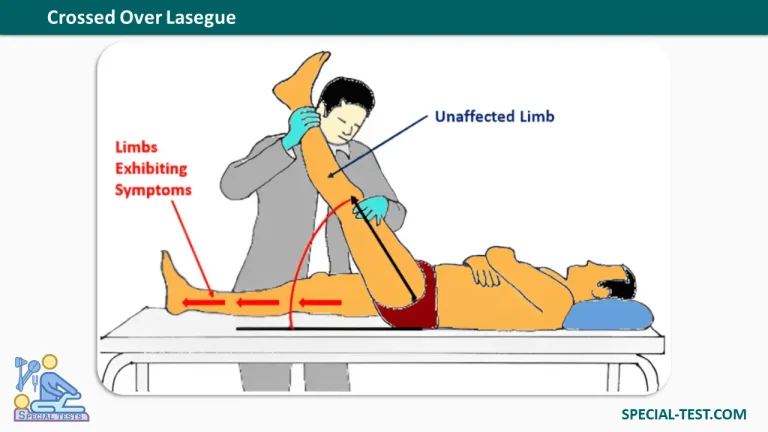
What Is the Crossed Over Lasègue Test?
The Crossed Over Lasègue Test, also called the Crossed Straight Leg Raise Test (Crossed SLR Test) or Crossed Lasègue Sign, is a clinical examination maneuver used to assess lumbosacral nerve root irritation associated with lumbar disc herniation.
The test is particularly useful when clinicians suspect a large or centrally located lumbar disc herniation causing significant nerve root irritation.
Unlike the traditional Straight Leg Raise Test, which evaluates symptoms when the affected leg is elevated, the Crossed Over Lasègue Test involves passively raising the patient’s unaffected leg while observing whether pain develops in the opposite, symptomatic lower limb.
A positive crossed straight leg raise sign increases suspicion of lumbar disc herniation, although additional clinical evaluation is necessary to establish the diagnosis.
What Is the Crossed Over Lasègue Test Used For?
The primary purpose of the Crossed Over Lasègue Test is to identify signs of lumbar nerve root irritation or compression caused by a herniated intervertebral disc.
The test is especially relevant in patients presenting with:
- Low back pain accompanied by unilateral sciatica.
- Radiating leg pain suggestive of lumbar radiculopathy.
- Suspected central or large medial lumbar disc herniation.
- Significant nerve root irritation associated with lumbar disc pathology.
- Symptoms suggesting compression or mechanical sensitivity of the lumbosacral nerve roots.
The test may help clinicians distinguish radicular pain from other causes of lower limb discomfort when interpreted alongside the patient’s medical history and neurological examination.
However, a positive result does not independently confirm the location, size, or severity of a disc herniation.
How to Perform the Crossed Over Lasègue Test
The Crossed Over Lasègue Test is performed with the patient lying supine on an examination table.
Step-by-step examination procedure:
- Patient positioning: Ask the patient to lie comfortably on their back with both lower limbs extended and the pelvis in a neutral position.
- Identify the affected side: Determine which lower limb is experiencing radiating pain or neurological symptoms.
- Position the examiner: Stand beside the patient’s unaffected lower limb.
- Passive hip flexion: Slowly elevate the unaffected leg by flexing the hip while keeping the knee fully extended.
- Monitor symptoms: Observe the patient’s response during elevation, particularly whether pain develops or increases in the opposite, symptomatic leg.
- Record the findings: Document the angle of hip flexion at which symptoms occur, their location, and whether they reproduce the patient’s familiar radicular pain.
The examiner should perform the maneuver gradually and avoid forceful elevation once significant symptoms develop.
What Is a Positive Crossed Over Lasègue Test?
A positive Crossed Over Lasègue Test occurs when passive elevation of the unaffected lower limb reproduces sciatic or radicular pain in the opposite, affected lower limb.
In the examination description presented by Orthofixar, a positive response is reported when pain develops in the involved limb at approximately 40 degrees of hip flexion during elevation of the uninvolved leg.
However, 40 degrees should not be regarded as a universally required diagnostic cutoff. The most important finding is the reproduction of characteristic contralateral radicular pain.
For example, in a patient experiencing left-sided sciatica, passive elevation of the right leg may reproduce radiating pain in the left lower limb.
This crossed pain response suggests irritation of the lumbosacral nerve roots and raises suspicion of lumbar disc herniation.
Importantly, isolated hamstring tightness, discomfort in the raised leg, or nonspecific lower back pain does not constitute a positive crossed straight leg raise sign.
Why Does the Crossed Over Lasègue Test Become Positive?
The proposed mechanism involves the transmission of mechanical tension through the sciatic nerve, lumbosacral nerve roots, and associated dural structures during straight leg elevation.
As the unaffected leg is raised with the knee extended, tension develops along the neural tissues.
In patients with significant lumbar disc pathology, these mechanical forces may provoke symptoms involving an irritated nerve root on the opposite side.
A large medial or central disc protrusion may contribute to this response by affecting neural structures within the vertebral canal.
Nevertheless, the crossed pain response is not specific to a particular disc level or herniation morphology, and imaging may be necessary when clinically indicated.
Sensitivity and Specificity of the Crossed Over Lasègue Test
The Crossed Over Lasègue Test is generally characterized by low sensitivity and relatively high specificity for lumbar disc herniation.
A systematic review published in Spine reported:
- Sensitivity: 29%
- Specificity: 88%
Another systematic review of physical examination for lumbar radiculopathy reported approximately 28% sensitivity and 90% specificity.
These findings indicate that the test is more useful for supporting suspicion of disc herniation when positive than for excluding the condition when negative.
Low sensitivity means that many patients with lumbar disc herniation may have a negative crossed straight leg raise test.
Relatively high specificity means that a positive result is less common among patients without the condition.
However, diagnostic studies have important methodological limitations, and the test should not be interpreted as definitive evidence of disc herniation.
Crossed Over Lasègue Test vs. Straight Leg Raise Test
Although the two examinations are closely related, they differ in technique and interpretation.
| Feature | Straight Leg Raise Test | Crossed Over Lasègue Test |
|---|---|---|
| Leg elevated | Affected leg | Unaffected leg |
| Positive finding | Radicular pain in the raised leg | Radicular pain in the opposite, affected leg |
| Clinical purpose | Evaluate lumbosacral nerve root irritation | Assess a crossed response associated with lumbar disc herniation |
| Diagnostic sensitivity | Generally higher | Lower |
| Diagnostic specificity | Generally lower | Higher |
Both tests should be interpreted alongside muscle strength, sensation, deep tendon reflexes, symptom distribution, and other relevant clinical findings.
Clinical Significance
The Crossed Over Lasègue Test is a useful component of the physical examination in patients with suspected lumbar disc herniation and sciatica.
A positive result may increase clinical suspicion of nerve root involvement, particularly when consistent with the patient’s neurological symptoms.
However, neither a positive nor a negative result is sufficient to independently diagnose or exclude lumbar disc herniation.
The decision to obtain lumbar magnetic resonance imaging (MRI) or pursue additional evaluation depends on the complete clinical presentation, including the severity and progression of neurological symptoms.
Frequently Asked Questions (FAQ)
1. What does a positive Crossed Over Lasègue Test indicate?
A positive test suggests lumbosacral nerve root irritation and increases suspicion of lumbar disc herniation. It is particularly associated with substantial disc pathology but does not independently establish the size or location of a herniation.
2. How is the Crossed Over Lasègue Test performed?
The examiner passively elevates the unaffected lower limb while maintaining full knee extension. The test is considered positive when this movement reproduces radicular pain in the opposite, symptomatic leg.
3. At what angle is the Crossed Over Lasègue Test positive?
A positive response at approximately 40 degrees of hip flexion is described in Orthofixar. However, there is no universally established angle that must be reached for a positive result. Reproduction of characteristic contralateral sciatic pain is the key finding.
4. What is the difference between the Lasègue Test and the Crossed Lasègue Test?
In the standard Lasègue Test, elevation of the affected leg reproduces pain in that same limb. In the Crossed Lasègue Test, elevation of the unaffected leg produces pain in the opposite, affected limb.
5. How accurate is the Crossed Over Lasègue Test?
Published systematic reviews report sensitivity of approximately 28–30% and specificity of approximately 88–90% for lumbar disc herniation. Its relatively high specificity makes a positive finding clinically useful, but its low sensitivity limits its ability to exclude disease.
6. Can a negative Crossed Over Lasègue Test rule out lumbar disc herniation?
No. A negative result does not exclude lumbar disc herniation or nerve root compression because many patients with these conditions do not demonstrate a positive crossed straight leg raise sign.
7. Does a positive Crossed Lasègue Test always indicate a central disc herniation?
No. Although the finding is classically associated with large or medial lumbar disc herniations, the test cannot reliably determine disc morphology or location by itself. Clinical assessment and appropriate imaging are needed for further evaluation.
References
- OrthoFixar. Lasègue Test | Straight Leg Raise Test. Includes the Crossed Over Lasègue Test, examination procedure, positive findings, and diagnostic accuracy.
https://orthofixar.com/special-test/lasegue-test/ - Devillé WL, et al. The test of Lasègue: Systematic review of the accuracy in diagnosing herniated discs. Spine. 2000;25(9):1140–1147.
https://pubmed.ncbi.nlm.nih.gov/10788860/ - Vroomen PC, et al. Diagnostic value of history and physical examination in patients suspected of sciatica due to disc herniation: A systematic review. Journal of Neurology. 1999.
https://pubmed.ncbi.nlm.nih.gov/10552236/ - Physical examination for lumbar radiculopathy due to disc herniation in patients with low-back pain. Systematic review indexed in PubMed.
https://pubmed.ncbi.nlm.nih.gov/20166095/ - Reliability of the straight leg raise test for suspected lumbar radicular pain: A systematic review with meta-analysis. 2022.
https://pubmed.ncbi.nlm.nih.gov/35245880/ - Clinical Tests for the Musculoskeletal System, 3rd Edition.
- Dutton’s Orthopaedic Examination, Evaluation, and Intervention, 3rd Edition.