Yergason Sign Test: How to Perform, Positive Sign & Accuracy
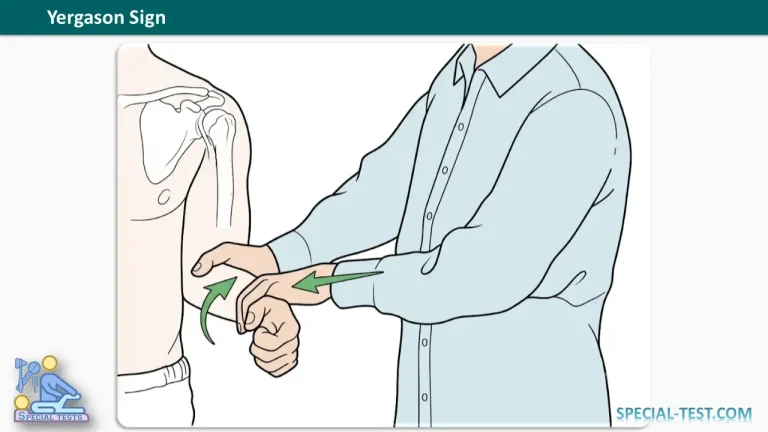
Yergason’s test is a clinical shoulder examination maneuver used to assess pathology involving the long head of the biceps tendon (LHBT), particularly biceps tendinopathy and tendon instability. It is performed by asking the patient to supinate the forearm against resistance while the examiner evaluates for pain or abnormal movement around the bicipital groove.
This guide explains the clinical purpose of Yergason’s test, how to perform it, how to interpret a positive result, and its diagnostic accuracy.
What Is Yergason Sign Test Used For?
Yergason’s test is used to help identify disorders affecting the long head of the biceps tendon, including:
- Biceps tendinopathy: Irritation or degeneration of the long head of the biceps tendon.
- Biceps tenosynovitis: Inflammation involving the tendon sheath.
- Biceps tendon instability: Subluxation or abnormal movement of the tendon within the bicipital groove.
- Associated shoulder pathology: Findings may also occur in patients with other shoulder disorders, including superior labrum anterior-to-posterior (SLAP) lesions.
A positive result can support suspicion of long head of the biceps tendon pathology, but it does not establish a specific diagnosis on its own.
How to Perform Yergason’s Test
Patient position
- Ask the patient to sit or stand comfortably with the affected arm alongside the trunk.
- Flex the elbow to approximately 90 degrees.
- Position the forearm in pronation, with the palm facing downward.
Examination technique
- Stabilize the patient’s upper arm and elbow close to the body.
- Ask the patient to supinate the forearm, turning the palm upward, against resistance applied by the examiner at the wrist or distal forearm.
- Depending on the examination technique, resisted external rotation of the shoulder may also be assessed.
- Palpate the bicipital groove over the anterior shoulder to identify localized pain, tenderness, or abnormal movement of the tendon.
- Compare findings with the unaffected shoulder when appropriate.
Perform the maneuver gently and stop if the patient experiences significant pain.
What Is a Positive Yergason’s Sign?
Yergason’s test is considered positive when the maneuver reproduces localized pain over the bicipital groove, suggesting possible pathology of the long head of the biceps tendon.
A painful snapping or clicking sensation, particularly when accompanied by palpable tendon movement, may indicate biceps tendon instability or subluxation.
Pain elsewhere in the shoulder is less specific and should be interpreted in the context of the complete shoulder examination.
Diagnostic Accuracy of Yergason’s Test
Reported diagnostic accuracy varies across studies because of differences in patient populations, examination techniques, and reference standards.
| Diagnostic measure | Reported value |
|---|---|
| Sensitivity | 43% |
| Specificity | 79% |
These figures are commonly cited estimates; they should not be considered universal values for every clinical population.
- Sensitivity (43%): The test may be negative in a substantial proportion of patients who have the underlying tendon pathology.
- Specificity (79%): A positive result provides some support for the diagnosis, but false-positive results can occur.
The relatively low sensitivity means that a negative Yergason’s test does not reliably exclude biceps tendon pathology. The test should be combined with the patient’s history, palpation findings, and other relevant examination maneuvers.
Clinical Interpretation and Limitations
Yergason’s test is best used as one component of a comprehensive shoulder assessment. Depending on the clinical presentation, the examiner may also perform Speed’s test, assess bicipital groove tenderness, and evaluate the rotator cuff and labrum.
A negative Yergason’s test does not rule out a partial or complete rotator cuff tear, including a supraspinatus tear. However, this is a limitation of the broader clinical assessment rather than a specific diagnostic feature of Yergason’s test.
If symptoms persist or the diagnosis remains uncertain, a clinician may consider imaging, such as musculoskeletal ultrasound or MRI, based on the suspected pathology and clinical findings.
Frequently Asked Questions (FAQ)
1. What does Yergason’s test assess?
Yergason’s test primarily assesses for pathology of the long head of the biceps tendon, including tendinopathy and tendon instability within the bicipital groove.
2. How do you perform Yergason’s test?
The patient flexes the elbow to 90 degrees with the forearm pronated. The examiner applies resistance while the patient attempts to supinate the forearm. The examiner monitors for pain over the bicipital groove and abnormal tendon movement.
3. What is a positive Yergason’s sign?
A positive result is reproduction of localized pain over the bicipital groove during resisted forearm supination. A painful snap or palpable tendon subluxation may suggest biceps tendon instability.
4. What are the sensitivity and specificity of Yergason’s test?
Frequently cited estimates are 43% sensitivity and 79% specificity. Published studies report variable results, so these values should be interpreted as estimates rather than fixed performance characteristics.
5. Can a negative Yergason’s test rule out biceps tendinopathy?
No. Because the test has limited sensitivity, patients with biceps tendon pathology may have a negative result. Other clinical findings and, when indicated, imaging may be needed.
6. Can Yergason’s test diagnose a rotator cuff tear?
No. Yergason’s test is primarily intended to assess the long head of the biceps tendon. It cannot reliably diagnose or exclude a rotator cuff tear, which requires a broader clinical assessment.
7. What is the difference between Yergason’s test and Speed’s test?
Yergason’s test involves resisted forearm supination with the elbow flexed. Speed’s test typically involves resisted shoulder flexion with the elbow extended and the forearm supinated. Both may help assess biceps tendon pathology, but neither should be used in isolation.
8. When should additional investigations be considered?
Further assessment may be appropriate when shoulder pain persists, there is significant weakness or a history of trauma, tendon instability is suspected, or clinical findings do not provide a clear diagnosis. Ultrasound or MRI may be considered according to the suspected condition.
References
- Churgay CA. Diagnosis and treatment of biceps tendinitis and tendinosis. American Family Physician. 2009;80(5):470–476. Read the article.
- Cleveland Clinic. Yergason’s Test: What It Is & How It’s Performed. Read the clinical overview.
- StatPearls. Proximal Biceps Tendinitis and Tendinopathy. National Center for Biotechnology Information, U.S. National Library of Medicine. Read the clinical reference.
- Bélanger V, et al. A practical, evidence-based, comprehensive physical examination for diagnosing pathology of the long head of the biceps. Journal of Shoulder and Elbow Surgery. Read the review on PubMed Central.