Subacromial Injection Test: Purpose, Procedure, Positive Results, and Accuracy
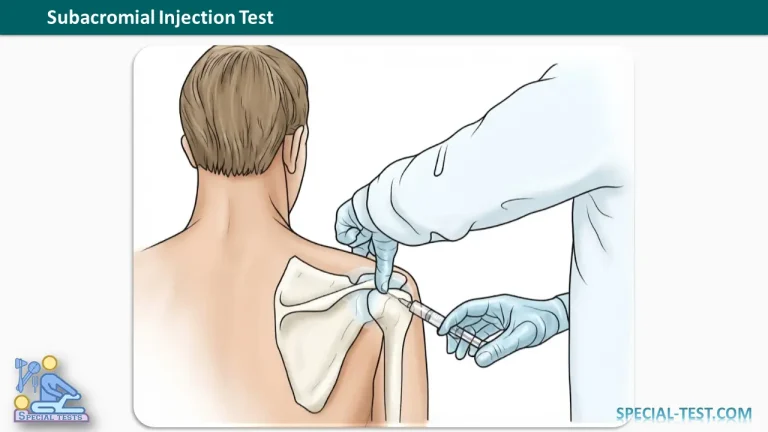
The Subacromial Injection Test is a diagnostic procedure used to help evaluate suspected subacromial impingement syndrome and other causes of shoulder pain. It involves injecting a local anesthetic, commonly lidocaine (Xylocaine), into the subacromial space to determine whether temporarily reducing pain improves the patient’s symptoms and shoulder function.
This test can help clinicians identify whether pain originates primarily from structures within the subacromial region, including the subacromial-subdeltoid bursa and the rotator cuff tendons. It is particularly useful when the physical examination suggests subacromial pain but other shoulder disorders may produce similar symptoms.
Although the test can provide useful diagnostic information, it should not be interpreted in isolation. Clinical history, physical examination findings, and appropriate imaging studies may also be needed to establish an accurate diagnosis.
What Is the Subacromial Injection Test Used For?
The primary indication for the Subacromial Injection Test is the assessment of subacromial impingement syndrome, also commonly described within the broader category of subacromial pain syndrome.
The subacromial space lies beneath the acromion and above the humeral head. Important structures in this region include the rotator cuff tendons, particularly the supraspinatus tendon, and the subacromial-subdeltoid bursa. Irritation, inflammation, or pathology involving these structures may cause pain during shoulder elevation and overhead activities.
The Subacromial Injection Test may help with the following clinical questions:
- Suspected subacromial impingement syndrome: Determines whether pain decreases after local anesthetic is introduced into the subacromial space.
- Rotator cuff-related shoulder pain: Helps assess whether symptoms are arising from the subacromial region, although it cannot independently identify a specific tendon tear.
- Subacromial bursitis: May help establish whether the subacromial bursa contributes to the patient’s pain.
- Differential diagnosis of shoulder pain: May help distinguish subacromial pain from other potential sources, such as glenohumeral joint pathology, although overlapping conditions can complicate interpretation.
- Assessment of functional limitation: Improvement in shoulder movement or strength after pain relief may help determine how much pain contributes to the patient’s apparent weakness or restricted movement.
The test is most informative when the patient’s usual pain and relevant functional limitations are documented before the injection and reassessed afterward.
Anatomy and Clinical Principle
The subacromial space is located between the inferior surface of the acromion and the structures of the rotator cuff and humeral head. During shoulder elevation, the rotator cuff and associated bursal tissues may become painful because of tendon disease, bursal irritation, altered shoulder mechanics, or other underlying pathology.
The Subacromial Injection Test works by temporarily reducing pain through local anesthesia. If the subacromial region is an important contributor to the patient’s symptoms, an accurately placed injection may substantially reduce pain during previously painful movements.
This response supports a subacromial source of pain but does not prove that mechanical impingement is the underlying cause. Several shoulder disorders can produce similar symptoms, and a patient may have more than one condition simultaneously.
How to Perform the Subacromial Injection Test
The procedure involves administering a local anesthetic into the subacromial space. A commonly described diagnostic protocol uses 10 mL of 1% lidocaine (Xylocaine).
The injection may be performed using a posterior or anterior approach. The choice depends on the clinician’s experience, patient anatomy, and the clinical circumstances.
This procedure should be performed by a qualified healthcare professional using appropriate aseptic technique. The following descriptions are educational and are not a substitute for supervised procedural training, local protocols, or image-guided injection when indicated.
1. Posterior Approach
The posterior approach accesses the subacromial region from the posterolateral aspect of the shoulder.
Patient positioning
- Place the patient in a seated position.
- Allow the affected upper extremity to rest comfortably at the side, supported by the chair’s armrest when available.
- Position the shoulder in internal rotation to facilitate identification of the relevant anatomical landmarks.
Identify the anatomical landmarks
- Inspect the posterolateral shoulder for redness, skin lesions, or evidence of cellulitis. Do not insert the needle through infected skin.
- Palpate the posterior and lateral borders of the acromion and identify its posterolateral corner.
- Palpate the coracoid process anteriorly as an additional anatomical reference.
- Identify the intended entry region in relation to the humeral head and glenoid. Rotation of the upper arm may help clarify the position of the humeral head.
The described landmark-based entry point is approximately two fingerbreadths distal and one fingerbreadth medial to the posterolateral corner of the acromion. Exact positioning must be adjusted to the patient’s anatomy and the intended injection target.
Injection technique
- Prepare the skin using an appropriate antiseptic and maintain aseptic technique.
- A suitable superficial anesthetic technique may be used when indicated.
- Direct the needle toward the intended subacromial target using the clinician’s established technique.
- Confirm appropriate needle placement before injecting the medication.
- Monitor the patient for pain, unexpected resistance, or other signs of a complication.
The needle trajectory and depth should be determined by a trained clinician rather than applied as a fixed angle or distance in every patient. Ultrasound guidance may be useful when landmarks are difficult to identify or accurate placement is particularly important.
2. Anterior Approach
The anterior approach accesses the subacromial region from the front of the shoulder.
Patient positioning
- Seat the patient comfortably.
- Keep the affected arm resting at the side.
- Position the shoulder in neutral rotation or slight external rotation, approximately 15–20 degrees when appropriate.
Identify the anatomical landmarks
- Inspect the anterior shoulder for cellulitis, wounds, or other skin abnormalities that would make the planned entry site unsuitable.
- Palpate the coracoid process and identify the humeral head.
- Use gentle rotation of the upper extremity, if necessary, to clarify the relationship between the humeral head and glenoid.
- The described landmark-based starting point is just medial to the humeral head and approximately 5–10 mm lateral to the tip of the coracoid process.
Injection technique
- Prepare the skin using an appropriate antiseptic and follow sterile procedural precautions.
- Identify the intended injection target and select a suitable needle trajectory.
- Advance the needle under the clinician’s established technique, using anatomical landmarks or ultrasound guidance as appropriate.
- Confirm the intended location before injecting the anesthetic.
The anterior approach requires familiarity with the local anatomy and nearby neurovascular structures. The entry point and trajectory should not be used as a substitute for individualized clinical assessment.
Medication Used in the Subacromial Injection Test
A commonly described protocol uses 10 mL of 1% lidocaine. Lidocaine is a local anesthetic that temporarily blocks nerve conduction and reduces pain in the targeted region.
It is important to distinguish a diagnostic anesthetic injection from a therapeutic corticosteroid injection. The diagnostic test assesses the response to temporary pain relief, whereas corticosteroids may be added in selected therapeutic procedures to address inflammation.
The medication, concentration, volume, and use of additional agents should be selected by the treating clinician after reviewing the patient’s medical history, allergies, contraindications, and relevant medication risks. A corticosteroid is not required simply to assess the diagnostic response to lidocaine.
What Is a Positive Subacromial Injection Test?
A positive Subacromial Injection Test occurs when the patient’s characteristic shoulder pain is significantly reduced or eliminated after the local anesthetic has taken effect.
The clinician should reassess the symptoms and repeat the movements or physical examination maneuvers that reproduced the patient’s pain before the injection.
A positive result may include:
- Marked reduction in pain during shoulder abduction or elevation.
- Improved tolerance of overhead movements.
- Reduced pain during previously positive impingement maneuvers, such as the Neer or Hawkins-Kennedy tests.
- Improved apparent muscle strength when pain inhibition was contributing to weakness.
Substantial pain relief supports the hypothesis that the subacromial region is an important source of symptoms. However, the result does not identify the precise structure responsible for the pain or establish a specific diagnosis by itself.
A lack of significant improvement is considered a negative response. This may suggest that the primary pain source is outside the targeted region, but incorrect injection placement, multiple coexisting disorders, or an inadequate anesthetic response may also explain the result.
Diagnostic Accuracy of the Subacromial Injection Test
The sensitivity and specificity of a diagnostic test describe its ability to identify people with and without the condition being investigated. The reported values for the Subacromial Injection Test are:
- Sensitivity: 79%
- Specificity: 53%
These figures should be interpreted in the context of the original study and the diagnostic criteria used. They should not be assumed to apply equally to every patient population, injection technique, or definition of subacromial pain.
The available literature also highlights the importance of standardized injection placement and interpretation. In a prospective study of ultrasound-guided diagnostic injections, only a proportion of patients with shoulder pain demonstrated a substantial anesthetic response, emphasizing that the response itself is not universal.
Furthermore, a study evaluating injection accuracy found that landmark-guided injections did not always reach the intended subacromial bursa. This provides an additional reason to interpret negative results cautiously and consider ultrasound guidance when appropriate.
What Do the Accuracy Values Mean?
Sensitivity of 79% means that, under the conditions in which these estimates were obtained, approximately 79% of individuals with the target condition would test positive. Specificity of 53% means that approximately 53% of individuals without the target condition would test negative.
The relatively limited specificity indicates that pain relief after injection should not be considered definitive proof of subacromial impingement syndrome.
These percentages also do not establish the probability that an individual patient has the condition. That probability depends on the patient’s symptoms, examination findings, clinical history, and other diagnostic information.
Limitations of the Subacromial Injection Test
Although the test can provide useful diagnostic information, several limitations should be considered.
1. It does not identify the exact injured structure.
Pain relief may occur in patients with different disorders involving the subacromial region, including rotator cuff tendinopathy and subacromial bursitis. The test cannot reliably distinguish among these conditions on its own.
2. Injection placement affects the result.
If the anesthetic does not reach the intended region, the patient may experience little or no pain relief despite having subacromial pathology. Ultrasound guidance can help visualize needle placement.
3. Shoulder disorders may coexist.
A patient may have both subacromial pain and another condition, such as glenohumeral joint disease or cervical referred pain. Partial improvement may reflect the presence of multiple pain generators.
4. Pain relief does not prove a mechanical impingement mechanism.
The term subacromial pain syndrome is often useful because symptoms may arise from several interacting factors rather than a single mechanical process.
5. Diagnostic accuracy depends on the reference standard.
Studies may use different criteria to define a positive response, such as a specified percentage reduction in pain. Differences in study design and patient selection can affect reported sensitivity and specificity.
A systematic review of shoulder examination tests also found substantial variation in diagnostic performance across studies, reinforcing the importance of combining clinical findings rather than relying on one test.
Contraindications and Safety Considerations
Subacromial injection is an invasive procedure and should be undertaken only after an appropriate clinical assessment.
Important safety considerations include:
- Local skin infection: Avoid inserting a needle through cellulitis or infected skin.
- Medication allergy: Check for previous hypersensitivity to lidocaine or any additional medication being considered.
- Bleeding risk: Review anticoagulant use, bleeding disorders, and other relevant risks.
- Local anesthetic toxicity: Use an appropriate dose based on the patient’s clinical circumstances and established safety guidance.
- Unexpected symptoms: Stop and reassess if severe pain, unusual resistance, or other concerning symptoms occur during the procedure.
Potential complications include temporary injection-site pain, bleeding, infection, and uncommon but potentially serious adverse reactions to the medication. Patients should receive appropriate aftercare instructions and guidance about symptoms that warrant medical assessment.
Clinical Significance
The Subacromial Injection Test is best understood as an adjunct to the shoulder examination. It can help clinicians evaluate whether the subacromial region contributes to pain and whether pain inhibition is limiting movement or apparent strength.
A careful assessment should combine the patient’s history, physical examination, response to the injection, and imaging when clinically indicated. Neither a positive nor a negative result should be used as the sole basis for diagnosis or treatment decisions.
Frequently Asked Questions (FAQ)
What is the Subacromial Injection Test used for?
It is used to help determine whether shoulder pain originates from the subacromial region, particularly in patients with suspected subacromial impingement syndrome or rotator cuff-related shoulder pain.
How is the Subacromial Injection Test performed?
A qualified clinician injects a local anesthetic, commonly lidocaine, into the subacromial space using an appropriate anterior, posterior, lateral, or image-guided approach. The patient’s pain and function are assessed before and after the injection.
What is a positive Subacromial Injection Test?
A positive test is characterized by substantial reduction or disappearance of the patient’s typical shoulder pain after the anesthetic takes effect, often accompanied by improved tolerance of previously painful movements.
What is the sensitivity and specificity of the Subacromial Injection Test?
The figures commonly cited for this test are a sensitivity of 79% and specificity of 53%. These estimates should be interpreted cautiously because diagnostic performance varies with study methods, injection accuracy, and the criteria used to define a positive response.
Does a positive test confirm rotator cuff tears?
No. A positive response supports a subacromial source of pain but does not confirm a rotator cuff tear or determine its severity. Additional clinical assessment and, when indicated, ultrasound or MRI may be necessary.
Can the test be negative in a patient with subacromial impingement?
Yes. A negative result does not completely exclude subacromial pathology. Inaccurate injection placement, overlapping pain sources, and differences in individual pain responses may affect the outcome.
Is corticosteroid necessary for the diagnostic test?
No. A diagnostic injection can use local anesthetic alone. Corticosteroids may be considered for therapeutic purposes in selected patients, but they are not necessary to assess the immediate anesthetic response.
How soon should the shoulder be reassessed after the injection?
The clinician should reassess the patient’s characteristic pain and relevant examination findings after allowing sufficient time for the local anesthetic to take effect, following the specific agent and protocol used.
References
- Çalış M, et al. Diagnostic values of clinical diagnostic tests in subacromial impingement syndrome. Annals of the Rheumatic Diseases. 2000;59:44–47. PubMed.
- Clinical predictors of a positive response to guided diagnostic block into the subacromial bursa. PubMed.
- The targeting accuracy of subacromial injection to the shoulder: an arthrographic evaluation. PubMed.
- Physical tests for shoulder impingements and local lesions of bursa, tendon or labrum that may accompany impingement. PubMed Central.
- Huu MN, Dung TT, Ngoc TM, Tran Q, Le Khanh T, et al. Corticoid Injection for Subacromial Impingement Syndrome Treatment. Global Journal of Medical and Clinical Case Reports. 2017;4(4):080–082. DOI: 10.17352/2455-5282.000055.
- Campbell’s Operative Orthopaedics. Reference textbook for orthopedic examination and procedural principles.