Starter Test: Zero-Degree Abduction Test for Rotator Cuff Tears
What Is the Starter Test?
The Starter Test, also called the Zero-Degree Abduction Test, is a shoulder examination maneuver used when assessing suspected rotator cuff injury, particularly involvement of the supraspinatus tendon. It evaluates the patient’s ability to begin moving the arm away from the body against resistance while the arm is initially resting at the side.
Pain or reduced strength during this movement may indicate shoulder dysfunction. However, a positive Starter Test does not establish the diagnosis of a rotator cuff tear by itself. Research evaluating the zero-degree abduction test supports interpreting it alongside other examination findings rather than using it as an independent diagnostic test.
What Does the Starter Test Assess?
The Starter Test assesses resisted shoulder abduction near the resting position. This movement involves the supraspinatus, deltoid, and coordinated activity of other shoulder muscles.
The supraspinatus contributes to arm elevation and helps stabilize the humeral head during movement. Although it is commonly described as the muscle that “starts” abduction, this description oversimplifies shoulder mechanics. Electromyographic research found that the supraspinatus activates before movement begins, but not significantly earlier than several other muscles, including the deltoid. Therefore, the Starter Test should not be considered an isolated assessment of supraspinatus function.
Within a broader shoulder assessment, the maneuver helps the examiner observe:
- Pain during resisted initiation of abduction.
- Reduced force compared with the opposite shoulder.
- Difficulty beginning or maintaining the resisted effort.
- Differences between painful movement and demonstrable weakness.
How to Perform the Starter Test
Patient Position
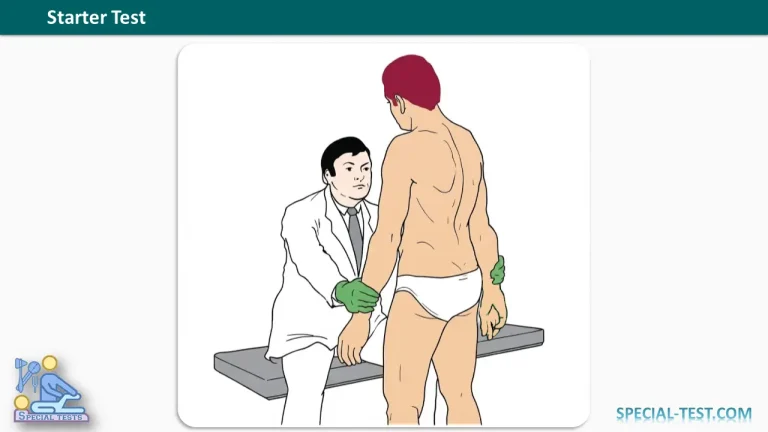
Ask the patient to stand upright with both arms hanging comfortably at the sides. The shoulders should remain relaxed, with the arms initially at approximately 0 degrees of abduction.
Explain that the patient will try to move the arms sideways, away from the body, while the examiner applies resistance.
Examiner Position and Technique
- Stand facing the patient.
- Grasp the distal third of each forearm, just proximal to the wrists.
- Ask the patient to begin abducting both arms against resistance.
- Apply controlled resistance directed inward, opposing the attempted outward movement.
- Compare the strength and symptom response between shoulders.
- Record whether the maneuver produces pain, weakness, or both.
The assessment focuses on the beginning of abduction. The patient does not need to raise the arms to shoulder height. Resistance should be applied gradually, allowing the examiner to assess effort without an abrupt force.
For clear documentation, describe the actual response rather than recording only “positive” or “negative.” For example, note whether pain occurs despite preserved strength or whether there is a definite reduction in force.
What Is a Positive Starter Test?
An abnormal response consists of pain and/or weakness during attempted resisted abduction from the resting position. Marked weakness raises concern for impaired rotator cuff function, but its cause must be interpreted within the complete clinical examination.
Pain During Testing
Pain indicates that the resisted movement provokes symptoms. It does not, by itself, demonstrate tendon discontinuity or identify the extent of an injury.
Weakness During Testing
Reduced force compared with the opposite shoulder is an important finding. In a prospective study of supraspinatus examination tests, interpreting weakness as the positive finding provided better diagnostic precision than pain alone or a combined pain-or-weakness criterion. Nevertheless, the zero-degree abduction test had limited value when used individually.
Clinicians should also consider whether pain prevents a full effort. An apparent strength deficit may reflect painful inhibition rather than the mechanical consequences of a torn tendon.
Starter Test Accuracy and Limitations
The Starter Test has been investigated, but the available evidence does not support describing it as a highly accurate standalone test.
Sgroi and colleagues evaluated seven clinical maneuvers in 115 patients scheduled for shoulder arthroscopy. Their study included the zero-degree abduction, empty can, and full can tests. Only the empty can and full can tests demonstrated effective individual diagnostic performance in that study. Combining these two maneuvers with the zero-degree abduction test improved diagnostic performance.
The investigated tests could not reliably distinguish partial-thickness from full-thickness supraspinatus tears. Because the participants were surgical patients, the findings also require caution when applied to a general primary-care population.
A textbook citation is useful for describing technique, but it is not itself a sensitivity or specificity estimate. Accuracy values from the empty can test, full can test, or other resisted abduction maneuvers should not be presented as Starter Test statistics.
How Does the Starter Test Fit Into a Shoulder Examination?
The Starter Test is most useful as one component of a structured assessment. Clinical evaluation should include the history, inspection, active and passive range of motion, strength testing, and selected special tests.
Comparing active and passive movement helps interpret functional loss. Rotator cuff disorders may reduce active elevation while passive movement remains relatively preserved; substantial passive restriction can suggest an additional or alternative joint disorder.
Other maneuvers may include Jobe’s empty can test, the full can test, and external rotation testing. These assess different aspects of shoulder function and have their own diagnostic characteristics. Their results should be interpreted together with the patient’s symptoms rather than treated as interchangeable findings.
When uncertainty remains and identifying a tear would affect management, further evaluation may include ultrasound or MRI. A normal Starter Test alone should not end the assessment when the history and other findings remain concerning.
Frequently Asked Questions
What is the Starter Test used for?
The Starter Test assesses pain and strength during resisted initiation of shoulder abduction. It can contribute to the examination of suspected rotator cuff dysfunction, particularly supraspinatus involvement.
Why is it called the Zero-Degree Abduction Test?
The arm begins beside the body at approximately zero degrees of abduction. The examiner resists the patient’s attempt to move it outward.
Does a positive Starter Test confirm a rotator cuff tear?
No. Pain or weakness warrants further interpretation, but neither finding confirms a tear independently. The result must be considered alongside the history and other examination findings.
Is the Starter Test the same as the empty can test?
No. The Starter Test begins with the arm at the side. The empty can test assesses resisted elevation with the arm raised in the scapular plane and internally rotated.
Can the Starter Test distinguish a partial tear from a full-thickness tear?
No. Available research does not support using this maneuver to reliably determine tear depth. Imaging may be needed when defining the structural injury would influence treatment.
References
- Sgroi M, Loitsch T, Reichel H, Kappe T. Diagnostic Value of Clinical Tests for Supraspinatus Tendon Tears. Arthroscopy. 2018;34(8):2326–2333.
- Reed D, Cathers I, Halaki M, Ginn K. Does supraspinatus initiate shoulder abduction?. Journal of Electromyography and Kinesiology. 2013;23(2):425–429.
- Jain NB, et al. Clinical Examination of the Rotator Cuff. PM&R. 2013.
- Jain NB, et al. The Diagnostic Accuracy of Special Tests for Rotator Cuff Tear: The ROW Cohort Study. American Journal of Physical Medicine & Rehabilitation. 2017;96(3):176–183.