Speed Test for Shoulder: How to Perform It, Positive Signs, and Diagnostic Accuracy
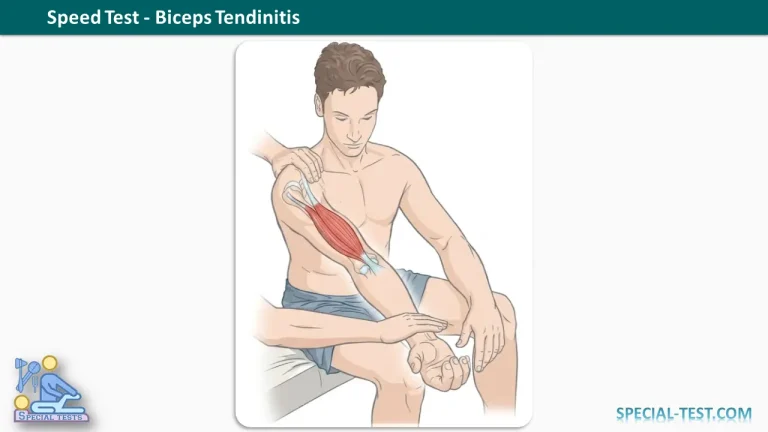
The Speed Test, also known as Speed’s Test, the Palm-Up Test, or the Straight Arm Test, is a commonly used orthopedic physical examination maneuver for evaluating shoulder pain associated with biceps tendinitis and superior labral anterior-to-posterior (SLAP) lesions.
The test assesses pain provoked by resisted shoulder flexion while the elbow remains extended and the forearm is supinated. It primarily evaluates the long head of the biceps tendon and may help identify abnormalities involving the biceps–labral complex.
Although the Speed Test is frequently performed during clinical shoulder examinations, its diagnostic accuracy varies considerably across studies. Therefore, it should be interpreted alongside the patient’s history, other physical examination findings, and appropriate imaging when indicated.
What Is the Speed Test Used For?
The Speed Test for the shoulder is primarily used to evaluate conditions affecting the long head of the biceps tendon and its attachment to the superior glenoid labrum.
The main indications include:
1. Biceps Tendinitis and Tendinopathy
Biceps tendinitis refers to inflammation of the long head of the biceps tendon, commonly associated with anterior shoulder pain. The term biceps tendinopathy is broader and includes degenerative tendon changes.
During the Speed Test, resisted shoulder flexion places a load on the biceps tendon. Reproduction of localized pain over the bicipital groove may suggest long-head biceps tendon pathology.
2. Superior Labral Anterior-to-Posterior (SLAP) Lesions
A SLAP lesion involves injury to the superior portion of the glenoid labrum, where the long head of the biceps tendon attaches.
Because of this anatomical relationship, resisted loading of the biceps tendon may provoke symptoms in patients with superior labral injuries.
However, a positive Speed Test alone cannot confirm a SLAP tear.
3. Other Long-Head Biceps Tendon Disorders
The Speed Test may also provoke pain in patients with other abnormalities of the long head of the biceps tendon, including:
- Biceps tenosynovitis
- Partial biceps tendon tears
- Long-head biceps tendon instability or subluxation
- Associated biceps–labral complex abnormalities
The test is not sufficiently specific to reliably distinguish between these conditions.
How to Perform the Speed Test
The Speed Test procedure is straightforward and can be performed with the patient sitting or standing.
Step-by-Step Examination Technique
- Patient position: Ask the patient to sit or stand upright with the affected shoulder exposed and relaxed.
- Shoulder position: Position the shoulder in approximately 90 degrees of forward flexion.
- Elbow position: Keep the elbow fully extended throughout the examination.
- Forearm position: Supinate the forearm so that the palm faces upward.
- Examiner position: Stand in front of or slightly lateral to the patient, facing the affected upper limb.
- Apply resistance: Place your hand over the distal forearm, proximal to the wrist, and apply downward resistance while instructing the patient to maintain shoulder flexion.
- Assess symptoms: Observe for pain, weakness, or discomfort, particularly over the bicipital groove at the anterior aspect of the shoulder.
The examination may also be performed dynamically by asking the patient to actively elevate the arm against resistance.
When appropriate, compare the symptomatic shoulder with the opposite side to identify differences in pain response and strength.
What Is a Positive Speed Test?
A positive Speed Test is characterized by reproduction of the patient’s familiar pain over the bicipital groove during resisted shoulder flexion.
The location and nature of the pain are important for clinical interpretation.
Pain localized to the bicipital groove: This finding may indicate pathology involving the long head of the biceps tendon, including tendinitis, tendinopathy, or tenosynovitis.
Deep or superior shoulder pain: This may raise suspicion of a SLAP lesion, particularly when accompanied by a compatible injury mechanism or additional positive labral examination tests.
Pain associated with weakness: This may occur with biceps tendon pathology but is not diagnostic of a tendon tear.
Importantly, shoulder pain during the test may also arise from other conditions, including rotator cuff disorders. A positive finding does not establish a definitive diagnosis.
Speed Test Sensitivity and Specificity
The diagnostic accuracy of the Speed Test has been investigated in several clinical studies, with substantially different findings.
Original Reported Diagnostic Accuracy
In a 1998 prospective study, Bennett evaluated the Speed Test against arthroscopic findings in 46 shoulders from 45 patients.
The study reported:
- Sensitivity: 90%
- Specificity: 13.8% (approximately 14%)
- Positive predictive value: 23%
- Negative predictive value: 83%
These findings suggest that the Speed Test identified many patients with macroscopic biceps–labral pathology within that study population, but also produced numerous false-positive results.
The very low specificity indicates that a positive test was common even in patients without the target biceps–labral abnormalities.
It is important to recognize that these percentages came from a relatively small surgical population and should not be treated as universal values.
Diagnostic Accuracy in Other Studies
Subsequent research has reported different results:
| Study | Sensitivity | Specificity | Evaluated condition |
|---|---|---|---|
| Bennett, 1998 | 90% | 14% | Biceps–labral pathology |
| Holtby and Razmjou, 2004 | 32% | 75% | Biceps pathology and SLAP lesions |
| Chen et al., 2011 | 63% | 58% | Long-head biceps tendinitis |
| Hegedus et al., 2008 | 32% | 61% | SLAP lesions, pooled estimates |
These differences reflect variations in patient populations, examination techniques, target diagnoses, and reference standards.
A systematic review by Hegedus and colleagues concluded that the Speed Test has limited diagnostic accuracy for labral pathology.
Consequently, neither a positive nor a negative Speed Test result can reliably confirm or exclude biceps tendon or SLAP pathology on its own.
Clinical Significance of the Speed Test
The Speed Test remains useful as part of a comprehensive clinical assessment of anterior shoulder pain.
Its main advantages include simplicity, minimal equipment requirements, and the ability to reproduce symptoms associated with loading of the biceps tendon.
However, clinicians should recognize its limitations.
A positive Speed Test may increase suspicion of biceps-related pathology when supported by localized bicipital groove tenderness and a compatible clinical history. Nevertheless, the test cannot reliably differentiate isolated biceps tendinopathy from associated rotator cuff or superior labral abnormalities.
Other examination maneuvers, such as Yergason’s Test, the O’Brien Active Compression Test, and selected biceps-loading tests, may provide additional clinical information.
When the diagnosis remains uncertain, imaging may be considered according to the suspected pathology. Musculoskeletal ultrasound can assist in evaluating long-head biceps tendon abnormalities, while suspected intra-articular labral pathology may require further specialist assessment and appropriate imaging.
The overall clinical diagnosis should be based on a combination of findings rather than a single provocative maneuver.
Key Points
The Speed Test is a widely recognized orthopedic examination technique used to assess the long head of the biceps tendon and possible SLAP lesions.
The maneuver is performed with the shoulder flexed to 90 degrees, the elbow extended, and the forearm supinated while the examiner applies downward resistance.
Pain over the bicipital groove represents the classical positive finding.
Although Bennett’s original study reported 90% sensitivity and approximately 14% specificity, subsequent investigations have demonstrated considerable variability in diagnostic performance.
Therefore, the Speed Test is best considered a supportive clinical examination maneuver rather than a definitive diagnostic test.
Frequently Asked Questions (FAQ)
What is the Speed Test for the shoulder?
The Speed Test is an orthopedic examination maneuver used to evaluate anterior shoulder pain and possible abnormalities of the long head of the biceps tendon or superior glenoid labrum.
How do you perform the Speed Test?
The patient elevates the shoulder to 90 degrees with the elbow extended and the palm facing upward. The examiner applies downward resistance to the forearm while the patient attempts to maintain the arm position.
What does a positive Speed Test indicate?
A positive Speed Test reproduces pain over the bicipital groove, suggesting possible long-head biceps tendon pathology. Deep or superior shoulder pain may also raise suspicion of a SLAP lesion, although the finding is not diagnostic.
What is the sensitivity and specificity of the Speed Test?
Bennett’s 1998 study reported a sensitivity of 90% and a specificity of approximately 14% for biceps–labral pathology. However, other studies have reported different values, so these figures should not be applied to all patient populations.
Can the Speed Test diagnose a SLAP tear?
No. The Speed Test may reproduce symptoms associated with a SLAP lesion, but its diagnostic accuracy is insufficient to confirm or exclude a labral tear independently.
What is the difference between the Speed Test and Yergason’s Test?
Both maneuvers assess possible long-head biceps tendon pathology. The Speed Test involves resisted shoulder flexion with the elbow extended and forearm supinated. Yergason’s Test primarily involves resisted forearm supination, usually with the elbow flexed to 90 degrees. Neither test should be used alone to establish a diagnosis.
Is the Speed Test reliable for diagnosing biceps tendinitis?
The Speed Test can contribute to the diagnosis of biceps tendinitis, particularly when it reproduces localized anterior shoulder pain. However, its sensitivity and specificity vary between studies, making it more useful as part of a complete shoulder examination.
Can a negative Speed Test rule out biceps tendon pathology?
No. Although one early study reported high sensitivity, subsequent research found substantially lower sensitivity. Therefore, a negative Speed Test does not reliably exclude biceps tendon abnormalities.
Medical References
- Bennett WF. Specificity of the Speed’s test: arthroscopic technique for evaluating the biceps tendon at the level of the bicipital groove. Arthroscopy. 1998;14(8):789–796. PubMed – PMID: 9848587
- Holtby R, Razmjou H. Accuracy of the Speed’s and Yergason’s tests in detecting biceps pathology and SLAP lesions: comparison with arthroscopic findings. Arthroscopy. 2004;20(3):231–236. PubMed – PMID: 15007311
- Chen HS, et al. A comparison of physical examinations with musculoskeletal ultrasound in the diagnosis of biceps long head tendinitis. Ultrasound Med Biol. 2011;37(9):1392–1398. PubMed – PMID: 21767902
- Hegedus EJ, et al. Physical examination tests of the shoulder: a systematic review with meta-analysis of individual tests. Br J Sports Med. 2008;42(2):80–92. PubMed – PMID: 17720798
- OrthoFixar. Shoulder Speed Test: Procedure, Positive Findings, and Sensitivity and Specificity. OrthoFixar – Speed Test