Rent Test (Transdeltoid Palpation Test) for Rotator Cuff Tears
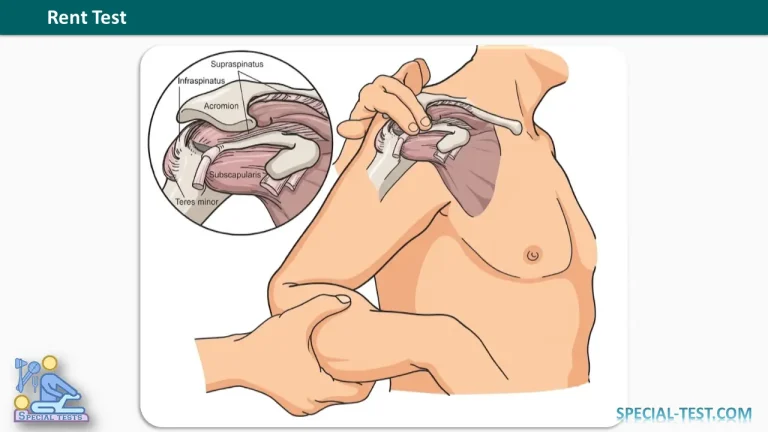
The Rent Test, also known as the Transdeltoid Palpation Test, is a clinical examination technique used to identify full-thickness rotator cuff tears. It involves palpating the rotator cuff insertion near the greater tuberosity of the humerus to detect a palpable defect or gap that may indicate tendon avulsion.
Rotator cuff tears are a common cause of shoulder pain, weakness, and functional limitation. They may develop following acute trauma or result from progressive tendon degeneration. Although several clinical tests are available to assess rotator cuff integrity, the Rent Test provides a direct method of examining the region where the tendons attach to the humerus.
The test is particularly useful when a clinician suspects a full-thickness tear and wants to determine whether a palpable defect is present. However, the findings should be interpreted alongside the patient’s history, symptoms, other physical examination findings, and appropriate imaging studies.
What Is the Rent Test Used For?
The Rent Test is primarily used to assess the presence of a full-thickness rotator cuff tear. It focuses on identifying a palpable gap or soft-tissue defect near the greater tuberosity, where the rotator cuff tendons attach to the humerus.
The main clinical applications of the Rent Test include:
- Detecting full-thickness rotator cuff tears: A palpable depression may suggest that the tendon has detached from its insertion.
- Assessing rotator cuff integrity: The test helps clinicians evaluate the continuity of the rotator cuff tendon attachment.
- Supporting the diagnosis of shoulder pathology: Findings may help guide further clinical assessment and decisions about imaging.
- Distinguishing the presence of a tear from an intact tendon: The test is intended primarily to assess whether a tear is present, rather than to determine its precise dimensions.
The rotator cuff consists of four muscles and their tendons: the supraspinatus, infraspinatus, teres minor, and subscapularis. These structures contribute to glenohumeral joint stability and coordinated shoulder movement. A full-thickness tear extends through the entire thickness of a tendon and may impair shoulder strength and function.
How to Perform the Rent Test
The Rent Test is performed by palpating the rotator cuff insertion while positioning the shoulder to improve access to the greater tuberosity.
Patient Position
- Ask the patient to sit or stand comfortably.
- Allow the affected arm to hang relaxed at the patient’s side.
- Ensure that the shoulder muscles are relaxed as much as possible.
Examiner Position and Arm Support
- Stand behind the patient.
- Hold the patient’s distal arm while maintaining the elbow in approximately 90 degrees of flexion.
- Support the arm throughout the examination to avoid unnecessary discomfort or muscle guarding.
Shoulder Positioning
- Passively move the glenohumeral joint into full extension, as tolerated.
- This position helps improve access to the humeral head and the rotator cuff tendon insertions near the greater tuberosity.
Palpation Technique
- Palpate the region near the anterior margin of the acromion to assess the underlying greater tuberosity and rotator cuff insertion.
- While maintaining the shoulder in a relaxed, extended position, gently rotate the arm internally and externally.
- Use these rotational movements to help identify the tendon margins and detect any palpable discontinuity or defect.
The examiner should compare the findings with the opposite shoulder when appropriate and consider the patient’s discomfort, muscle tension, and anatomical variations when interpreting the examination.
What Is a Positive Rent Test?
A positive Rent Test is characterized by a palpable defect or depression at the rotator cuff insertion, suggesting a full-thickness tendon tear.
The principal findings include:
- Prominent greater tuberosity: The greater tuberosity may feel unusually prominent beneath the examiner’s fingers.
- Palpable sulcus or rent: A depression or soft-tissue gap may be felt at the site of tendon detachment. The defect has been described as approximately one finger-width in some clinical descriptions.
- Palpable tendon margins: The anterior or posterior edges of the torn tendon may be detectable during careful palpation.
- Evidence of tendon discontinuity: The examiner may appreciate a gap where the tendon would normally cover or attach to the greater tuberosity.
These findings can support the suspicion of a full-thickness rotator cuff tear. However, palpation alone cannot reliably establish which tendon is torn, determine the exact tear dimensions, or fully characterize the degree of tendon retraction.
What Is a Negative Rent Test?
A negative Rent Test occurs when the examiner cannot identify a palpable defect or sulcus at the rotator cuff insertion.
This finding may suggest that no obvious full-thickness tear is present. Nevertheless, a negative test does not completely exclude a rotator cuff tear.
Small tears, tears involving particular tendon locations, patient guarding, body habitus, and difficulty palpating the tendon insertion may affect the examination. Partial-thickness tears may also be present without a distinct palpable gap.
If the patient’s symptoms and other examination findings remain suggestive of a rotator cuff injury, further assessment may be warranted despite a negative result.
Rent Test Accuracy
The following diagnostic accuracy values have been reported for the Rent Test:
- Sensitivity: 95.7%
- Specificity: 96.8%
Sensitivity describes the proportion of patients with the target condition who test positive, while specificity describes the proportion of patients without the condition who test negative.
These figures suggest that the test may be useful for identifying rotator cuff tears in the population in which it was studied. However, diagnostic accuracy can vary according to the patient population, examiner experience, tear characteristics, and reference standard used.
The figures should not be interpreted as universal performance estimates for every clinical setting. The original study and its methodology should be consulted before using these values to guide clinical decisions.
Clinical Significance and Limitations
The Rent Test is a useful component of a comprehensive shoulder examination, but it should not be used in isolation.
A palpable defect may increase suspicion of a full-thickness tear, while a negative result cannot exclude all forms of rotator cuff pathology. Other shoulder conditions may also produce pain or weakness, including tendinopathy, bursitis, adhesive capsulitis, and glenohumeral joint disorders.
The examination should therefore be combined with an appropriate history and other clinical tests. When indicated, ultrasound or magnetic resonance imaging (MRI) can help confirm a tear, identify the involved tendon, and assess tear size, retraction, and associated muscle changes.
The Rent Test is primarily intended to help determine the presence or absence of a rotator cuff tear. It should not be relied upon to estimate the tear’s size.
Frequently Asked Questions (FAQ)
What is the Rent Test used for?
The Rent Test is used to assess the presence of a full-thickness rotator cuff tear by palpating for a gap or depression near the greater tuberosity of the humerus.
What is another name for the Rent Test?
The Rent Test is also known as the Transdeltoid Palpation Test because it involves palpation of the rotator cuff insertion through the deltoid region.
How do you perform the Rent Test?
The patient sits or stands with the affected arm relaxed. The examiner stands behind the patient, supports the arm with the elbow flexed to approximately 90 degrees, and passively extends the shoulder. The examiner then palpates near the anterior acromial margin while gently rotating the shoulder internally and externally.
What is a positive Rent Test?
A positive result is the detection of a palpable sulcus, depression, or soft-tissue defect near the greater tuberosity, suggesting a full-thickness rotator cuff tear.
What is the sensitivity of the Rent Test?
The reported sensitivity is 95.7%. This represents the proportion of patients with the target condition who test positive in the studied population. The estimate may vary across clinical settings.
What is the specificity of the Rent Test?
The reported specificity is 96.8%. This represents the proportion of patients without the target condition who test negative in the studied population.
Can the Rent Test determine the size of a rotator cuff tear?
No. The Rent Test is primarily used to assess the presence or absence of a rotator cuff tear. Imaging, such as ultrasound or MRI, is more appropriate for evaluating tear dimensions, tendon retraction, and associated muscle changes.
Does a negative Rent Test rule out a rotator cuff tear?
No. A negative result does not exclude a tear, particularly when the defect is small or difficult to palpate. Further clinical assessment and imaging may be necessary when symptoms suggest rotator cuff pathology.
What imaging is used to confirm a rotator cuff tear?
Musculoskeletal ultrasound and MRI are commonly used to evaluate suspected rotator cuff tears. The choice depends on clinical findings, availability, and the information required for diagnosis and treatment planning.
References
- Dutton M. Dutton’s Orthopaedic Examination, Evaluation, and Intervention. 3rd edition.
- Rent Test (Transdeltoid Palpation Test) – OrthoFixar.