Prone Anterior Instability Test: How to Perform and Interpret
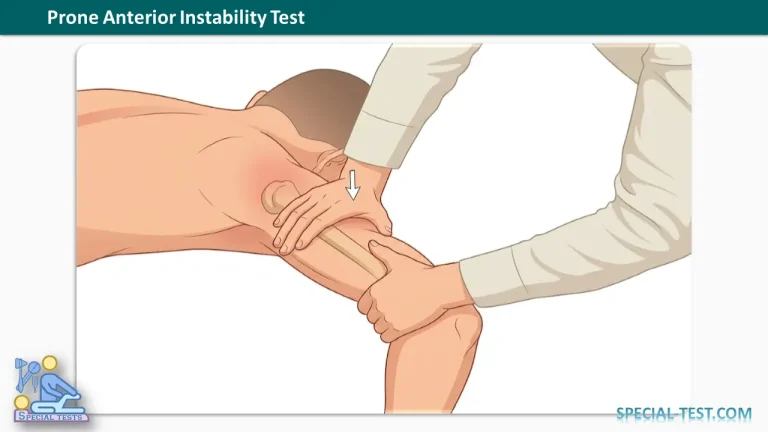
The Prone Anterior Instability Test is a clinical examination maneuver used to assess anterior shoulder instability. It evaluates the response of the glenohumeral joint to an anteriorly directed force applied to the humeral head.
This test is described as a modification of the load-and-shift test, a clinical maneuver used to assess glenohumeral translation. It may help clinicians evaluate patients with suspected shoulder instability, particularly following shoulder trauma or recurrent episodes of subluxation or dislocation.
What Is the Prone Anterior Instability Test Used For?
The Prone Anterior Instability Test is used to assess suspected anterior glenohumeral instability, which occurs when the humeral head demonstrates excessive anterior translation relative to the glenoid.
It may be considered as part of a comprehensive shoulder examination in patients who report:
- A history of anterior shoulder dislocation or subluxation.
- A sensation that the shoulder is slipping out of place.
- Recurrent shoulder instability during arm movement.
- Symptoms following shoulder trauma.
Clinical note: This test should not be interpreted in isolation. Findings must be considered alongside the patient’s history, other shoulder instability tests, and the overall clinical examination.
How to Perform the Prone Anterior Instability Test
Follow these steps to perform the examination maneuver:
- Position the patient: Ask the patient to lie prone on the examination table.
- Position the shoulder: Abduct the patient’s arm to approximately 90 degrees and externally rotate it to approximately 90 degrees, as described in the test protocol.
- Stabilize the arm: Support the patient’s elbow with one hand to maintain the required position.
- Apply the anterior force: Place the other hand over the humeral head and gently direct the humeral head anteriorly.
- Assess the response: Observe the patient’s symptoms, apprehension, and response to the applied force.
The maneuver should be performed carefully by a trained healthcare professional. Avoid excessive force, particularly in patients with acute injury, severe pain, or a suspected unreduced dislocation.
What Is a Positive Prone Anterior Instability Test?
A positive Prone Anterior Instability Test is indicated when the maneuver reproduces the patient’s familiar symptoms associated with shoulder instability.
The response should be interpreted in context. Pain alone is not specific for instability, and symptom reproduction does not independently establish a diagnosis.
Clinicians should distinguish between:
- Apprehension: A feeling that the shoulder may dislocate or slip out of place.
- Pain: Discomfort during the maneuver, which may have several possible causes.
- Excessive translation: Increased anterior movement of the humeral head compared with the expected range or the opposite shoulder.
These findings should be documented separately when possible, as they provide different information during the clinical assessment.
Clinical Significance and Limitations
The Prone Anterior Instability Test can contribute to the assessment of suspected anterior shoulder instability, but its diagnostic accuracy should not be assumed to match that of other established shoulder instability tests.
The test should be interpreted alongside the patient’s history, examination findings, and other appropriate clinical assessments. Depending on the presentation, a clinician may consider additional maneuvers, such as the anterior apprehension test, relocation test, or load-and-shift test.
Further evaluation or imaging may be indicated when there is a history of significant trauma, recurrent instability, suspected structural injury, or persistent symptoms.
Frequently Asked Questions (FAQ)
1. What does the Prone Anterior Instability Test assess?
It assesses suspected anterior instability of the glenohumeral joint by applying an anteriorly directed force to the humeral head and evaluating the patient’s response.
2. How is the patient positioned for the Prone Anterior Instability Test?
The patient lies face down in a prone position. The shoulder is abducted to approximately 90 degrees and externally rotated to approximately 90 degrees, while the examiner supports the elbow and applies an anterior force to the humeral head.
3. What is a positive Prone Anterior Instability Test?
A positive result is described as reproduction of the patient’s familiar instability-related symptoms. Apprehension and excessive humeral head translation should be distinguished from pain alone.
4. Is the Prone Anterior Instability Test the same as the load-and-shift test?
No. It is described as a modification of the load-and-shift test. Both maneuvers assess glenohumeral translation, but their positioning and execution may differ.
5. Does a positive test confirm anterior shoulder instability?
No. A positive finding contributes to the clinical assessment but does not independently confirm the diagnosis. The result should be interpreted with the patient’s history and other examination findings.
6. Which other tests can help assess anterior shoulder instability?
Other commonly used examination maneuvers include the anterior apprehension test, relocation test, and load-and-shift test. The choice of tests depends on the patient’s symptoms, history, and clinical presentation.
7. When should this test be avoided or modified?
The maneuver should be avoided or modified when it may aggravate an acute injury, severe pain, or a suspected unreduced shoulder dislocation. Clinical judgment and appropriate precautions are essential.
References and Further Reading
For additional information about shoulder instability and clinical examination, consult established medical resources:
- American Academy of Orthopaedic Surgeons (AAOS): Shoulder Dislocation
- Merck Manual Professional Edition: Shoulder Dislocations
- StatPearls, NCBI Bookshelf: Anterior Shoulder Instability