Norwood Stress Test: Purpose, Procedure, and Interpretation
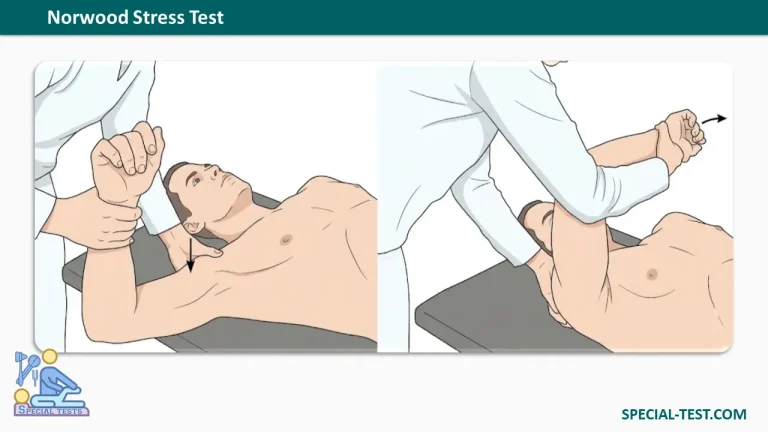
The Norwood Stress Test is a clinical orthopedic examination used to assess posterior shoulder instability, particularly posterior subluxation of the humeral head relative to the glenoid. It helps clinicians evaluate whether the humeral head moves abnormally backward within the glenohumeral joint during specific shoulder movements.
Posterior shoulder instability can develop following trauma, repetitive loading, sports-related activities, or structural abnormalities affecting the shoulder joint. Patients may report shoulder pain, a sensation of slipping or giving way, clicking, or instability during pushing activities and movements that place the shoulder in flexion, adduction, and internal rotation.
The Norwood Stress Test was described in the clinical literature by Norwood and Terry in their 1984 publication, Shoulder Posterior Subluxation. It remains a recognized examination maneuver for evaluating posterior translation of the humeral head. The test is generally performed as part of a comprehensive shoulder assessment rather than as a standalone diagnostic procedure.
What Is the Norwood Stress Test Used For?
The primary indication for the Norwood Stress Test is the assessment of posterior glenohumeral instability.
The test helps identify excessive posterior translation of the humeral head relative to the glenoid cavity. Under normal conditions, the glenohumeral joint allows a degree of translation while maintaining joint stability. When the supporting structures are insufficient or injured, the humeral head may move excessively posteriorly, resulting in subluxation or, in more severe cases, dislocation.
The Norwood Stress Test may be useful when evaluating patients with suspected:
- Posterior shoulder instability: Abnormal posterior movement of the humeral head during examination.
- Posterior humeral head subluxation: Partial displacement of the humeral head relative to the glenoid without complete loss of joint contact.
- Recurrent instability symptoms: Episodes of slipping, clicking, or giving way during shoulder movement.
- Traumatic or atraumatic shoulder instability: Symptoms associated with injury, repetitive loading, or underlying joint laxity.
The findings should be interpreted alongside the patient’s history, other physical examination tests, and imaging when clinically indicated. A positive test does not, by itself, establish the exact structural cause of instability.
Anatomy and Clinical Significance
The glenohumeral joint is formed by the humeral head and the glenoid cavity of the scapula. Although this arrangement provides a wide range of shoulder motion, stability depends on several interacting structures.
Important stabilizing structures include the glenoid labrum, joint capsule, glenohumeral ligaments, rotator cuff muscles, and surrounding scapular musculature. The labrum increases the effective depth of the glenoid cavity, while the capsule and ligaments help restrain excessive translation. The rotator cuff contributes dynamic stability by maintaining appropriate positioning of the humeral head during movement.
Posterior instability may occur when these stabilizing mechanisms are compromised. Potential contributing factors include traumatic injury, repetitive posterior loading, capsulolabral abnormalities, and muscle-patterning disorders.
The Norwood Stress Test places the shoulder in a position that allows the examiner to assess posterior humeral head translation while stabilizing the scapula. Palpation helps the examiner appreciate the movement of the humeral head relative to the glenoid.
How to Perform the Norwood Stress Test
The Norwood Stress Test should be performed by a qualified healthcare professional who is familiar with shoulder instability examinations. The maneuver must be conducted carefully because excessive force may provoke pain, subluxation, or dislocation.
Patient Position
- Position the patient lying supine on the examination table.
- Abduct the affected shoulder approximately 60° to 100°.
- Laterally rotate the shoulder to approximately 90°.
- Flex the elbow to 90°, positioning the arm approximately horizontally.
This starting position prepares the shoulder for controlled horizontal adduction and assessment of posterior humeral head translation.
Examiner Hand Placement
- The examiner stabilizes the scapula with one hand to minimize scapular movement.
- The fingers of the stabilizing hand palpate the posterior aspect of the humeral head.
- The other hand supports and controls the patient’s upper limb by holding the forearm, wrist, or elbow, as appropriate for the examination technique.
Proper stabilization is important because it helps distinguish actual humeral head translation from movement of the scapula or the entire shoulder girdle.
Performing the Maneuver
- From the starting position, gradually move the patient’s arm into horizontal adduction toward the forward-flexed position.
- While moving the arm, palpate the posterior humeral head to detect whether it translates backward relative to the glenoid.
- Observe the patient’s response and ask about pain, clicking, slipping, or a sensation of instability.
- If appropriate, the examiner may incorporate the modification described by Cofield and Irving: medially rotate the forearm by approximately 20° after forward flexion and then apply a controlled posterior force through the elbow.
- Another described modification involves applying gentle posterior pressure to the humeral head with the thumb while performing horizontal adduction, making the maneuver similar to a posterior apprehension test.
These modifications are intended to accentuate posterior translation when clinically appropriate. They should not be applied forcefully, particularly in patients with a history of dislocation or marked instability.
Returning the Arm to the Starting Position
After assessing the shoulder’s response, the examiner gradually returns the arm to its original position. The humeral head may be palpated as it returns toward its normal position within the glenoid.
A palpable or audible click may occur during posterior subluxation or reduction. Such a click should be interpreted in the context of the entire examination because clicking alone is not specific for posterior instability.
What Is a Positive Norwood Stress Test?
A positive Norwood Stress Test is indicated when the humeral head translates abnormally posteriorly relative to the glenoid during the maneuver, suggesting posterior shoulder instability.
The following findings may support a positive result:
- Excessive posterior translation: The examiner palpates the humeral head moving backward relative to the glenoid.
- Subluxation or slipping: The humeral head partially loses its normal relationship with the glenoid.
- Reproduction of familiar symptoms: The patient recognizes the sensation as similar to the instability experienced during daily activities or sports.
- Clicking associated with translation or reduction: A click may accompany the movement of the humeral head over the glenoid rim.
Importantly, apprehension is not always present before posterior subluxation or dislocation occurs. Therefore, the absence of apprehension does not automatically exclude a positive test if abnormal posterior translation is clearly demonstrated.
The examiner should distinguish between pain alone and true mechanical instability. Pain during the maneuver without demonstrable abnormal translation is not sufficient to confirm posterior shoulder instability.
Clinical Interpretation and Limitations
The Norwood Stress Test is one component of the clinical evaluation of a potentially unstable shoulder. Its findings should be correlated with the patient’s history, mechanism of injury, symptom pattern, and other examination findings.
Other posterior instability assessment maneuvers, such as the posterior apprehension test and posterior load-and-shift test, may provide complementary information. Depending on the clinical presentation, a healthcare professional may also consider radiographs, magnetic resonance imaging (MRI), or other investigations to assess associated injuries and structural abnormalities.
A negative Norwood Stress Test does not definitively exclude posterior shoulder instability. Symptoms may vary depending on the direction of instability, the severity of the underlying problem, and the position in which instability occurs. Likewise, excessive translation should be interpreted in relation to the patient’s baseline joint laxity and symptoms.
The maneuver should be stopped if the patient develops significant pain, marked apprehension, or obvious subluxation. Repeatedly provoking instability is unnecessary and may increase the risk of further injury.
Frequently Asked Questions (FAQ)
What does the Norwood Stress Test assess?
The Norwood Stress Test assesses posterior shoulder instability by evaluating whether the humeral head translates excessively backward relative to the glenoid during a controlled shoulder movement.
How do you perform the Norwood Stress Test?
The patient lies supine with the shoulder abducted approximately 60° to 100°, laterally rotated 90°, and the elbow flexed 90°. The examiner stabilizes the scapula, palpates the posterior humeral head, and moves the arm into horizontal adduction while monitoring posterior translation.
What is a positive Norwood Stress Test?
A positive result occurs when the humeral head demonstrates abnormal posterior translation relative to the glenoid. Reproduction of the patient’s familiar instability symptoms may further support the finding.
Does a positive Norwood Stress Test always cause apprehension?
No. Posterior subluxation or even dislocation may occur without the patient experiencing clear apprehension beforehand. The examiner should assess actual humeral head movement as well as the patient’s symptoms.
Can the Norwood Stress Test diagnose a posterior labral tear?
The test may raise suspicion of posterior shoulder instability, which can be associated with a posterior labral injury. However, it cannot independently confirm a labral tear. Further clinical assessment and, when indicated, imaging may be required.
Is the Norwood Stress Test sufficient to diagnose shoulder instability?
No. It should be combined with the patient’s history, other instability tests, and additional investigations when necessary. Neither a positive nor a negative result should be interpreted in isolation.
References
- Magee DJ. Orthopedic Physical Assessment. 7th ed. Elsevier.
- Norwood LA, Terry GC. Shoulder posterior subluxation. The American Journal of Sports Medicine. 1984;12(1):25–30. doi: 10.1177/036354658401200104. PMID: 6703179. PubMed
- Cofield RH, Irving JF. Evaluation and classification of shoulder instability. With special reference to examination under anesthesia. Clinical Orthopaedics and Related Research. 1987;(223):32–43. PMID: 3308270. PubMed