Neer Test for Shoulder Impingement: Procedure, Positive Findings & Diagnostic Accuracy
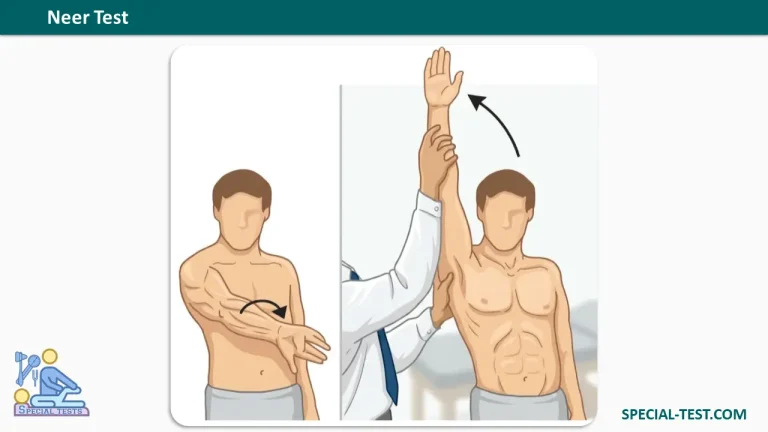
The Neer test, also known as the Neer impingement test, is a clinical shoulder examination maneuver used to assess pain associated with subacromial impingement and rotator cuff–related shoulder disorders. It is commonly performed during musculoskeletal assessments in orthopedics, sports medicine, physiotherapy, and primary care.
The test helps clinicians evaluate shoulder pain, but it should not be used alone to establish a diagnosis. Findings must be interpreted alongside the patient’s history, range of motion, strength testing, and other relevant examination maneuvers.
What Is the Neer Test Used For?
The Neer test is primarily used to assess whether passive shoulder elevation reproduces pain suggestive of subacromial or rotator cuff–related pathology.
It may be helpful when evaluating patients with suspected:
- Subacromial pain syndrome: Pain associated with structures in the subacromial region.
- Rotator cuff tendinopathy: Disorders involving the rotator cuff tendons.
- Subacromial bursitis: Irritation or inflammation of the subacromial-subdeltoid bursa.
- Rotator cuff tears: Particularly when interpreted alongside appropriate strength and tendon-specific tests.
Shoulder pain caused by other conditions, including adhesive capsulitis, glenohumeral osteoarthritis, calcific tendinopathy, and bone lesions, requires additional assessment. The Neer test does not independently diagnose or reliably distinguish these disorders.
How to Perform the Neer Test
Patient position: The patient is seated or standing comfortably.
Examiner position and technique:
- Stabilize the patient’s scapula to limit scapular movement.
- Passively elevate the affected arm forward in the sagittal plane.
- Internally rotate the shoulder, typically positioning the thumb downward.
- Continue forward elevation toward the end of the available range, provided the movement is tolerated.
- Ask the patient whether the maneuver reproduces their familiar shoulder pain.
The maneuver reduces the available space beneath the acromion and may provoke symptoms from sensitive subacromial structures.
Clinical note: Perform the maneuver gently and avoid forcing the shoulder through severe pain or marked restriction.
What Is a Positive Neer Test?
The Neer test is considered positive when passive forward elevation of the internally rotated arm reproduces the patient’s shoulder pain, particularly pain consistent with their presenting symptoms.
A positive result suggests possible subacromial or rotator cuff–related shoulder pathology. However, pain during the maneuver is not specific to a single diagnosis and may occur in other shoulder conditions.
A negative result does not completely exclude rotator cuff disease or other causes of shoulder pain.
Neer Test: Sensitivity and Specificity
Diagnostic accuracy estimates for the Neer test vary across studies because of differences in patient populations, testing methods, and diagnostic reference standards.
A systematic review and meta-analysis published in British Journal of Sports Medicine reported the following pooled estimates for the Neer test in assessing shoulder impingement:
| Diagnostic measure | Pooled estimate |
|---|---|
| Sensitivity | 79% |
| Specificity | 53% |
Source: Hegedus et al., Physical examination tests of the shoulder: a systematic review with meta-analysis of individual tests. Read the study on PubMed.
These findings indicate that the Neer test has limited diagnostic accuracy when used in isolation. A positive result does not confirm impingement, and a negative result cannot definitively rule it out.
Important: Other reviews have reported different estimates, including sensitivity of approximately 72% and specificity of 60%. For educational accuracy, always identify the study associated with the figures you quote rather than presenting one set of values as universally applicable.
Clinical Interpretation and Limitations
The Neer test is one component of a comprehensive shoulder examination. Its results should be interpreted in conjunction with:
- The patient’s symptoms, injury history, and functional limitations.
- Active and passive shoulder range of motion.
- Rotator cuff strength testing.
- Other relevant provocative tests, such as the Hawkins–Kennedy test.
- Imaging when clinically indicated.
A cluster of findings generally provides more useful clinical information than a single provocative test. Modern clinical terminology also increasingly emphasizes rotator cuff–related shoulder pain and subacromial pain syndrome rather than assuming that all reproduced pain results from a purely mechanical impingement process.
Frequently Asked Questions (FAQ)
1. What does the Neer test assess?
The Neer test assesses whether passive forward elevation of the internally rotated shoulder reproduces pain associated with subacromial or rotator cuff–related disorders. It is a clinical screening maneuver, not a definitive diagnostic test.
2. How do you perform the Neer impingement test?
With the patient seated or standing, the examiner stabilizes the scapula and passively elevates the internally rotated arm forward toward the end of the available range. Reproduction of the patient’s familiar shoulder pain is considered a positive result.
3. What is a positive Neer test?
A positive Neer test occurs when passive forward elevation of the internally rotated shoulder reproduces pain. This finding may indicate subacromial or rotator cuff–related pathology, but it does not establish a specific diagnosis.
4. What are the sensitivity and specificity of the Neer test?
One systematic review and meta-analysis reported a pooled sensitivity of 79% and specificity of 53%. Estimates vary across studies, and the test has limited diagnostic accuracy when used alone. Source: PubMed.
5. Can the Neer test diagnose a rotator cuff tear?
No. The Neer test may reproduce pain in patients with rotator cuff disorders, but it cannot reliably confirm a tear or determine its severity. Specific strength tests, clinical assessment, and imaging when indicated may be needed.
6. What is the difference between the Neer test and the Hawkins–Kennedy test?
Both are provocative shoulder examination maneuvers used to assess pain associated with subacromial and rotator cuff–related conditions. The Neer test involves passive forward elevation of the internally rotated arm, whereas the Hawkins–Kennedy test involves approximately 90° of shoulder and elbow flexion followed by passive internal rotation of the shoulder.
7. Can the Neer test be positive in conditions other than shoulder impingement?
Yes. Pain may be reproduced in several shoulder disorders, including rotator cuff tendinopathy and other painful shoulder conditions. A positive result is not specific enough to distinguish among these diagnoses.
8. Is the Neer test sufficient to diagnose shoulder impingement syndrome?
No. The test should be combined with a detailed history, physical examination, and other relevant findings. Imaging may be appropriate when the diagnosis remains uncertain or when structural injury is suspected.
9. Is the Neer test painful?
The maneuver may reproduce shoulder pain, which is the response being assessed. It should be performed gently and stopped or modified if the patient experiences severe pain or cannot tolerate the movement.
10. What are the limitations of the Neer test?
Its principal limitation is modest diagnostic accuracy when used in isolation. Sensitivity and specificity vary across studies, and a positive result does not confirm impingement. Combining the test with other examination findings helps clinicians make a more informed assessment.
Medical education disclaimer: This content is intended for educational purposes and should not replace professional clinical assessment or individualized medical advice.
References
- Creech JA, Busse A, Li D, et al. Shoulder Impingement Syndrome. StatPearls. NCBI Bookshelf. Read the clinical review.
- Hegedus EJ, et al. Physical examination tests of the shoulder: a systematic review with meta-analysis of individual tests. British Journal of Sports Medicine. Read on PubMed.
- Hegedus EJ, et al. Diagnostic accuracy of clinical tests for subacromial impingement syndrome: a systematic review and meta-analysis. Read on PubMed.
- Wikimedia Commons. Neer Test illustration.