Miniaci Test: Purpose, Procedure, Positive Result, and Clinical Significance
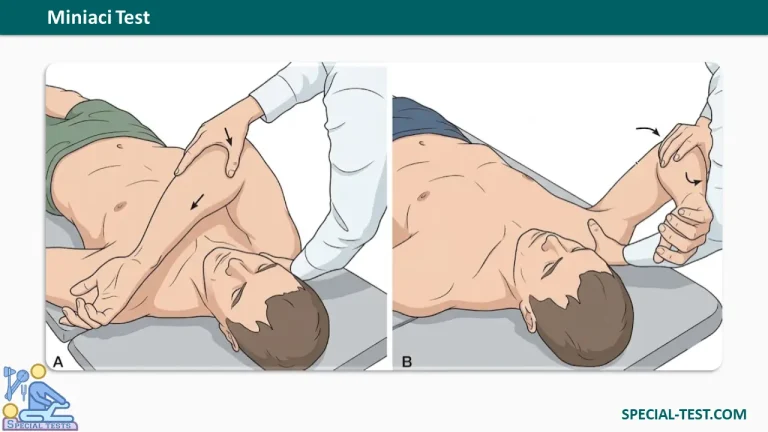
The Miniaci Test is a clinical shoulder examination maneuver used to assess posterior shoulder subluxation and instability. It helps clinicians evaluate abnormal posterior translation of the humeral head relative to the glenoid cavity. The test involves positioning the shoulder in flexion, adduction, and medial rotation while applying a posteriorly directed force to the humerus. The examiner then moves the arm into abduction and lateral rotation to assess whether the humeral head reduces, sometimes producing a palpable or audible clunk.
Posterior shoulder instability occurs when the humeral head translates excessively toward the back of the shoulder joint. This abnormal movement may cause pain, apprehension, a sensation of slipping, or episodes of subluxation or dislocation. Although posterior instability is less common than anterior shoulder instability, it can significantly affect athletes and individuals who perform repetitive pushing movements or activities that place the shoulder under posteriorly directed loads.
The Miniaci Test is one component of a comprehensive shoulder examination. Its findings should be interpreted alongside the patient’s history, other instability tests, and imaging when indicated.
What Is the Miniaci Test Used For?
The Miniaci Test is primarily used to evaluate posterior subluxation of the shoulder and identify clinical signs consistent with posterior glenohumeral instability.
The glenohumeral joint is formed by the humeral head and the glenoid cavity of the scapula. Because the glenoid is relatively shallow, shoulder stability depends on several structures, including the joint capsule, glenoid labrum, rotator cuff muscles, and surrounding ligaments.
Posterior instability may develop following trauma, repetitive loading, or structural abnormalities affecting these stabilizing structures. Patients may describe shoulder pain during pressing exercises, difficulty with overhead or athletic activities, or a sensation that the shoulder moves backward.
During the Miniaci Test, the examiner attempts to reproduce posterior translation of the humeral head and then assesses its reduction when the arm is repositioned. The test may help identify abnormal movement and apprehension associated with posterior instability.
A positive result supports the clinical suspicion of posterior shoulder instability, but the test should not be used in isolation to establish a definitive diagnosis.
How to Perform the Miniaci Test
The Miniaci Test can be performed with the patient lying supine or, alternatively, in a seated position. The examiner should explain the procedure before beginning and avoid forceful movement, particularly when the patient has a history of shoulder dislocation or significant pain.
Patient Position
- Ask the patient to lie supine on the examination table.
- Position the patient so that the affected shoulder and arm can move freely beyond the edge of the table.
- Ensure that the patient is relaxed and that the examiner can monitor the shoulder throughout the maneuver.
The test can also be performed with the patient sitting, provided the examiner can adequately control the arm and palpate the shoulder.
Step 1: Position the Shoulder
The examiner uses one hand to support and control the patient’s arm. The shoulder is placed in approximately 70° to 90° of flexion, combined with adduction and medial (internal) rotation.
These movements position the humeral head in a way that can facilitate posterior translation when an appropriate posteriorly directed force is applied.
Step 2: Apply Posterior Pressure
While maintaining the arm position, the examiner applies a controlled posteriorly directed force to the humerus.
This maneuver attempts to translate the humeral head posteriorly relative to the glenoid. The examiner should observe the patient’s response carefully, looking for apprehension, discomfort, or abnormal movement.
Step 3: Palpate the Shoulder
With the other hand, the examiner palpates the anterior and posterior aspects of the shoulder to assess humeral head movement.
The examiner evaluates whether the humeral head translates posteriorly and monitors the patient’s symptoms during the maneuver. Apprehension may occur because the position can provoke posterior subluxation in an unstable shoulder.
Step 4: Abduct and Laterally Rotate the Arm
The examiner then moves the arm into abduction and lateral (external) rotation while continuing to assess the position of the humeral head.
If the humeral head has subluxed posteriorly, this repositioning may allow it to return to its normal relationship with the glenoid. The examiner assesses for a palpable or audible clunk associated with reduction.
The maneuver should be performed gently and stopped if severe pain, marked apprehension, or other concerning symptoms occur.
What Is a Positive Miniaci Test?
A positive Miniaci Test is characterized by posterior subluxation of the humeral head during the initial maneuver, followed by reduction when the examiner abducts and laterally rotates the arm. The reduction may produce a palpable or audible clunk.
The examiner may also observe apprehension or symptoms consistent with the patient’s history of posterior shoulder instability.
The important clinical finding is the abnormal posterior translation followed by relocation, rather than the presence of a sound alone. A clunk can occur for reasons unrelated to instability, so it must be interpreted in the context of the complete examination.
A positive test raises suspicion for posterior glenohumeral instability and may indicate the need for additional clinical assessment.
Clinical Significance of the Miniaci Test
Posterior shoulder instability can be associated with several underlying conditions, including capsulolabral injury, repetitive microtrauma, and traumatic shoulder injury. It may also occur in patients exposed to repetitive posteriorly directed forces, such as during bench pressing or other pushing activities.
The Miniaci Test can contribute to the assessment by demonstrating abnormal humeral head translation and reduction. However, no single examination maneuver should determine the diagnosis or treatment plan.
A comprehensive assessment may include the patient’s injury history, evaluation of shoulder range of motion and strength, palpation, and other tests for posterior instability. Depending on the clinical findings, radiographs, magnetic resonance imaging (MRI), or magnetic resonance arthrography may be considered to investigate structural abnormalities.
Management depends on the cause and severity of instability. Some patients benefit from activity modification and rehabilitation focused on rotator cuff strength, scapular control, and dynamic shoulder stability. Recurrent instability or associated structural injury may require evaluation by an orthopedic shoulder specialist.
Limitations and Precautions
The Miniaci Test should be interpreted cautiously because examination findings can vary with the patient’s anatomy, muscle control, pain, and degree of instability. A negative result does not necessarily exclude posterior shoulder instability, and a positive result does not independently confirm a specific labral or capsular injury.
The examiner should avoid excessive force and should not attempt to provoke a dislocation. Particular caution is appropriate in patients with recent trauma, suspected fracture, acute dislocation, severe pain, or a history of recurrent instability.
Clinical findings should be correlated with the patient’s symptoms and, when necessary, further diagnostic investigations.
Frequently Asked Questions (FAQ)
1. What does the Miniaci Test assess?
The Miniaci Test assesses posterior shoulder subluxation and clinical signs of posterior glenohumeral instability. It evaluates abnormal posterior translation of the humeral head and its subsequent reduction.
2. What is a positive Miniaci Test?
A positive test occurs when the humeral head translates posteriorly during the initial maneuver and subsequently reduces as the arm is abducted and laterally rotated. A palpable or audible clunk may accompany reduction.
3. Which shoulder condition is associated with a positive Miniaci Test?
A positive Miniaci Test suggests posterior shoulder instability or posterior subluxation. However, the finding must be interpreted alongside the patient’s symptoms and other examination results.
4. What position is used for the Miniaci Test?
The patient is usually positioned supine with the affected shoulder near the edge of the examination table. The examiner flexes the shoulder approximately 70° to 90°, adducts and medially rotates the arm, and applies a controlled posterior force to the humerus. The test can also be performed with the patient seated.
5. Is the Miniaci Test sufficient to diagnose posterior shoulder instability?
No. The Miniaci Test is one part of the clinical assessment. Diagnosis requires correlation with the patient’s history, physical examination findings, and imaging when indicated.
6. What is the difference between posterior shoulder subluxation and dislocation?
Posterior subluxation is a partial loss of normal contact between the humeral head and the glenoid, whereas posterior dislocation involves a complete loss of normal joint contact. Both conditions may cause pain and functional limitation, but their severity and management can differ.
7. What other investigations may be required after a positive Miniaci Test?
Depending on the clinical presentation, the clinician may request shoulder radiographs or MRI to assess joint alignment and investigate possible labral, capsular, or other structural injuries. The choice of investigation depends on the patient’s history and examination findings.
Reference
- Valencia Mora M, Ibán MÁR, Heredia JD, Gutiérrez-Gómez JC, Diaz RR, Aramberri M, Cobiella C. Physical Exam and Evaluation of the Unstable Shoulder. The Open Orthopaedics Journal. 2017;11:946–956. Published August 31, 2017. doi:10.2174/1874325001711010946. PMID: 29114336; PMCID: PMC5646139. Read the full article on PubMed Central.