Ludington Test: Procedure, Positive Sign & Clinical Uses
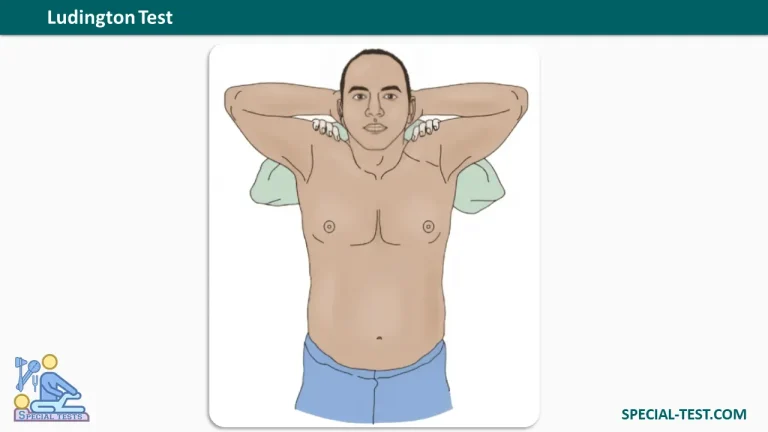
The Ludington Test is a clinical shoulder examination maneuver used to assess pathology involving the long head of the biceps brachii tendon, particularly suspected tendon rupture. It is one of several orthopedic special tests used during the physical examination of patients presenting with anterior shoulder pain, weakness, or suspected biceps tendon injuries.
The long head of the biceps tendon contributes to shoulder function and is frequently involved in shoulder disorders, including biceps tendinopathy, tendon instability, and degenerative or traumatic tendon rupture. Because biceps tendon abnormalities often coexist with rotator cuff injuries, a comprehensive shoulder examination is essential for identifying the underlying cause of symptoms.
The Ludington Test can provide useful clinical information when combined with the patient’s medical history, physical examination findings, and appropriate imaging studies.
What Is the Ludington Test Used For?
The Ludington Test is primarily used to evaluate the integrity of the long head of the biceps tendon, particularly when a proximal biceps tendon rupture is suspected.
The test is intended to help identify abnormalities of the biceps tendon through clinical examination. A suspected rupture may be associated with:
- Anterior shoulder pain or tenderness.
- Weakness during elbow flexion or forearm supination.
- A history of sudden shoulder pain following lifting or pulling.
- Bruising or swelling in the upper arm.
- A visible change in biceps muscle contour, sometimes described as a Popeye deformity.
- Associated rotator cuff pathology.
Proximal long head of biceps tendon rupture is frequently associated with degenerative changes in the shoulder and may occur alongside rotator cuff disease.
Importantly, the Ludington Test should not be used as the sole diagnostic method for biceps tendon pathology.
How to Perform the Ludington Test
The classic Ludington Test involves positioning the patient’s hands behind the head and palpating the biceps muscles during contraction.
Patient Position
- Ask the patient to sit or stand comfortably.
- Instruct the patient to place both hands behind the head.
- The fingers should be interlocked behind the head, with the elbows pointing laterally.
- The shoulders are abducted and externally rotated, while the elbows remain flexed.
Examiner Position
- Stand behind the patient.
- Palpate the biceps brachii muscle bellies or proximal biceps tendons as accessible.
- Ask the patient to alternately contract and relax the biceps muscles while maintaining the examination position.
- Compare the muscle contraction and tendon findings between the affected and unaffected sides.
Interpretation
The examiner assesses the presence, symmetry, and quality of biceps muscle contraction.
A noticeable difference between sides, particularly an absent or abnormal palpable contraction associated with other clinical findings, may raise suspicion of a long head of biceps tendon rupture.
Clinical note: The maneuver involving shoulder abduction, elbow flexion to 90°, and resisted external rotation described in some examination resources differs from the classic Ludington Test. That resisted external rotation maneuver places greater emphasis on evaluating the posterior rotator cuff, particularly the infraspinatus muscle.
What Is a Positive Ludington Test?
A positive Ludington Test is traditionally associated with an abnormal or absent palpable biceps contraction on the symptomatic side compared with the opposite shoulder, raising suspicion of a proximal long head of biceps tendon rupture.
Additional clinical findings that may support the diagnosis include:
- A visible Popeye deformity.
- Tenderness over the bicipital groove.
- Weakness during resisted elbow flexion or forearm supination.
- A history of an acute popping sensation in the shoulder.
- Bruising or discomfort in the anterior upper arm.
However, these findings are not specific to an isolated long head of biceps tendon rupture.
A positive examination should be interpreted alongside other clinical findings, and further investigation may be necessary to establish the diagnosis.
Clinical Significance of the Ludington Test
The Ludington Test may be useful during the initial assessment of patients with suspected proximal biceps tendon injuries.
The long head of the biceps originates from the supraglenoid tubercle and superior glenoid labrum before passing through the shoulder joint and entering the intertubercular groove of the humerus.
This anatomical relationship explains why disorders involving the long head of the biceps tendon frequently coexist with other shoulder conditions, particularly rotator cuff tears and superior labral pathology.
Long Head of Biceps Tendinopathy
Biceps tendinopathy commonly produces anterior shoulder pain, which may worsen during overhead activities, lifting, or repetitive shoulder movements.
Tenderness over the bicipital groove and discomfort during resisted movements may support clinical suspicion, although no single physical examination maneuver reliably establishes the diagnosis.
Long Head of Biceps Tendon Rupture
A proximal biceps tendon rupture may occur following an acute injury or as a consequence of chronic tendon degeneration.
Patients may report a sudden popping sensation followed by pain, bruising, weakness, or a visible change in muscle contour.
The Ludington Test may contribute to the clinical assessment of these patients, particularly when the examiner compares muscle contraction between both arms.
Associated Rotator Cuff Injuries
Long head of biceps tendon abnormalities are commonly associated with rotator cuff disease.
Patients with combined pathology may experience shoulder pain, weakness, and reduced functional capacity.
Consequently, the examination should include assessment of the supraspinatus, infraspinatus, subscapularis, and other relevant shoulder structures.
Diagnostic Accuracy and Limitations
Although the Ludington Test is described in orthopedic examination literature, high-quality evidence establishing its sensitivity, specificity, and diagnostic likelihood ratios is limited.
Therefore, the test should be considered a supplementary clinical maneuver rather than a definitive diagnostic investigation.
Several factors may influence its interpretation:
- Patient discomfort or limited shoulder mobility.
- Difficulty maintaining the examination position.
- Muscle weakness unrelated to tendon rupture.
- Previous shoulder injuries or surgery.
- Coexisting rotator cuff pathology.
- Differences in examiner technique and palpation skills.
A normal Ludington Test does not reliably exclude long head of biceps tendon pathology.
Likewise, an abnormal result does not independently confirm a tendon rupture.
When the diagnosis remains uncertain, additional investigations may be appropriate.
Imaging for Suspected Biceps Tendon Pathology
Musculoskeletal Ultrasound
Ultrasound can help evaluate the long head of the biceps tendon, including tendon continuity, displacement, and certain inflammatory or degenerative changes.
Dynamic ultrasound examination may also help identify tendon instability.
Magnetic Resonance Imaging (MRI)
MRI may be useful when clinicians suspect associated shoulder pathology, particularly rotator cuff tears or other intra-articular abnormalities.
The choice of imaging depends on the clinical presentation, suspected diagnosis, and whether the findings would influence treatment decisions.
Ludington Test vs. Other Biceps Special Tests
Several orthopedic special tests are used to evaluate biceps tendon pathology.
| Clinical Test | Primary Clinical Application |
|---|---|
| Ludington Test | Assessment of suspected proximal long head of biceps tendon rupture |
| Speed’s Test | Evaluation of anterior shoulder pain potentially associated with long head of biceps pathology |
| Yergason’s Test | Assessment of symptoms associated with the long head of biceps tendon and possible tendon instability |
| Uppercut Test | Evaluation of suspected long head of biceps tendon pathology |
These tests evaluate overlapping clinical features, and their diagnostic performance varies.
Combining physical examination findings with the patient’s history and imaging results is generally more informative than relying on a single special test.
Frequently Asked Questions (FAQ)
1. What is the purpose of the Ludington Test?
The Ludington Test is used to assess suspected pathology of the long head of the biceps tendon, particularly proximal tendon rupture. It involves palpating biceps muscle contraction while the patient positions the hands behind the head.
2. What does a positive Ludington Test indicate?
A positive Ludington Test may suggest a proximal long head of biceps tendon rupture. An abnormal or absent palpable biceps contraction compared with the opposite side raises clinical suspicion, especially when accompanied by characteristic symptoms or deformity.
3. How is the Ludington Test performed?
The patient interlocks the fingers behind the head with the elbows pointing outward. The examiner palpates the biceps muscles while the patient alternately contracts and relaxes them, comparing findings between both arms.
4. Is the Ludington Test used for rotator cuff injuries?
The Ludington Test primarily assesses suspected long head of biceps tendon rupture rather than rotator cuff integrity. However, biceps tendon pathology frequently coexists with rotator cuff disease, making a comprehensive shoulder examination important.
5. Can the Ludington Test diagnose a biceps tendon tear?
The Ludington Test can raise suspicion of a proximal biceps tendon rupture, but it cannot independently confirm the diagnosis. Ultrasound or MRI may be necessary when clinical findings are uncertain.
6. What is the difference between the Ludington Test and Speed’s Test?
The Ludington Test focuses on identifying abnormalities in biceps muscle contraction associated with suspected proximal tendon rupture. Speed’s Test uses resisted shoulder flexion to reproduce symptoms potentially associated with long head of biceps tendon pathology.
7. Is the Ludington Test reliable?
The diagnostic accuracy of the Ludington Test has not been adequately established through high-quality clinical research. Its findings should therefore be interpreted in conjunction with other examination techniques and relevant imaging studies.
8. What causes long head of biceps tendon rupture?
Proximal biceps tendon rupture may result from age-related tendon degeneration, repetitive loading, chronic shoulder disease, or an acute traumatic event. Rotator cuff pathology is a common associated finding.
Conclusion
The Ludington Test is an orthopedic special test used primarily to assess suspected proximal rupture of the long head of the biceps tendon. It involves palpation of the biceps muscle during contraction while the patient’s hands are positioned behind the head.
An abnormal examination may raise suspicion of tendon rupture, particularly when accompanied by anterior shoulder symptoms, weakness, or a Popeye deformity.
However, because robust diagnostic accuracy data are limited, the Ludington Test should be interpreted as part of a comprehensive shoulder examination rather than as a standalone diagnostic tool.
References
- Hegedus EJ, Goode AP, Cook CE, et al. Which physical examination tests provide clinicians with the most value when examining the shoulder? Update of a systematic review with meta-analysis of individual tests. British Journal of Sports Medicine. 2012;46(14):964–978.
PubMed: https://pubmed.ncbi.nlm.nih.gov/22773322/ - Nho SJ, Strauss EJ, Lenart BA, et al. Long head of the biceps tendinopathy: diagnosis and management. Journal of the American Academy of Orthopaedic Surgeons. 2010;18(11):645–656.
- Hegedus EJ, Goode A, Campbell S, et al. Physical examination tests of the shoulder: a systematic review with meta-analysis of individual tests. British Journal of Sports Medicine. 2008;42(2):80–92.
- Clinical Tests for the Musculoskeletal System. 3rd Edition. Thieme.
- Orthofixar — Orthopedic clinical examination and special tests.
https://orthofixar.com/