Locking Test of the Shoulder: Purpose, Procedure, and Interpretation
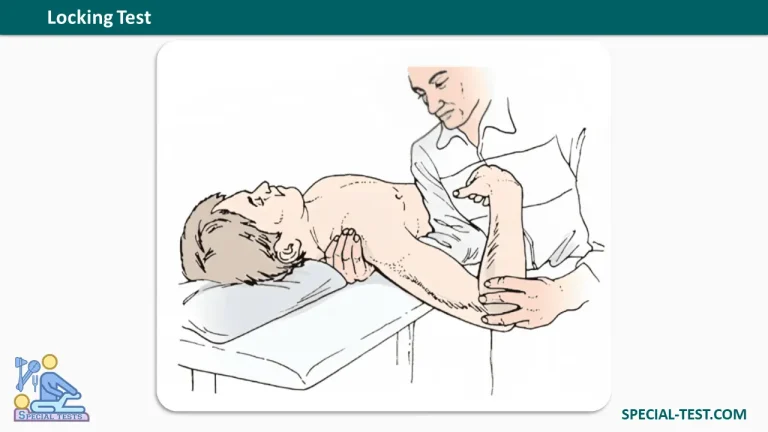
The Locking Test is a clinical shoulder examination maneuver used to assess symptoms associated with subacromial impingement syndrome. It places the shoulder in a specific position involving internal rotation, extension, and abduction while the examiner stabilizes the scapula. This position may narrow the subacromial space and reproduce pain in patients with symptomatic shoulder impingement.
The Locking Test is performed as part of a comprehensive shoulder assessment. Although it may help reproduce a patient’s familiar symptoms and identify restricted shoulder movement, its findings should be interpreted alongside the patient’s history, other physical examination tests, and relevant imaging when indicated.
What Is the Locking Test Used For?
The primary purpose of the Locking Test is to assess shoulder pain associated with subacromial impingement syndrome. This condition describes shoulder pain that may occur when structures around the subacromial region are subjected to mechanical compression or loading during arm movement.
The subacromial region contains important structures, including the supraspinatus tendon and subacromial-subdeltoid bursa. Irritation or pathology affecting these tissues can contribute to pain during shoulder elevation and other movements.
The Locking Test combines several shoulder movements to place the joint in a position that may provoke symptoms. These movements include:
- Internal rotation: Rotates the humerus inward.
- Extension: Moves the arm posteriorly relative to the trunk.
- Abduction: Moves the arm away from the body’s midline.
- Scapular stabilization: Limits shoulder shrugging and helps maintain the intended test position.
With the scapula stabilized, the combined movements alter the relationship between the humeral head, glenoid, and surrounding shoulder structures. The maneuver is intended to reproduce pain associated with a symptomatic shoulder.
Biomechanical Basis of the Locking Test
The rationale behind the Locking Test is based on the relationship between shoulder position and the available space around the rotator cuff tendons and other subacromial structures.
In the locking position, the combination of internal rotation, extension, and abduction may increase mechanical loading in the shoulder. Stabilizing the scapula helps prevent compensatory scapular movement and allows the examiner to assess the response to the prescribed maneuver.
Cadaveric studies have described contact between the posterosuperior tip of the glenoid and the humeral head in this position. This observation provides a biomechanical explanation for the term locking position.
However, anatomical contact or narrowing does not automatically indicate a clinical impingement disorder. Shoulder pain can arise from several conditions, and the relationship between structural changes, mechanical contact, and symptoms is complex. Therefore, the Locking Test should be considered one component of the overall shoulder examination rather than a stand-alone diagnostic test.
How to Perform the Locking Test
The Locking Test is performed with the patient lying supine while the examiner controls the position of the affected shoulder and stabilizes the scapula.
Patient Position
Ask the patient to lie comfortably on their back on an examination table. The affected shoulder should be accessible, and the examiner should stand beside the patient near the shoulder being examined.
Explain the maneuver before beginning and ask the patient to report any pain or familiar symptoms immediately.
Examiner Hand Placement
The examiner places the palmar aspect of their forearm beneath the patient’s shoulder. The examiner then grips the trapezius muscle to help prevent shoulder shrugging during the maneuver.
This stabilization is important because scapular elevation or other compensatory movements can change the mechanics of the shoulder and affect the interpretation of the test.
Performing the Maneuver
- Hold the patient’s elbow securely to control the position of the upper arm.
- Stabilize the shoulder girdle by maintaining the grip on the trapezius muscle and limiting shoulder shrugging.
- Slightly internally rotate the patient’s arm.
- Gradually lift the arm into abduction while maintaining the intended shoulder position.
- Observe the patient’s response and compare the available range of motion with that of the unaffected shoulder, when appropriate.
- Stop the maneuver if significant pain, marked discomfort, or an unexpected restriction occurs.
The examiner should perform the maneuver gently and avoid forcing the shoulder through a painful or restricted range. The patient’s comfort and safety take priority over completing the test.
What Is a Positive Locking Test?
A positive Locking Test is indicated by reproduction of the patient’s familiar shoulder symptoms and/or a reduction in range of motion compared with the unaffected shoulder.
The findings should be documented clearly, including the location and nature of the pain, the degree of movement tolerated, and whether the response resembles the patient’s usual symptoms.
1. Reproduction of Shoulder Pain
The patient experiences pain during the locking maneuver, particularly when the symptoms resemble the pain reported during daily activities or other shoulder movements.
This response may suggest that the tested shoulder position provokes symptoms associated with subacromial pain. However, pain during the maneuver is not specific to one diagnosis and may also occur with other shoulder disorders.
2. Reduced Range of Motion
The affected shoulder demonstrates less available movement than the contralateral shoulder. This restriction may reflect pain, muscle guarding, joint stiffness, or other underlying pathology.
Range-of-motion findings should be interpreted in the context of the patient’s baseline mobility, previous injuries, and any pre-existing limitation affecting the opposite shoulder.
Clinical Significance and Limitations
The Locking Test may be useful when examining a patient with shoulder pain suspected to involve the subacromial region. Nevertheless, a positive result does not independently confirm subacromial impingement syndrome, a rotator cuff tear, or another specific structural diagnosis.
Shoulder examination findings are most useful when interpreted as part of a broader assessment. Depending on the clinical presentation, the examiner may also evaluate active and passive range of motion, rotator cuff strength, and other established shoulder provocation tests.
A complete assessment may help distinguish subacromial pain from alternative causes, such as glenohumeral joint disorders, rotator cuff pathology, adhesive capsulitis, or referred pain from the cervical spine.
The available evidence for the diagnostic accuracy of the Locking Test specifically is limited. Clinicians should therefore avoid assigning a definitive diagnosis based on this maneuver alone.
Frequently Asked Questions (FAQ)
What is the Locking Test used for?
The Locking Test is used to assess shoulder pain that may be associated with subacromial impingement syndrome. It places the shoulder in a position combining internal rotation, extension, and abduction while the examiner stabilizes the scapula.
How do you perform the Locking Test?
The patient lies supine. The examiner places their forearm beneath the patient’s shoulder, grips the trapezius muscle to prevent shoulder shrugging, holds the elbow, slightly internally rotates the arm, and lifts it into abduction.
What is a positive Locking Test?
A positive result involves reproduction of the patient’s familiar shoulder pain and/or reduced range of motion compared with the unaffected shoulder. These findings require interpretation alongside other clinical examination results.
What does the locking position do to the shoulder?
The locking position changes the relationship between the humeral head, glenoid, and surrounding structures. Cadaveric studies have described contact between the posterosuperior tip of the glenoid and the humeral head in this position.
Does a positive Locking Test confirm shoulder impingement?
No. A positive test may indicate that the maneuver provokes shoulder symptoms, but it does not independently confirm subacromial impingement syndrome or identify a specific injured structure. A comprehensive clinical assessment is necessary.
Is the Locking Test sufficient to diagnose a rotator cuff tear?
No. The Locking Test alone cannot reliably establish the presence of a rotator cuff tear. Additional examination findings and, when clinically indicated, imaging may be needed to determine the underlying cause of shoulder pain.
References
- Dutton M. Dutton’s Orthopaedic Examination, Evaluation, and Intervention. 3rd edition. Reference for orthopedic examination techniques and clinical assessment.
- Musculoskeletal Key. The Shoulder. Reference for shoulder examination and clinical assessment.