Internal Rotation Lag Sign: Purpose, Procedure, Positive Result, and Diagnostic Accuracy
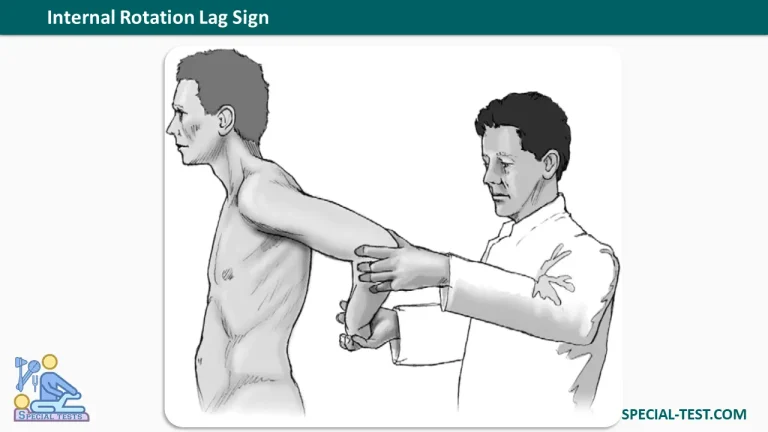
The Internal Rotation Lag Sign is a clinical shoulder examination test used to assess the integrity and function of the subscapularis tendon, one of the four tendons that make up the rotator cuff. This test helps clinicians identify possible subscapularis tendon tears or dysfunction in patients presenting with shoulder pain, weakness, or limited internal rotation.
The test evaluates the patient’s ability to maintain the shoulder in a passively positioned internal rotation position. If the patient cannot hold the position after the examiner releases the wrist, an internal rotation lag occurs, suggesting impaired subscapularis function.
The Internal Rotation Lag Sign is particularly useful when evaluating suspected rotator cuff injuries, including subscapularis tears. However, it should be interpreted alongside the patient’s history, other physical examination findings, and appropriate imaging studies when indicated.
What Is the Internal Rotation Lag Sign Used For?
The primary purpose of the Internal Rotation Lag Sign is to assess the functional integrity of the subscapularis muscle and tendon.
The subscapularis originates from the anterior surface of the scapula and inserts onto the lesser tuberosity of the humerus. It is the largest and one of the most powerful rotator cuff muscles, playing an essential role in shoulder internal rotation and anterior shoulder stability.
Clinicians commonly use this test to investigate:
- Subscapularis tendon tears: Difficulty maintaining internal rotation may indicate a significant tendon injury.
- Rotator cuff dysfunction: The test helps assess the functional status of the anterior portion of the rotator cuff.
- Shoulder pain and weakness: It can contribute to the clinical evaluation of patients who report weakness during internal rotation.
- Postoperative subscapularis dysfunction: The test may be useful when assessing subscapularis function following shoulder surgery involving the subscapularis tendon.
The test is not intended to establish a diagnosis on its own. Pain, restricted shoulder mobility, and weakness from other causes may affect the result.
Anatomy and Clinical Significance
The subscapularis is responsible for internal rotation of the shoulder and contributes to dynamic stabilization of the glenohumeral joint. It works with the other rotator cuff muscles to maintain the humeral head in a stable position during shoulder movement.
Damage to the subscapularis tendon may result from acute trauma, repetitive loading, degenerative changes, or surgical disruption. Patients may experience anterior shoulder pain, weakness during internal rotation, and difficulty performing activities such as reaching behind the back.
Because the subscapularis is important for both movement and joint stability, identifying tendon dysfunction can help guide further investigation and treatment planning.
How to Perform the Internal Rotation Lag Sign
The Internal Rotation Lag Sign is performed with the patient seated. The examiner positions the affected shoulder in internal rotation and assesses the patient’s ability to maintain that position actively.
Patient Position
- Ask the patient to sit upright with their back facing the examiner.
- Position the affected arm behind the patient’s back.
- Flex the elbow to approximately 90 degrees.
- Position the shoulder at approximately 20 degrees of elevation and 20 degrees of extension, as described in the test technique.
Examination Technique
- The examiner holds the patient’s affected arm and passively moves it into almost maximal internal rotation.
- The dorsum of the patient’s hand is lifted away from the lumbar region until the shoulder reaches near-maximal internal rotation.
- Ask the patient to actively maintain the position of the hand and arm.
- Release the patient’s wrist while continuing to support the elbow.
- Observe whether the patient can maintain the internally rotated position or whether the hand moves back toward the lumbar region.
The examiner should compare the findings with the unaffected shoulder when appropriate and consider any pain or restriction that might interfere with the test.
Important Examination Considerations
The examiner should avoid forcing the shoulder into a painful or restricted position. Adequate passive mobility is important because stiffness can interfere with the patient’s ability to assume the test position.
The result should also be interpreted in the context of other findings, including the patient’s pain level, strength, injury mechanism, and results of additional shoulder examination tests.
What Is a Positive Internal Rotation Lag Sign?
A positive Internal Rotation Lag Sign occurs when the patient cannot maintain the passively established internal rotation position after the examiner releases the wrist.
The hand moves away from the position in which it was placed, producing a noticeable lag. This finding suggests weakness or dysfunction of the subscapularis tendon and may indicate a significant tear.
A negative result occurs when the patient can maintain the position without a noticeable lag. However, a negative test does not completely exclude a subscapularis injury, particularly a small or partial-thickness tear.
Interpretation of Results
- Positive test: The patient cannot maintain internal rotation, and a lag occurs. This raises suspicion for subscapularis tendon dysfunction or a tear.
- Negative test: The patient maintains the position. Significant functional impairment is less apparent, but a tendon injury may still be present.
Pain inhibition, restricted range of motion, and weakness involving other shoulder structures may influence the findings. Therefore, the test should not be used as the sole basis for diagnosis.
Internal Rotation Lag Sign: Sensitivity and Specificity
The reported diagnostic accuracy values provided for this test are:
- Sensitivity: 100%
- Specificity: 84%
Sensitivity describes the proportion of patients with the target condition who test positive. Specificity describes the proportion of patients without the condition who test negative.
These figures should be interpreted cautiously. Diagnostic accuracy can vary according to the study population, the severity and type of subscapularis tears, the examination technique, and the reference standard used to confirm the diagnosis. A reported sensitivity of 100% in a particular study does not mean that the test will detect every subscapularis tear in all clinical settings.
A positive result should prompt further clinical assessment rather than being treated as definitive proof of a tendon tear. Depending on the clinical presentation, ultrasound or magnetic resonance imaging (MRI) may be considered to evaluate the rotator cuff.
Clinical Importance of the Internal Rotation Lag Sign
The Internal Rotation Lag Sign is one component of the clinical examination for suspected subscapularis pathology. It may be especially helpful when a patient has weakness during internal rotation or symptoms following an injury or shoulder operation.
The findings can be combined with other subscapularis tests, such as the Lift-Off Test, Belly-Press Test, and Bear-Hug Test. Using multiple examination maneuvers may provide a more complete assessment because individual tests differ in their sensitivity to tendon tears of varying sizes and locations.
The clinical history and physical examination remain essential. Imaging may be appropriate when a substantial tear is suspected, symptoms persist, or the findings could influence treatment decisions.
Limitations of the Internal Rotation Lag Sign
Although the test can provide useful information, several factors may affect its accuracy:
- Shoulder pain may prevent the patient from maintaining the required position.
- Restricted internal rotation or shoulder stiffness may make the test difficult to perform.
- Partial tendon tears may not produce a detectable lag.
- Other sources of shoulder weakness may affect performance.
- Diagnostic accuracy estimates from individual studies may not apply to every patient population.
For these reasons, clinicians should interpret the Internal Rotation Lag Sign alongside the overall clinical presentation and other relevant examination findings.
Frequently Asked Questions (FAQ)
1. What does the Internal Rotation Lag Sign test for?
The Internal Rotation Lag Sign evaluates the integrity and function of the subscapularis tendon, which is responsible for shoulder internal rotation and contributes to glenohumeral stability.
2. What is a positive Internal Rotation Lag Sign?
The test is positive when the patient cannot maintain the passively positioned internal rotation after the examiner releases the wrist, resulting in a noticeable lag.
3. Which tendon is assessed by the Internal Rotation Lag Sign?
The test primarily assesses the subscapularis tendon, which forms part of the rotator cuff.
4. What are the reported sensitivity and specificity of the test?
The supplied reference figures are 100% sensitivity and 84% specificity. These values are study-dependent and should not be assumed to apply universally.
5. Can a negative Internal Rotation Lag Sign rule out a subscapularis tear?
No. A negative result does not exclude every subscapularis tear, especially smaller or partial-thickness injuries. Other examination findings and imaging may be needed.
6. What other tests assess the subscapularis tendon?
Common complementary tests include the Lift-Off Test, Belly-Press Test, and Bear-Hug Test. Clinicians may use several maneuvers to improve the overall clinical assessment.
7. Is the Internal Rotation Lag Sign sufficient to diagnose a rotator cuff tear?
No. It is a clinical examination maneuver, not a definitive standalone diagnostic test. Findings should be interpreted with the patient’s history, other physical examination tests, and imaging when indicated.
References
- Campbell’s Operative Orthopaedics. Standard reference text for orthopaedic examination and management.
- Scheibel M, Habermeyer P. Subscapularis dysfunction following anterior surgical approaches to the shoulder. Journal of Shoulder and Elbow Surgery. 2008;17(4):671–683.
- Orthofixar. Internal Rotation Lag Sign: Clinical Examination Technique.