Lateral Scapular Winging Test: Purpose, Procedure, and Positive Result

Lateral scapular winging is an abnormal position or movement of the scapula (shoulder blade) that can indicate weakness or dysfunction of the muscles responsible for scapular stabilization. It is particularly associated with trapezius muscle weakness and spinal accessory nerve (cranial nerve XI) dysfunction. Recognizing this pattern during a shoulder examination can help clinicians identify the underlying cause of shoulder pain, weakness, and impaired overhead movement.
The lateral scapular winging test is a clinical examination maneuver used to observe abnormal scapular movement and assess scapular stability. Although pushing against a wall can make scapular winging more apparent, the findings should be interpreted alongside other clinical signs because different muscle and nerve disorders can produce similar abnormalities.
What Is the Lateral Scapular Winging Test Used For?
The lateral scapular winging test helps identify abnormal scapular positioning associated with dysfunction of the scapular stabilizing muscles. Its principal clinical associations include:
- Trapezius muscle weakness: The trapezius helps stabilize and rotate the scapula during shoulder elevation. Weakness can cause the shoulder to droop and the scapula to move abnormally.
- Spinal accessory nerve (CN XI) dysfunction: The spinal accessory nerve supplies the trapezius muscle. Injury to this nerve can result in trapezius paralysis or weakness and lateral scapular winging.
- Scapular dyskinesis: The test may reveal abnormal scapular movement that contributes to shoulder dysfunction and reduced functional performance.
Spinal accessory nerve injury can occur after neck surgery, lymph node biopsy, penetrating trauma, or other injuries along the nerve’s course. Early recognition is important because missed trapezius palsy may lead to persistent shoulder pain, weakness, and difficulty performing overhead activities.
How to Perform the Lateral Scapular Winging Test
Follow these steps to assess for lateral scapular winging:
- Patient position: Ask the patient to stand facing a wall or another stable vertical surface.
- Arm positioning: Instruct the patient to raise both arms forward to approximately 90 degrees of shoulder flexion.
- Hand placement: Place both hands against the wall, with the elbows extended or comfortably positioned for a controlled push.
- Apply pressure: Ask the patient to push against the wall while maintaining the arms in the prescribed position.
- Observe the scapulae: Stand behind the patient and inspect both shoulder blades, paying particular attention to the inferior angles, scapular borders, shoulder height, and symmetry.
- Compare both sides: Look for abnormal lateral displacement, altered scapular rotation, or asymmetry that becomes more apparent during the maneuver.
The maneuver should be performed in a controlled manner. Avoid excessive force, particularly when the patient has significant shoulder pain or a suspected acute injury.
What Is a Positive Lateral Scapular Winging Test?
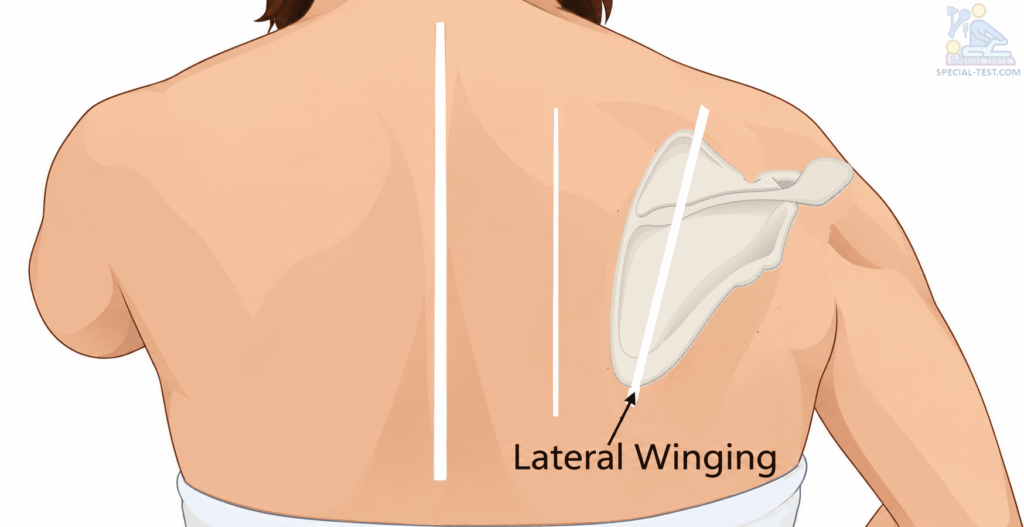
The test is considered positive when the examiner observes abnormal lateral displacement of the scapula, particularly lateral migration of its inferior angle, compared with the opposite side. This finding may be associated with trapezius dysfunction or spinal accessory nerve injury.
Typical associated findings may include:
- Drooping of the affected shoulder.
- Abnormal lateral displacement or rotation of the scapula.
- Weakness during shoulder abduction.
- Difficulty with overhead activities.
- Pain, fatigue, or discomfort around the shoulder and upper back.
- Visible trapezius muscle wasting in more established cases.
Important clinical distinction: Medial scapular winging, which is commonly associated with serratus anterior weakness and long thoracic nerve dysfunction, is often accentuated by forward flexion and pushing against a wall. Lateral winging from trapezius palsy may be more evident during shoulder abduction or resisted external rotation. Therefore, the direction of scapular displacement and the accompanying examination findings are more important than a positive wall-push maneuver alone.
Clinical Significance of Lateral Scapular Winging
The trapezius muscle is essential for normal scapular positioning and coordinated shoulder movement. When the muscle becomes weak or paralyzed, the scapula may lose its normal alignment, resulting in abnormal movement and reduced shoulder function.
The spinal accessory nerve is particularly vulnerable during procedures involving the posterior triangle of the neck. Patients with nerve injury may develop shoulder drooping, trapezius atrophy, pain, and difficulty raising the arm. A history of neck surgery, lymph node biopsy, or trauma should increase suspicion of spinal accessory neuropathy.
A positive test does not establish the exact site or cause of the lesion. The clinician should also assess trapezius strength, shoulder shrug, active shoulder elevation, scapular movement, and the function of other scapular stabilizers.
If spinal accessory nerve injury is suspected, electromyography (EMG) and nerve conduction studies may help confirm the diagnosis and evaluate the extent of nerve or muscle dysfunction. Additional imaging may be indicated according to the patient’s history and examination findings.
Differential Diagnosis
Several conditions can produce abnormal scapular movement. The main differential diagnoses include:
| Condition | Typical association |
|---|---|
| Trapezius palsy | Spinal accessory nerve dysfunction; lateral scapular winging and shoulder drooping |
| Serratus anterior palsy | Long thoracic nerve dysfunction; typically medial scapular winging |
| Rhomboid weakness | Dorsal scapular nerve dysfunction; subtle lateral displacement or abnormal scapular movement |
| Scapular dyskinesis | Altered scapular movement caused by muscular, neurologic, or shoulder-related dysfunction |
| Structural muscle injury | Traumatic damage or detachment of scapular stabilizing muscles |
These patterns help guide the examination, but they are not sufficient on their own to confirm a diagnosis.
Limitations of the Lateral Scapular Winging Test
The lateral scapular winging test is a clinical observation maneuver rather than a definitive diagnostic test. The wall-push position can reveal abnormal scapular movement, but it may not reliably distinguish between different causes of scapular dysfunction.
Research on scapular winging emphasizes the importance of combining clinical inspection with targeted muscle testing and, when indicated, electrodiagnostic assessment. The examiner should also consider pain-related movement changes, structural abnormalities, and other neuromuscular disorders.
Frequently Asked Questions (FAQ)
1. What does the lateral scapular winging test assess?
It assesses scapular positioning and movement, particularly abnormalities that may indicate trapezius muscle weakness or spinal accessory nerve dysfunction.
2. What is the most common nerve associated with lateral scapular winging?
The spinal accessory nerve (cranial nerve XI) is the principal nerve associated with lateral scapular winging caused by trapezius paralysis. Dysfunction of the dorsal scapular nerve and rhomboid muscles can also cause lateral displacement.
3. How do you perform the lateral scapular winging test?
Ask the patient to stand, flex both shoulders forward to approximately 90 degrees, and push against a wall. Observe the scapulae from behind for abnormal displacement and asymmetry. Additional maneuvers may be necessary to assess suspected trapezius palsy.
4. What is a positive result?
A positive finding is abnormal lateral displacement of the scapula, particularly its inferior angle, compared with the opposite side. The finding should be interpreted in conjunction with other clinical signs.
5. What is the difference between medial and lateral scapular winging?
Medial winging is typically associated with serratus anterior weakness due to long thoracic nerve dysfunction. Lateral winging is classically associated with trapezius weakness due to spinal accessory nerve injury, although rhomboid dysfunction can also contribute.
6. Can the wall push-up test confirm spinal accessory nerve injury?
No. The wall push-up test can reveal abnormal scapular movement, but it cannot independently confirm spinal accessory nerve injury. A focused neurologic and musculoskeletal examination, with EMG or nerve conduction studies when indicated, may be needed.
7. What should be done after a positive test?
Perform a comprehensive shoulder and neurologic examination, assess trapezius strength and atrophy, and review any history of neck surgery or trauma. If nerve injury is suspected, consider referral for electrodiagnostic testing and further specialist assessment.
References
- Didesch JT, Tang P. Anatomy, Etiology, and Management of Scapular Winging. Journal of Hand Surgery. 2019. PubMed
- Chan PKH, Hems TEJ. Clinical signs of accessory nerve palsy. Journal of Trauma. 2006. PubMed
- Martin RM, Fish DE. Scapular winging: anatomical review, diagnosis, and treatments. Current Reviews in Musculoskeletal Medicine. 2008. PubMed
- Park SB, Weishuhn LJ, Taqi M. Winging of the Scapula. StatPearls. NCBI Bookshelf. NCBI Bookshelf
- Orthofixar. Scapular Winging Test. Orthofixar