Jobe’s Test (Empty Can Test): Procedure, Positive Result, and Diagnostic Accuracy
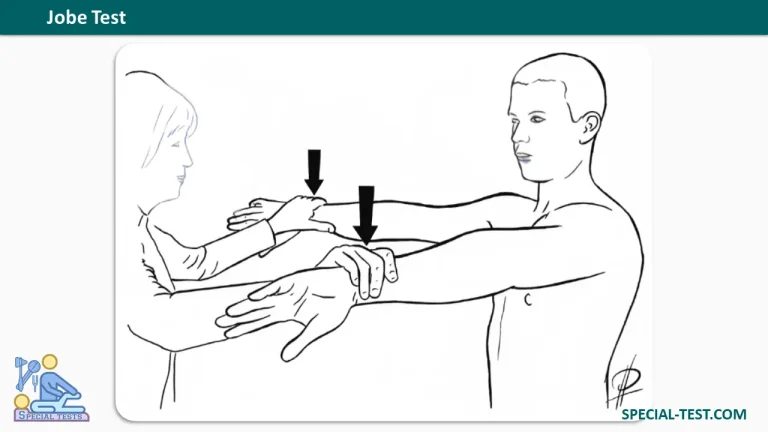
Jobe’s Test, also known as the Empty Can Test, is a clinical shoulder examination used to assess the supraspinatus muscle and tendon, one of the four components of the rotator cuff. Orthopedic surgeons, sports medicine physicians, and physical therapists commonly use this test when evaluating shoulder pain, rotator cuff weakness, and suspected supraspinatus tendon tears.
The test is performed by positioning the shoulder in approximately 90 degrees of abduction in the scapular plane, with the thumb pointing downward. The examiner then applies downward resistance while the patient attempts to maintain the arm position. Pain or weakness during the maneuver may indicate supraspinatus pathology.
Although the Empty Can Test is useful in the clinical assessment of rotator cuff disorders, its findings should be interpreted alongside the patient’s history, other physical examination tests, and imaging when indicated.
What Is Jobe’s Test (Empty Can Test) Used For?
The Empty Can Test is primarily used to assess:
- Supraspinatus muscle weakness or insufficiency: Helps identify impaired function of the supraspinatus muscle and tendon.
- Supraspinatus tendon tears: May help detect a partial- or full-thickness rotator cuff tear.
- Rotator cuff-related shoulder pain: Reproduction of pain during resisted abduction may suggest rotator cuff tendinopathy or other painful shoulder conditions.
- Possible subacromial impingement: The test position can provoke pain in some patients with subacromial shoulder pathology, although the test is not specific for impingement alone.
The supraspinatus muscle contributes to shoulder abduction and helps stabilize the humeral head within the glenoid cavity. Its tendon passes beneath the acromion before attaching to the greater tubercle of the humerus, making it vulnerable to degenerative changes and injury.
Jobe’s Test places the supraspinatus under load during resisted arm elevation. However, it does not isolate the supraspinatus completely, and other shoulder structures may contribute to the patient’s symptoms.
How to Perform Jobe’s Test (Empty Can Test)
The test can be performed with the patient sitting or standing.
Patient Position
- Ask the patient to sit or stand upright with the shoulders relaxed.
- Position the affected arm at approximately 90 degrees of shoulder abduction in the scapular plane, which is about 30 degrees anterior to the frontal plane.
- Internally rotate the shoulder so that the thumb points toward the floor, as if the patient were emptying a can.
- Keep the elbow extended or slightly relaxed, depending on the examination technique and the patient’s tolerance.
Examiner Technique
- Stand facing the patient and ensure that the arm is correctly positioned.
- Apply a downward force to the patient’s arm, commonly over the distal forearm or wrist, while avoiding unnecessary stress.
- Ask the patient to resist the downward pressure and maintain the arm in its original position.
- Compare the affected shoulder with the opposite shoulder when appropriate.
- Record the presence, location, and severity of pain, as well as any weakness or inability to maintain the position.
Resistance should be applied gradually, particularly when the patient has significant shoulder pain. The examiner should avoid forcing the arm into a painful position.
What Is a Positive Jobe’s Test?
The Empty Can Test is considered positive when the maneuver produces findings such as:
- Weakness: The patient cannot maintain the arm against resistance or demonstrates clear weakness compared with the opposite shoulder.
- Pain: The maneuver reproduces the patient’s familiar shoulder pain.
- Pain accompanied by weakness: Both findings occur during resisted abduction.
Interpretation of the Results
Weakness with relatively little pain raises suspicion of significant supraspinatus dysfunction or a tendon tear. However, weakness alone does not establish the presence, size, or severity of a tear.
Pain without clear weakness may be associated with rotator cuff tendinopathy, a symptomatic tendon lesion, or subacromial pain. Pain can inhibit muscle activation and make the shoulder appear weaker than it actually is.
Marked weakness or inability to hold the arm up warrants further evaluation for a substantial rotator cuff tear or another cause of shoulder dysfunction.
The Empty Can Test is not a definitive diagnostic test. A positive result must be interpreted in the context of the patient’s symptoms and the findings of the complete shoulder examination.
Diagnostic Accuracy of Jobe’s Test
The diagnostic accuracy of Jobe’s Test varies depending on the patient population, the definition of a positive test, and the reference standard used to identify rotator cuff tears.
In the ROW Cohort Study, which evaluated clinical tests for rotator cuff tears, the Jobe Test demonstrated the following results for supraspinatus tears:
| Diagnostic measure | Reported result |
|---|---|
| Sensitivity | 88% |
| Specificity | 62% |
| Positive likelihood ratio | 2.30 |
| Negative likelihood ratio | 0.19 |
These estimates were reported in a cohort of patients presenting with shoulder pain. The results suggest that the test may be useful for identifying patients who require further assessment, but a positive result does not independently confirm a supraspinatus tear.
Sensitivity of 88% means that the test identified approximately 88% of the patients with supraspinatus tears in that study population.
Specificity of 62% means that approximately 62% of patients without the target tear had a negative test result.
These figures should not be treated as universal values. Other studies have reported different diagnostic performance, highlighting the importance of clinical context and the limitations of relying on one special test.
Empty Can Test vs. Full Can Test
The Full Can Test is a related examination that uses a similar arm position but keeps the thumb pointing upward through external rotation.
A study by Itoi and colleagues evaluated both tests in 143 shoulders from 136 patients. The authors found no significant difference in overall accuracy when muscle weakness was used as the criterion for identifying a supraspinatus tear. The Full Can Test may be preferable in some patients because it can provoke less pain.
A more recent diagnostic study also found that muscle weakness was more informative than pain alone or the combination of pain and weakness when evaluating supraspinatus tendon tears. Combining several examination tests may improve diagnostic assessment.
Clinical Significance and Limitations
Jobe’s Test is most useful when incorporated into a comprehensive shoulder assessment. The examiner should consider the patient’s age, injury mechanism, pain pattern, range of motion, muscle strength, and other examination findings.
Important limitations include:
- Pain may cause protective muscle inhibition, creating apparent weakness even when the tendon is intact.
- Other shoulder structures may contribute to pain during the maneuver.
- A negative result does not exclude every supraspinatus tendon tear.
- The test cannot reliably distinguish partial-thickness tears from full-thickness tears.
- Diagnostic accuracy depends on the population examined and the criteria used to define a positive result.
If symptoms and examination findings suggest a significant rotator cuff injury, ultrasound or magnetic resonance imaging may be appropriate, depending on the clinical circumstances.
Frequently Asked Questions (FAQ)
1. What is Jobe’s Test used for?
Jobe’s Test is used to assess supraspinatus muscle and tendon function and to help identify possible rotator cuff tears or rotator cuff-related shoulder pain.
2. How do you perform the Empty Can Test?
Position the patient’s arm at approximately 90 degrees of abduction in the scapular plane, with the thumb pointing downward. Apply downward resistance while the patient attempts to maintain the position.
3. What is a positive Empty Can Test?
A positive result consists of pain, weakness, or both during resisted arm elevation. Weakness, particularly when compared with the opposite shoulder, raises suspicion of supraspinatus dysfunction or a tendon tear.
4. What does a positive Jobe’s Test indicate?
It may indicate a supraspinatus tendon tear, tendinopathy, or another source of rotator cuff-related shoulder pain. The result alone cannot establish a specific diagnosis.
5. What are the sensitivity and specificity of Jobe’s Test?
In the ROW Cohort Study, sensitivity was 88% and specificity was 62% for supraspinatus tears. Diagnostic estimates vary between studies and patient populations.
6. Is the Empty Can Test accurate for diagnosing a rotator cuff tear?
It can contribute useful diagnostic information, particularly when weakness is present, but it is not sufficiently definitive on its own. Combining the test with other examination findings can improve clinical assessment.
7. What is the difference between the Empty Can and Full Can Tests?
The Empty Can Test is performed with the thumb pointing downward, whereas the Full Can Test is performed with the thumb pointing upward. Both assess supraspinatus function, but the Full Can Test may be less painful for some patients.
8. Can Jobe’s Test diagnose shoulder impingement?
The test may reproduce pain associated with subacromial shoulder pathology, but a positive result is not specific for impingement. Other clinical findings and tests are needed to evaluate the cause of shoulder pain.
9. Does a negative Empty Can Test rule out a supraspinatus tear?
No. A negative result does not completely exclude a tear. Persistent symptoms, traumatic injury, or substantial functional weakness may warrant further clinical evaluation.
10. What should be done after a positive Jobe’s Test?
The clinician should assess the complete rotator cuff, shoulder range of motion, and other possible sources of pain. Imaging may be considered if the clinical findings suggest a significant tear or if symptoms persist despite appropriate management.
References
- Jain NB, et al. The Diagnostic Accuracy of Special Tests for Rotator Cuff Tear: The ROW Cohort Study. PubMed. https://pubmed.ncbi.nlm.nih.gov/27386812/
- Itoi E, Kido T, Sano A, Urayama M, Sato K. Which is more useful, the “full can test” or the “empty can test,” in detecting the torn supraspinatus tendon? American Journal of Sports Medicine. 1999;27(1):65–68. https://pubmed.ncbi.nlm.nih.gov/9934421/
- Diagnostic Value of Clinical Tests for Supraspinatus Tendon Tears. PubMed. https://pubmed.ncbi.nlm.nih.gov/29802066/
- Approach to Musculoskeletal Examination. NCBI Bookshelf. https://www.ncbi.nlm.nih.gov/books/NBK585755/
- OrthoFixar. Empty Can Test for Supraspinatus Impingement. https://orthofixar.com/special-test/jobe-test-empty-can-test/