Internal Rotation Resistance Stress Test: Purpose, Procedure, Interpretation, and Accuracy
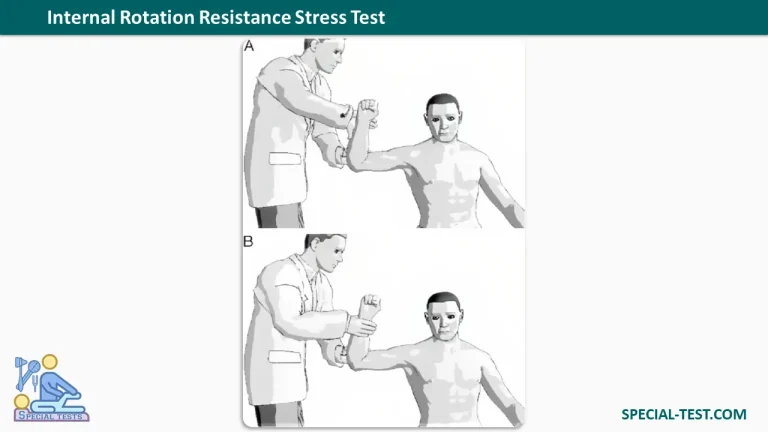
The Internal Rotation Resistance Stress Test (IRRST) is a clinical shoulder examination maneuver used to help differentiate internal shoulder impingement from classic subacromial (outlet) impingement. It assesses the relative strength of the shoulder’s internal and external rotator muscles when the arm is positioned in abduction and external rotation.
The test is particularly relevant when evaluating patients with shoulder pain associated with overhead activities, including throwing and other sports that repeatedly place the shoulder in an abducted and externally rotated position. It is performed as part of a comprehensive shoulder examination and should be interpreted alongside the patient’s history, symptoms, and other clinical findings.
What Is the Internal Rotation Resistance Stress Test Used For?
The primary purpose of the Internal Rotation Resistance Stress Test is to help distinguish between two important causes of shoulder pain:
- Internal impingement: Contact between the articular surface of the rotator cuff, particularly the supraspinatus and infraspinatus tendons, and the posterosuperior glenoid or labrum during shoulder abduction and external rotation.
- Classic outlet impingement: Traditionally describes subacromial impingement, in which the rotator cuff tendons and associated tissues are irritated or compressed beneath the coracoacromial arch.
Internal impingement is commonly encountered in overhead athletes, particularly throwing athletes. Repetitive throwing can place considerable stress on the posterior shoulder structures and may be associated with articular-sided rotator cuff abnormalities, posterosuperior labral lesions, and changes in shoulder motion.
Classic subacromial impingement, by contrast, is associated with pain involving the subacromial structures during shoulder elevation. Although these conditions may produce overlapping symptoms, identifying the likely source of pain can help guide further examination and management.
The IRRST evaluates the relative strength of internal and external rotation in a specific shoulder position. It is not intended to establish a diagnosis in isolation.
How to Perform the Internal Rotation Resistance Stress Test
The test is performed by a trained clinician using manual resistance. Correct positioning and comparison of rotational strength are important for consistent interpretation.
Patient Position
- Ask the patient to sit comfortably with the trunk upright.
- Stand behind the patient to control the arm position and apply resistance.
- Position the patient’s shoulder at approximately 90 degrees of abduction in the coronal plane.
- Externally rotate the shoulder to approximately 80 degrees, provided the position is tolerated and does not create excessive pain.
External Rotation Resistance Test
- Maintain the shoulder in the prescribed position.
- Ask the patient to resist the examiner’s force while attempting to externally rotate the shoulder.
- Apply gradual manual resistance without allowing the arm to move significantly.
- Assess the patient’s ability to maintain the position and note any pain or weakness.
Internal Rotation Resistance Test
- Keep the shoulder in the same position: approximately 90 degrees of abduction and 80 degrees of external rotation.
- Ask the patient to resist the examiner’s force while attempting to internally rotate the shoulder.
- Apply comparable manual resistance.
- Compare internal rotation strength with the strength demonstrated during the external rotation maneuver.
The comparison should be performed in the same shoulder position because changing the position may alter muscle recruitment and the mechanical demands placed on the shoulder.
The examiner should distinguish true weakness from pain-related inhibition. If the patient experiences substantial pain, apprehension, or restricted motion, the results may be difficult to interpret reliably.
What Is a Positive Internal Rotation Resistance Stress Test?
A positive IRRST is characterized by a particular pattern of relative rotational strength in a patient who also demonstrates a positive shoulder impingement sign.
Positive result:
- External rotation strength is relatively well preserved.
- Internal rotation strength is noticeably weaker than external rotation strength.
- The patient demonstrates findings consistent with shoulder impingement during the broader examination.
This pattern suggests internal impingement and may indicate that the posterior-superior shoulder structures are involved.
Negative result or a pattern favoring classic outlet impingement:
- External rotation strength is weaker than internal rotation strength.
- The relative weakness is more consistent with the pattern traditionally associated with classic subacromial or outlet impingement.
The interpretation depends on the relative difference between the two movements rather than on a single absolute strength measurement.
It is important to recognize that the term negative does not exclude internal impingement or confirm subacromial impingement. Rotator cuff tears, pain inhibition, neurological problems, and other shoulder disorders can also affect rotational strength.
Internal Rotation Resistance Stress Test Accuracy
The original study by Zaslav and colleagues evaluated the Internal Rotation Resistance Strength Test in 115 consecutive patients with shoulder impingement signs, comparing the test findings with arthroscopic findings.
The reported diagnostic values were as follows:
| Diagnostic measure | Reported value |
|---|---|
| Sensitivity | 88% |
| Specificity | 96% |
| Positive predictive value | 88% |
| Negative predictive value | 96% |
| Overall accuracy | 94.5% |
Sensitivity of 88% means that the test identified 88% of patients with the target condition in the original study. Specificity of 96% means that it correctly classified 96% of patients without that condition.
These figures should be interpreted cautiously. They come from the original study population and may not apply equally to all patients, clinical settings, or examiners. A high reported accuracy does not mean that the test can independently confirm or exclude a particular shoulder disorder.
Clinical Significance and Limitations
The IRRST can be a useful component of the shoulder examination when the clinician needs to distinguish between intra-articular or internal impingement and traditional subacromial outlet impingement.
However, several factors can affect the results:
- Rotator cuff pathology: Tendon injury or tearing can reduce internal or external rotation strength.
- Pain inhibition: Pain during resisted movement can make a muscle appear weak even when its structural integrity is preserved.
- Shoulder instability: Apprehension or instability in the abducted and externally rotated position can interfere with the examination.
- Restricted range of motion: Patients who cannot comfortably achieve the required position may not be suitable for standard testing.
- Examiner technique: Differences in positioning and applied resistance can affect the consistency of manual strength assessment.
The IRRST should therefore be combined with a detailed history, inspection, range-of-motion assessment, rotator cuff strength testing, and other appropriate shoulder special tests. Imaging or further specialist evaluation may be indicated when clinically warranted.
The review by Tennent, Beach, and Meyers emphasizes the importance of understanding the intended interpretation and limitations of shoulder examination maneuvers rather than relying on a single test result.
Frequently Asked Questions (FAQ)
1. What is the Internal Rotation Resistance Stress Test used for?
The IRRST is used to help differentiate internal or non-outlet shoulder impingement from classic subacromial outlet impingement by comparing internal and external rotation strength with the shoulder abducted and externally rotated.
2. How do you perform the IRRST?
The patient sits upright while the examiner stands behind them. The shoulder is positioned at approximately 90 degrees of abduction and 80 degrees of external rotation. The examiner applies manual resistance to external rotation and internal rotation in the same position and compares the patient’s strength.
3. What is a positive IRRST?
A positive test is characterized by relatively preserved external rotation strength and weaker internal rotation strength in a patient who also has a positive impingement sign. This pattern suggests internal impingement.
4. What does a negative IRRST indicate?
A pattern in which external rotation is weaker than internal rotation traditionally favors classic outlet impingement. However, a negative result does not definitively exclude internal impingement or establish an alternative diagnosis.
5. What are the sensitivity and specificity of the IRRST?
The original study reported a sensitivity of 88% and a specificity of 96%. These results were obtained in a study of 115 patients and should not be assumed to represent diagnostic performance in every clinical setting.
6. Is the IRRST sufficient to diagnose internal shoulder impingement?
No. The test is an adjunct to the clinical examination. Its findings must be interpreted alongside the patient’s symptoms, other examination findings, and additional investigations when appropriate.
7. Which patients may benefit from the IRRST?
It may be useful when evaluating patients with shoulder pain and positive impingement signs, particularly overhead athletes and throwing athletes in whom internal impingement is part of the differential diagnosis.
References
- Zaslav KR. Internal rotation resistance strength test: A new diagnostic test to differentiate intra-articular pathology from outlet (Neer) impingement syndrome in the shoulder. Journal of Shoulder and Elbow Surgery. 2001;10(1):23–27. PubMed.
- Tennent TD, Beach WR, Meyers JF. A review of the special tests associated with shoulder examination. Part I: The rotator cuff tests. The American Journal of Sports Medicine. 2003;31(1):154–160. PubMed.
- Canale ST, Beaty JH, editors. Campbell’s Operative Orthopaedics. Elsevier. Refer to the relevant shoulder examination and impingement sections in the edition being used.