Hyperextension Internal Rotation Test (HERI Test): Procedure, Positive Findings & Clinical Significance
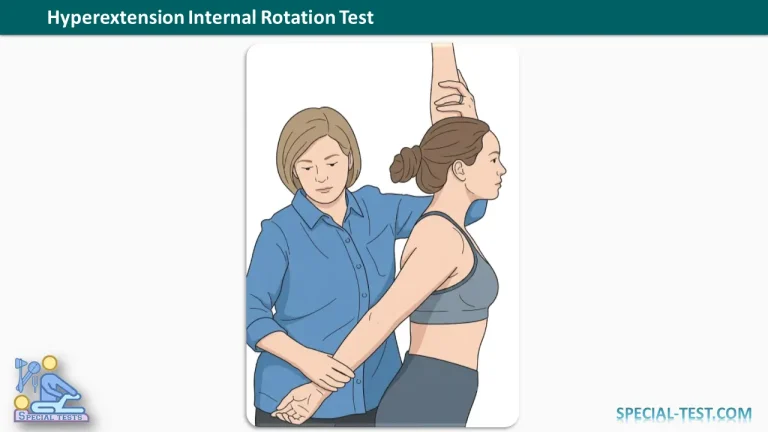
The Hyperextension Internal Rotation Test (HERI Test) is a clinical orthopedic examination used to assess anterior shoulder instability, particularly injuries involving the inferior glenohumeral ligament (IGHL) and inferior joint capsule. This shoulder special test evaluates differences in glenohumeral extension between the affected and unaffected shoulders.
The HERI Test was introduced by Lafosse and colleagues in 2016 as an alternative examination maneuver intended to assess anterior shoulder instability while minimizing patient apprehension and the potential risk of shoulder dislocation.
Unlike traditional shoulder instability tests that may provoke apprehension, the HERI Test primarily evaluates excessive shoulder extension associated with damage to the inferior capsuloligamentous structures.
What Is the Purpose of the Hyperextension Internal Rotation Test?
The primary purpose of the HERI Test is to evaluate the integrity of the inferior glenohumeral ligament and inferior shoulder capsule in patients with suspected anterior glenohumeral instability.
The inferior glenohumeral ligament complex plays an important role in maintaining shoulder stability by limiting excessive translation of the humeral head relative to the glenoid.
Anterior shoulder dislocation can damage these stabilizing structures, potentially resulting in increased glenohumeral joint laxity and recurrent instability.
The HERI Test is particularly useful for:
- Assessing suspected anterior glenohumeral instability.
- Identifying excessive shoulder extension associated with inferior capsular laxity.
- Evaluating the potential consequences of inferior glenohumeral ligament injury.
- Comparing shoulder extension between the symptomatic and asymptomatic sides.
- Supporting the clinical assessment of patients with a history of anterior shoulder dislocation.
The test should be considered part of a comprehensive shoulder examination rather than a definitive diagnostic procedure.
How to Perform the Hyperextension Internal Rotation Test (HERI Test)
The HERI Test requires careful patient positioning and controlled movement to assess shoulder extension while minimizing compensatory motion.
Step 1: Position the patient
Position the patient appropriately for examination, with both shoulders accessible. The examiner stands behind the patient to control shoulder and upper-limb movement.
Step 2: Begin with the unaffected shoulder
Examine the asymptomatic shoulder first to establish a reference for normal shoulder extension.
Step 3: Elevate the opposite upper limb
Carefully elevate the patient’s contralateral arm toward its maximum range. This positioning helps restrict compensatory movement of the thoracic spine and scapulothoracic articulation during the examination.
Step 4: Internally rotate and extend the tested shoulder
While controlling compensatory movement, internally rotate the tested arm and gradually move it into maximum tolerated extension.
The examiner should perform this maneuver carefully, avoiding sudden or excessive force.
Step 5: Assess shoulder extension
Observe or measure the maximum extension achieved. The examiner should distinguish true glenohumeral extension from compensatory trunk or scapular movement.
Step 6: Repeat the examination on the symptomatic shoulder
Perform the same maneuver on the affected shoulder, comparing the degree of extension with the unaffected side.
Monitor the patient for discomfort, apprehension, or other signs of instability throughout the procedure.
What Is a Positive Hyperextension Internal Rotation Test?
A positive HERI Test occurs when the affected shoulder demonstrates more than 10 degrees of additional extension compared with the unaffected shoulder.
For example, if the symptomatic shoulder extends 15° farther than the opposite shoulder under comparable testing conditions, the result meets the positive-test criterion.
This increased extension may indicate damage or laxity involving the inferior glenohumeral ligament complex and inferior shoulder capsule.
A positive finding supports the clinical suspicion of anterior shoulder instability but does not independently confirm a specific ligament injury.
Clinical Evidence and Diagnostic Significance
The HERI Test was described by Lafosse et al. in a 2016 study published in Orthopaedics & Traumatology: Surgery & Research.
The researchers investigated the relationship between injury to the inferior glenohumeral ligament and increased shoulder extension.
Their investigation included:
- 14 fresh cadaver shoulders, assessed before and after isolated sectioning of the inferior glenohumeral ligament.
- 50 patients with chronic unilateral anterior glenohumeral instability, in whom shoulder extension was compared bilaterally.
The cadaveric component demonstrated that sectioning the inferior glenohumeral ligament increased shoulder extension by an average of 14.5°, with observed increases ranging from 11° to 18°.
In the clinical component, the mean extension difference between the unstable and unaffected shoulders was also 14.5°.
Importantly, the patients in the clinical study did not report apprehension during the HERI Test.
These findings suggest that increased shoulder extension during internal rotation may be a useful clinical indicator of inferior capsuloligamentous injury.
However, the study was classified as Level III evidence. Additional research is needed to establish diagnostic accuracy across broader patient populations.
Advantages of the HERI Test
The HERI Test offers several potential advantages during the assessment of anterior shoulder instability.
1. Reduced patient apprehension
The original clinical investigation reported no apprehension among the examined patients. This may be advantageous when evaluating individuals who are uncomfortable with conventional provocative shoulder instability maneuvers.
2. Assessment of inferior capsuloligamentous integrity
The test focuses on increased shoulder extension associated with injury to the inferior glenohumeral ligament and inferior capsule.
3. Contralateral comparison
Comparing both shoulders provides a practical method for identifying asymmetrical extension that may indicate instability.
4. Simple clinical application
The examination can be performed as part of a standard orthopedic shoulder assessment without requiring specialized imaging equipment.
Nevertheless, the absence of apprehension in the original study does not establish that the test is completely risk-free.
Limitations and Precautions
Although the HERI Test may provide useful information, several limitations should be considered.
First, the procedure relies on comparing the affected and unaffected shoulders. Its interpretation may therefore be more difficult in individuals with bilateral shoulder instability or substantial asymmetry in shoulder mobility.
Second, increased shoulder extension may reflect generalized joint laxity rather than an isolated injury to the inferior glenohumeral ligament.
Third, the available original clinical evidence does not establish definitive sensitivity and specificity values for diagnosing anterior shoulder instability.
Finally, the maneuver should be performed cautiously in patients with painful, recently injured, or potentially unstable shoulders. The examiner should not force the arm beyond the patient’s tolerated range.
Clinical interpretation should combine HERI Test findings with the patient’s history, physical examination, other appropriate shoulder instability tests, and imaging when clinically indicated.
Frequently Asked Questions (FAQ)
What does the HERI Test assess?
The Hyperextension Internal Rotation Test assesses the integrity of the inferior glenohumeral ligament and inferior shoulder capsule. It helps identify excessive shoulder extension associated with anterior glenohumeral instability.
What is considered a positive HERI Test?
A positive HERI Test is defined as more than 10° of additional extension in the affected shoulder compared with the unaffected shoulder. This finding may suggest inferior capsuloligamentous injury or laxity.
What ligament is primarily evaluated during the HERI Test?
The test primarily evaluates the inferior glenohumeral ligament (IGHL), an important stabilizing structure of the shoulder joint. It also provides information about the integrity of the inferior joint capsule.
Is the HERI Test painful?
The original study reported no patient apprehension during testing. However, patients with shoulder injuries may experience discomfort, and the examiner should avoid forceful or painful movements.
Can the HERI Test diagnose anterior shoulder instability?
The HERI Test can provide supportive clinical evidence of anterior shoulder instability, but it cannot establish the diagnosis independently. A complete clinical examination and additional investigations may be necessary.
What is the difference between the HERI Test and the Shoulder Apprehension Test?
The HERI Test evaluates excessive shoulder extension during internal rotation, whereas the Shoulder Apprehension Test evaluates the patient’s apprehension during positioning that may provoke anterior instability. The two examinations assess different clinical findings and may provide complementary information.
Is the HERI Test safe for patients with previous shoulder dislocations?
The HERI Test was developed to reduce apprehension and avoid the provocative positioning associated with some other instability examinations. However, complete safety cannot be guaranteed, and testing should be performed carefully by a qualified healthcare professional.
References
- Lafosse T, Fogerty S, Idoine J, Gobezie R, Lafosse L. Hyper extension-internal rotation (HERI): A new test for anterior gleno-humeral instability. Orthop Traumatol Surg Res. 2016;102(1):3–12. doi: 10.1016/j.otsr.2015.10.006. PMID: 26726100. PubMed.
- Orthofixar. Hyperextension Internal Rotation Test (HERI Test). Orthofixar Clinical Reference.